



Leucanthemum vulgare
Common Name(s):
Previously known as:
- Chrysanthemum leucanthemum
- Phonetic Spelling
- lew-KAN-theh-mum vul-GAIR-ee
- This plant has low severity poison characteristics.
- See below
- Description
-
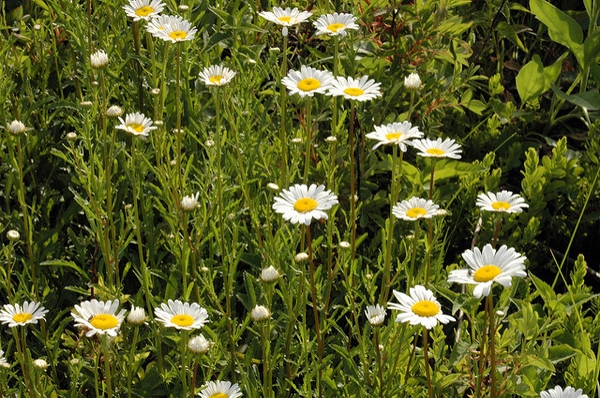
Ox-eye daisy is an erect, rhizomatous, herbaceous perennial weed and wildflower introduced from Europe to the United States in the 1800s. It grows 1-3 feet tall, 1-2 feet wide, and a single plant produces 1-40 flowering stems. It is often found in disturbed open areas, grasslands, forests, riverbanks, and roadsides, and easily spreads via seeds and rhizomes. Blooming occurs from May to August and consists of white, daisy-like flowers with rounded-tip petal rays and a yellow center disc. The dark green leaves found at the base of the stem are toothed and spatulate, and the leaves along the flower stalk are frequently pinnatifid. This plant emits a strong, harsh scent. The ox-eye daisy is a member of the daisy family (Asteraceae). The genus name Leucanthemum is derived from two Greek words: leukos, meaning white, and anthemum, meaning flower. The specific epithet vulgare means common.
Prefers full sun and medium moist to dry, well-drained, acidic to neutral, sandy, loamy, or clay soil. It can tolerate some afternoon shade, particularly in hot, humid climates. It is hardy from zones 3 through 8. Drought-, deer-, rabbit-, and dry-soil tolerant. Plants spread by rhizomes and should be divided every 2-3 years to maintain vigor. Deadhead flowers to encourage more blooms. Easily spreads by abundant seed production and underground stems.
Ox-eye daisy is considered an invasive weed when grown outside of its native origin and tends to displace our native species. It is harmful if ingested by cats and dogs. While it is considered non-poisonous to cows, ingestion can cause an altered taste in the cow's milk.
The ox-eye daisy would be attractive planted in perennial beds and borders, in a cottage, wildflower, or night garden, but be cognizant of its rapid spread in the landscape. It may be best to consider a native alternative.
Insects, Diseases, and Other Plant Problems: Generally has no serious insect or disease issues. Aphids, mites, and leaf miners are occasional visitors. May be susceptible to verticillium wilt, leaf spots, and stem rots.
Wear protective gloves and clothing when handling this plant. The flowers and leaves can cause skin irritation.
- See this plant in the following landscape :
- Cultivars / Varieties:
-
-
Leucanthemum x superbum (L. lacustre x L. maximum x L. vulgare)
- 'Maikonigin' or 'May Queen'
Grows up to 2 ft. tall, compact habit, white petal-rays and yellow center disc
Hybrid, grows 2-4 ft. tall, clumping habit, with dark green leaves, white petal-rays and bright yellow center disc - 'Maikonigin' or 'May Queen'
- Leucanthemum x superbum (L. lacustre x L. maximum x L. vulgare), 'Maikonigin' or 'May Queen'
- Tags:



- Cultivars / Varieties:
-
-
Leucanthemum x superbum (L. lacustre x L. maximum x L. vulgare)
- 'Maikonigin' or 'May Queen'
Grows up to 2 ft. tall, compact habit, white petal-rays and yellow center disc
Hybrid, grows 2-4 ft. tall, clumping habit, with dark green leaves, white petal-rays and bright yellow center disc - 'Maikonigin' or 'May Queen'
- Leucanthemum x superbum (L. lacustre x L. maximum x L. vulgare), 'Maikonigin' or 'May Queen'
- Tags:
-
-
Attributes:
- Genus:
- Leucanthemum
- Species:
- vulgare
- Family:
- Asteraceae
- Uses (Ethnobotany):
- This plant has been used to treat asthma, conjunctivitis, and dry skin. The leaves have been used to make a poultice to treat bruises; hence the common name bruise wort.
- Life Cycle:
- Perennial
- Recommended Propagation Strategy:
- Division
- Seed
- Country Or Region Of Origin:
- Europe to Siberia and Iran
- Distribution:
- Native: All of Europe; Iran, Kazakhstan, Kyrgyzstan, Krasnoyarsk, Krym, North Caucasus, Northwest Balkan Peninsula, Tajikistan, Transcaucasus, Turkey, Ukraine, West Siberia, and Yakutiya. Introduced: Iceland, United States--AK, AZ, AR, CA, CO, CT, FL, HI, ID, IL, IN, IA, KS, MD, MA, MI, MN, MO, MT, NV, NM, NY, ND, OH, OK, OR, PA, SC, SD, TN, UT, VA, WA, WV, WI, and WY; Canada-- Alberta, British Colombia, Newfoundland, Ontario, Quebec, and Saskatchewan; Central and South America--Bolia, Colombia, Costa Rica, Cuba, Dominican Republic, El Salvadr, Haiti, Hondruas, Mexico, Peru, Uruguay, and Venezuela; Australia--Tasmania, Victoria; New Zealand North, New Zealand South; Africia--Cameroon, Cape Provinces, Ethiopia; Asia--India, Pakistan, Sri Lanka;
- Wildlife Value:
- Attracts butterflies, moths, bees, flies, and beetles.
- Play Value:
- Attractive Flowers
- Attracts Pollinators
- Easy to Grow
- Edibility:
- In moderate amounts, the leaves are edible and contain Vitamins A and C.
- Dimensions:
- Height: 1 ft. 0 in. - 3 ft. 0 in.
- Width: 1 ft. 0 in. - 2 ft. 0 in.
-
-
Whole Plant Traits:
- Plant Type:
- Herbaceous Perennial
- Perennial
- Weed
- Wildflower
- Habit/Form:
- Erect
- Growth Rate:
- Medium
- Maintenance:
- Low
- Texture:
- Fine
-
-
Cultural Conditions:
- Light:
- Full sun (6 or more hours of direct sunlight a day)
- Soil Texture:
- Clay
- Loam (Silt)
- Sand
- Soil pH:
- Acid (<6.0)
- Neutral (6.0-8.0)
- Soil Drainage:
- Good Drainage
- Occasionally Dry
- Available Space To Plant:
- 12 inches-3 feet
- NC Region:
- Coastal
- Mountains
- Piedmont
- USDA Plant Hardiness Zone:
- 3a, 3b, 4a, 4b, 5a, 5b, 6a, 6b, 7a, 7b, 8a, 8b
-
-
Fruit:
- Fruit Color:
- Brown/Copper
- White
- Display/Harvest Time:
- Fall
- Fruit Type:
- Achene
- Fruit Length:
- < 1 inch
- Fruit Width:
- < 1 inch
- Fruit Description:
- The fruit is tiny, narrow, dark brown with white ribs, and measures up to 2.5 mm long. Each flower can produce up to 200 seeds, which are dispersed by the wind.
-
-
Flowers:
- Flower Color:
- Gold/Yellow
- White
- Flower Inflorescence:
- Head
- Flower Value To Gardener:
- Good Cut
- Long-lasting
- Showy
- Flower Bloom Time:
- Spring
- Summer
- Flower Shape:
- Radial
- Flower Petals:
- 7 - 20 petals/rays
- Flower Size:
- 1-3 inches
- Flower Description:
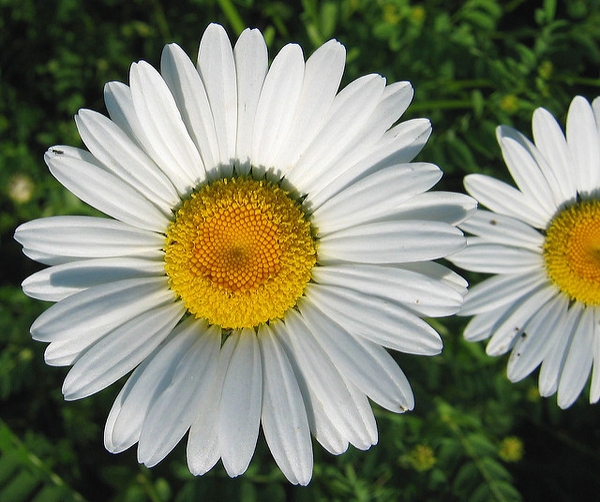
- There are 15 to 35 white petal rays surrounding the yellow center disc. A single bloom measures 1-2 inches in diameter, and the central disc is up to 0.75 inches in diameter. Bracts are at the base of the flower and are green with purplish-brown edges. Blooms May through August. The white rays with the flattened yellow center disk flowers resemble the eye of an ox, hence the common name. The plant has a strong, harsh scent.
-
-
Leaves:
- Leaf Color:
- Green
- Leaf Type:
- Simple
- Leaf Arrangement:
- Alternate
- Leaf Shape:
- Lanceolate
- Linear
- Oblanceolate
- Spatulate
- Leaf Margin:
- Dentate
- Lobed
- Serrate
- Hairs Present:
- No
- Leaf Length:
- 3-6 inches
- Leaf Width:
- < 1 inch
- Leaf Description:
- The dark green, basal leaves are serrate to dentate, spatulate to ovate, measuring up to 5 inches long and up to 1.5 inches wide, with petioles. The cauline leaves are smaller, sessile, and may be oblanceolate-spatulate or lanceolate-linear.
-
-
Stem:
- Stem Color:
- Green
- Stem Is Aromatic:
- No
- Stem Cross Section:
- Round
- Stem Surface:
- Hairy (pubescent)
- Stem Description:
- The stem is green, single, and may be distally branched.
-
-
Landscape:
- Landscape Location:
- Meadow
- Patio
- Small Space
- Landscape Theme:
- Butterfly Garden
- Cottage Garden
- Drought Tolerant Garden
- Pollinator Garden
- Design Feature:
- Border
- Attracts:
- Butterflies
- Pollinators
- Resistance To Challenges:
- Deer
- Diseases
- Drought
- Dry Soil
- Rabbits
- Problems:
- Contact Dermatitis
- Problem for Cats
- Problem for Dogs
- Problem for Horses
- Weedy
-
-
Poisonous to Humans:
- Poison Severity:
- Low
- Poison Symptoms:
- The leaves and flowers can cause contact dermatitis in humans. Toxic to cats and dogs if ingested, and causes hypersalivation, incoordination, vomiting, diarrhea, and dermatitis.
- Poison Toxic Principle:
- Sesquiterpene lactones
- Causes Contact Dermatitis:
- Yes
- Poison Part:
- Flowers
- Leaves


