


Lantana montevidensis
Common Name(s):
Previously known as:
- Camara montevidensis
- Lantana sellowiana
- Lippia montevidensis
- Phonetic Spelling
- lahn-TAHN-ah mon-tay-vid-EN-sis
- This plant has medium severity poison characteristics.
- See below
- Description
-
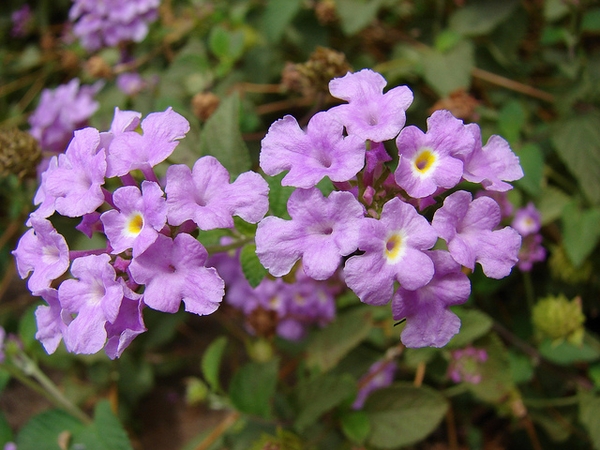
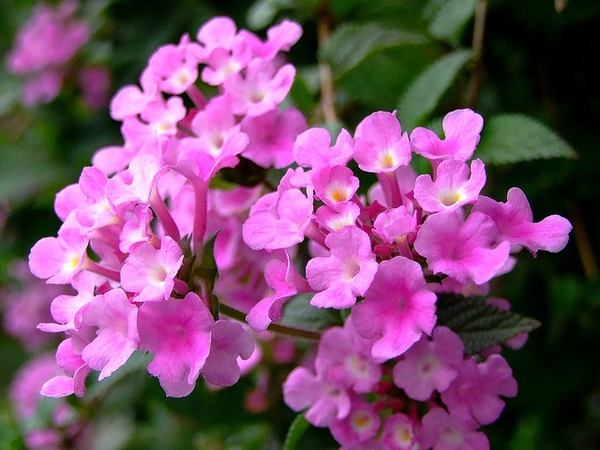
Trailing lantana is a low-growing, tropical, groundcover, woody vine, and shrub native to Bolivia, Brazil, and Northern Argentina. It grows 1-1.5 feet tall and 3-5 feet wide, and can be used as a climbing vine with support, as a trailer, or grown flat as a groundcover. The plant has dark green, ovate leaves with toothed margins, and its flowers are clusters of tiny, scented, light purple to purplish-pink blooms with yellow throats. Blooms are present from June until the first frost of fall. The stems are thin, drooping, and hairy. The specific epithet montevidensis honors the town of Montevideo, Uruguay, where the plant was found. This species is a member of the verbena family (Verbenaceae)
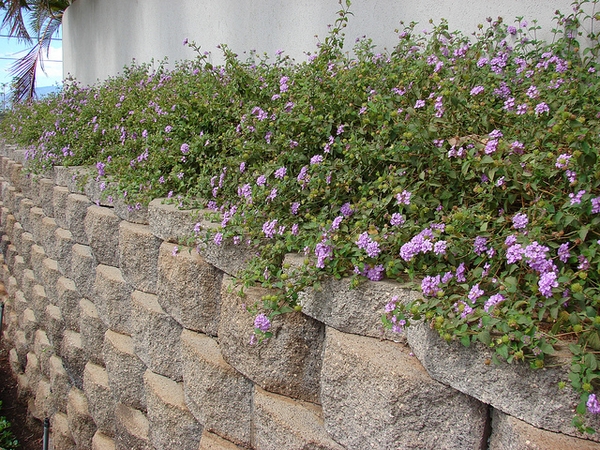
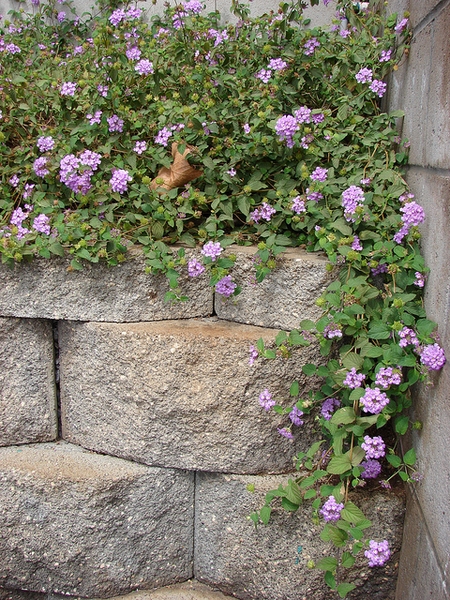
Easily grown in full sun and sandy, medium-moist, well-drained soil in hardiness zones 8-10. They will tolerate partial shade and do well in sandy, slightly dry soil. In colder climates, they may be used as annuals and either overwintered indoors or replaced in the following spring. It is drought-tolerant once established and tolerant of coastal conditions, such as heat, humidity, and salt spray. In Zone 8, plants are root hardy; they will die back to the ground in winter but, if well mulched, will resprout in spring. In warmer climates, it can be used for erosion control along a slope or bank. Trailing lantana may be propagated by seeds, vegetative layering, and stem cuttings. Seeds are easily spread by wildlife.
Trailing lantana has naturalized in eastern Australia, New Zealand, Hawaii, New Caledonia, and the Southern United States (i.e., California, Texas, Louisiana, Alabama, Georgia, and Florida). Where naturalized, it is primarily a weed of pastures, open woodlands, hillsides, railways, roadsides, embankments, disturbed sites, and waste areas.
Trailing lantana may be used as a flowering bedding plant or groundcover, or for erosion control. The trailing and cascading stems make it a perfect specimen for a hanging basket or container plant.
Insects, Diseases and Other Plant Problems: No significant insect pests or diseases. Monitor for spider mites and whiteflies. May be susceptible to powdery mildew, leaf spot, and stem rot.
This plant is toxic to humans, dogs, cats, and horses if ingested. The leaves and sap are skin irritants. Wear protective clothing and gloves when handling this plant.
- See this plant in the following landscape :
- Cultivars / Varieties:
-
- 'Alba'
Grows 1-2 ft. tall, 3-10 ft. wide, with trailing dark green leaves and clusters of white blooms with yellow eyes - 'Lavender Swirl'
Lavender and white flowers - Luscious® Grape
Grows 10-14 inches tall, trails up to 36 inches, with trailing bright purple flowers, exceptionally heat-tolerant - 'Monarch Purple'
Drought-tolerant, deep purple blooms - 'New Gold' (L. camara x L. montevidensis)
Spreading habit, golden-yellow flowers - 'Weeping Lavender'
Trailing habit, humidity-tolerant, lavender flowers - 'White Lightning'
Attracts nocturnal moths, pure white blooms, rare selection
- 'Alba'
- 'Alba', 'Lavender Swirl', Luscious® Grape, 'Monarch Purple', 'New Gold' (L. camara x L. montevidensis), 'Weeping Lavender', 'White Lightning'
- Tags:


- Cultivars / Varieties:
-
- 'Alba'
Grows 1-2 ft. tall, 3-10 ft. wide, with trailing dark green leaves and clusters of white blooms with yellow eyes - 'Lavender Swirl'
Lavender and white flowers - Luscious® Grape
Grows 10-14 inches tall, trails up to 36 inches, with trailing bright purple flowers, exceptionally heat-tolerant - 'Monarch Purple'
Drought-tolerant, deep purple blooms - 'New Gold' (L. camara x L. montevidensis)
Spreading habit, golden-yellow flowers - 'Weeping Lavender'
Trailing habit, humidity-tolerant, lavender flowers - 'White Lightning'
Attracts nocturnal moths, pure white blooms, rare selection
- 'Alba'
- 'Alba', 'Lavender Swirl', Luscious® Grape, 'Monarch Purple', 'New Gold' (L. camara x L. montevidensis), 'Weeping Lavender', 'White Lightning'
- Tags:
-
-
Attributes:
- Genus:
- Lantana
- Species:
- montevidensis
- Family:
- Verbenaceae
- Life Cycle:
- Annual
- Perennial
- Woody
- Recommended Propagation Strategy:
- Seed
- Stem Cutting
- Country Or Region Of Origin:
- Bolivia to Brazil and Northern Argentina
- Distribution:
- Native: Argentina Northeast, Argentina Northwest, Bolivia, Brazil Northeast, Brazil South, Brazil Southeast, Paraguay, and Uruguay. Introduced: Azores, Bangladesh, Costa Rica, Cuba, Dominican Republic, Fiji, Haiti, Italy, Marianas, Mexico Northwest, New Caledonia, New Zealand North, New Zealand South, Puerto Rico, Society Islands, Spain, Trinidad-Tobago, United States--AL, CA, FL, GA, HI, LA, and TX, Venezuela, and Windward Islands.
- Wildlife Value:
- Favorite among butterflies, bees, and other pollinators and a food source for birds.
- Play Value:
- Attractive Flowers
- Attracts Pollinators
- Wildlife Food Source
- Edibility:
- Toxic if ingested.
- Dimensions:
- Height: 1 ft. 0 in. - 1 ft. 6 in.
- Width: 3 ft. 0 in. - 5 ft. 0 in.
-
-
Whole Plant Traits:
- Plant Type:
- Annual
- Ground Cover
- Perennial
- Shrub
- Woody Plant Leaf Characteristics:
- Broadleaf Evergreen
- Habit/Form:
- Cascading
- Creeping
- Horizontal
- Prostrate
- Weeping
- Growth Rate:
- Rapid
- Maintenance:
- Low
- Texture:
- Coarse
-
-
Cultural Conditions:
- Light:
- Full sun (6 or more hours of direct sunlight a day)
- Soil Texture:
- Clay
- Loam (Silt)
- Sand
- Soil pH:
- Neutral (6.0-8.0)
- Soil Drainage:
- Good Drainage
- Moist
- Occasionally Dry
- Available Space To Plant:
- 12 inches-3 feet
- NC Region:
- Coastal
- USDA Plant Hardiness Zone:
- 8a, 8b, 9a, 9b, 10a, 10b
-
-
Fruit:
- Fruit Color:
- Green
- Purple/Lavender
- Red/Burgundy
- Display/Harvest Time:
- Fall
- Fruit Type:
- Drupe
- Fruit Length:
- < 1 inch
- Fruit Width:
- < 1 inch
- Fruit Description:
- The fruit is a drupe, measuring 6-8 mm across, and contains a single, hard, round, black seed. Initially, the fruit is green, and then ripens to reddish-purple. Some cultivars do not produce seed (sterile).
-
-
Flowers:
- Flower Color:
- Pink
- Purple/Lavender
- Flower Inflorescence:
- Umbel
- Flower Value To Gardener:
- Fragrant
- Showy
- Flower Bloom Time:
- Spring
- Summer
- Flower Shape:
- Funnel
- Tubular
- Flower Petals:
- 6 petals/rays
- Flower Size:
- 1-3 inches
- Flower Description:
- The blooms are circular heads of purple-lavender funnel-shaped flowers. There are usually up to 20 flowers per cluster. The individual flowers measure less than 0.5 inches wide. They are white colored toward the base of the petal lobes and have a yellow throat. Blooms from the outside of the inflorescence, then works its way to the center.
-
-
Leaves:
- Woody Plant Leaf Characteristics:
- Broadleaf Evergreen
- Leaf Color:
- Green
- Leaf Feel:
- Glossy
- Rough
- Leaf Value To Gardener:
- Fragrant
- Leaf Type:
- Simple
- Leaf Arrangement:
- Opposite
- Leaf Shape:
- Ovate
- Leaf Margin:
- Serrate
- Hairs Present:
- Yes
- Leaf Length:
- 1-3 inches
- Leaf Width:
- < 1 inch
- Leaf Description:
- Dark green leaves have an unpleasant aroma when bruised and can be a skin irritant. The petioles are short (2- 4 mm). The leaves are opposite, ovate, and have serrated margins. The upper surfaces are rough, and the lower surfaces are softly hairy.
-
-
Stem:
- Stem Is Aromatic:
- No
- Stem Cross Section:
- Square
- Stem Description:
- The stems (1-2 mm thick) are quadrangular but become woody (about 5 mm thick) and more or less cylindrical as they mature. They may grow to about 1 m long and form dense mats on the ground, sometimes producing roots at the nodes where they make soil contact.
-
-
Landscape:
- Landscape Location:
- Coastal
- Container
- Hanging Baskets
- Patio
- Rock Wall
- Slope/Bank
- Walkways
- Landscape Theme:
- Butterfly Garden
- Cottage Garden
- Drought Tolerant Garden
- Pollinator Garden
- Design Feature:
- Border
- Foundation Planting
- Mass Planting
- Small groups
- Attracts:
- Bees
- Butterflies
- Songbirds
- Resistance To Challenges:
- Deer
- Drought
- Heat
- Humidity
- Poor Soil
- Rabbits
- Salt
- Problems:
- Contact Dermatitis
- Poisonous to Humans
- Problem for Cats
- Problem for Children
- Problem for Dogs
- Problem for Horses