


Dogtooth-daisy Helenium autumnale
Other Common Name(s):
- Phonetic Spelling
- hel-EH-nee-um aw-tum-NAH-lay
- This plant has medium severity poison characteristics.
- See below
- Description
-
Common sneezeweed is a herbaceous perennial in the aster family (Asteraceae) and can be found throughout the United States in moist soils along streams, ponds, in swamps, and wetlands. The specific epithet autumnale refers to the plant's autumn flowering.
Sneezeweed can be cultivated in average to rich soils and requires moist to wet conditions in full sun to partial shade. It should be cut back in early summer to encourage branching and increase the number of flowers. It grows 3 to 5 feet tall and 2 to 3 feet wide.
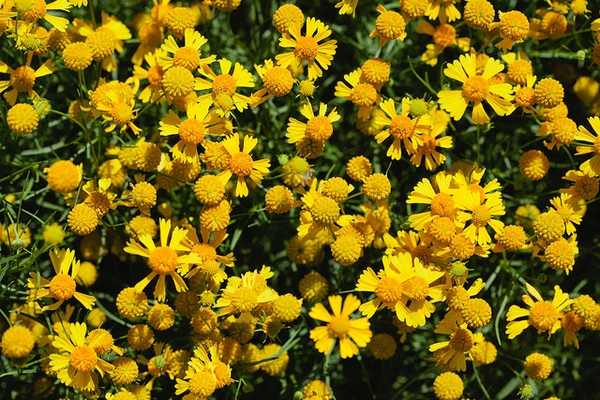
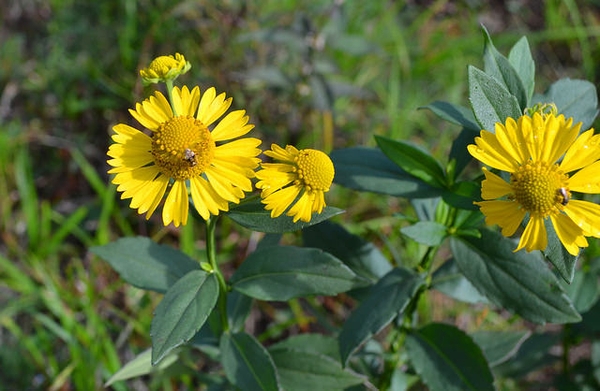
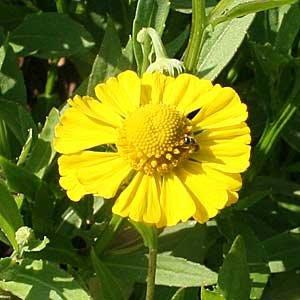
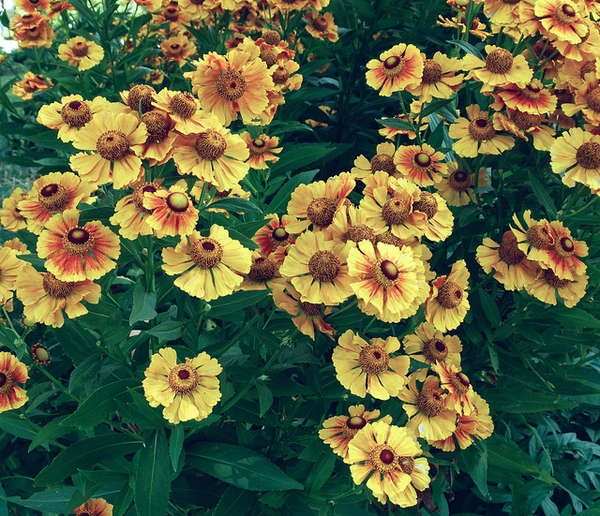
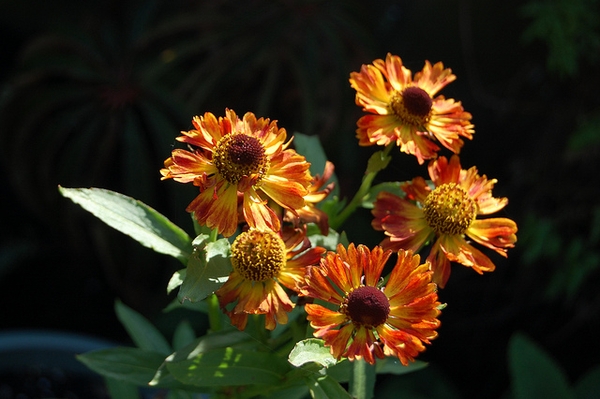
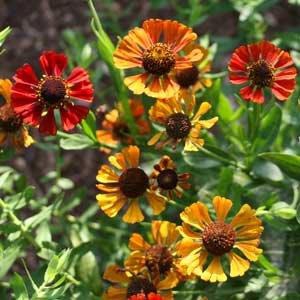
Yellow rays surround a dome of florets in late summer into fall. They appear in clusters on distinctive winged stems with dark green 6-inch-long leaves. Cultivars are much showier than the weedy native sneezeweed.
Use this plant in the native and pollinator garden, in naturalized areas and along ponds, bogs and streams.
Insects, Diseases, and Other Plant Problems: No significant problems. Watch for powdery mildew, leaf spot and rust. Staking may be necessary.
- See this plant in the following landscape :
- Cultivars / Varieties:
-
- Butterpat
Tough, upright perennial, buttery-yellow daisy-like blooms summer into fall, 3 to 4 feet. - Helena Red Shades
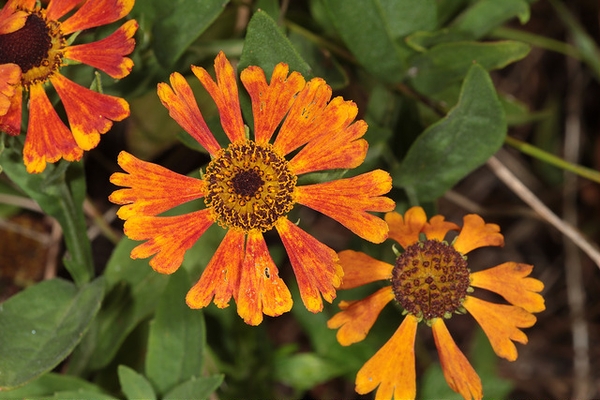
Vigorous, clump-forming, 3 to 4 feet tall, crimson, burgundy, and bronze-red flowers. - Moerheim Beauty
Upright, clump-forming, coppery-red flowers. - Riverton Beauty
Tall, clump-forming, 3 to 4 feet high, golden-yellow flowers.
- Butterpat
- Butterpat, Helena Red Shades, Moerheim Beauty, Riverton Beauty
- Tags:


- Cultivars / Varieties:
-
- Butterpat
Tough, upright perennial, buttery-yellow daisy-like blooms summer into fall, 3 to 4 feet. - Helena Red Shades
Vigorous, clump-forming, 3 to 4 feet tall, crimson, burgundy, and bronze-red flowers. - Moerheim Beauty
Upright, clump-forming, coppery-red flowers. - Riverton Beauty
Tall, clump-forming, 3 to 4 feet high, golden-yellow flowers.
- Butterpat
- Butterpat, Helena Red Shades, Moerheim Beauty, Riverton Beauty
- Tags:
-
-
Attributes:
- Genus:
- Helenium
- Species:
- autumnale
- Family:
- Asteraceae
- Uses (Ethnobotany):
- Powdered leaves and flower heads were used in the treatment of colds and congestion by inducing sneezing. Indians used an infusion of the leaves as a laxative.d
- Life Cycle:
- Perennial
- Recommended Propagation Strategy:
- Division
- Country Or Region Of Origin:
- North America
- Distribution:
- AL , AR , AZ , CA , CO , CT , DC , DE , FL , GA , IA , ID , IL , IN , KS , KY , LA , MA , MD , MI , MN , MO , MS , MT , NC , ND , NE , NJ , NM , NV , NY , OH , OK , OR , PA , RI , SC , SD , TN , TX , UT , VA , VT , WA , WI , WV , WY Canada: AB , BC , MB , NT , ON , QC , SK
- Particularly Resistant To (Insects/Diseases/Other Problems):
- Deer and rabbit resistant
- Dimensions:
- Height: 3 ft. 0 in. - 5 ft. 0 in.
- Width: 2 ft. 0 in. - 3 ft. 0 in.
-
-
Whole Plant Traits:
- Plant Type:
- Herbaceous Perennial
- Native Plant
- Poisonous
- Wildflower
- Habit/Form:
- Clumping
- Erect
- Maintenance:
- Medium
-
-
Cultural Conditions:
- Light:
- Full sun (6 or more hours of direct sunlight a day)
- Partial Shade (Direct sunlight only part of the day, 2-6 hours)
- Soil Texture:
- Clay
- High Organic Matter
- Soil Drainage:
- Frequent Standing Water
- Moist
- Occasionally Wet
- NC Region:
- Coastal
- Mountains
- Piedmont
- USDA Plant Hardiness Zone:
- 3a, 3b, 4a, 4b, 5a, 5b, 6a, 6b, 7a, 7b, 8a, 8b
-
-
Fruit:
- Display/Harvest Time:
- Fall
- Fruit Description:
- Displays from October to November
-
-
Flowers:
- Flower Color:
- Brown/Copper
- Gold/Yellow
- Orange
- Flower Value To Gardener:
- Showy
- Flower Bloom Time:
- Fall
- Summer
- Flower Shape:
- Radial
- Flower Petals:
- 7 - 20 petals/rays
- Flower Size:
- 1-3 inches
- Flower Description:
- flattened or ball-shaped flower heads with bright yellow wedge-shaped rays which are 3-lobed at the outer end, drooping away from the center ball.
-
-
Leaves:
- Leaf Color:
- Green
- Leaf Type:
- Simple
- Leaf Arrangement:
- Alternate
- Leaf Shape:
- Lanceolate
- Oblong
- Leaf Margin:
- Dentate
- Hairs Present:
- No
- Leaf Length:
- 3-6 inches
- Leaf Width:
- 1-3 inches
- Leaf Description:
- Dark green stalkless, usually toothed margins, 3 to 6 inch long
-
-
Stem:
- Stem Color:
- Green
- Stem Is Aromatic:
- No
- Stem Description:
- Green winged stems
-
-
Landscape:
- Landscape Location:
- Meadow
- Naturalized Area
- Riparian
- Landscape Theme:
- Cottage Garden
- Native Garden
- Pollinator Garden
- Rain Garden
- Design Feature:
- Border
- Small groups
- Attracts:
- Butterflies
- Pollinators
- Small Mammals
- Songbirds
- Resistance To Challenges:
- Deer
- Poor Soil
- Rabbits
- Wet Soil
- Problems:
- Poisonous to Humans
-
-
Poisonous to Humans:
- Poison Severity:
- Medium
- Poison Symptoms:
- Salivation, elevated temperature and pulse, difficulty of breathing, vomiting, and convulsions. TOXIC ONLY IF INGESTED IN LARGE QUANTITIES.
- Poison Toxic Principle:
- Sesquiterpene lactone
- Causes Contact Dermatitis:
- Yes
- Poison Part:
- Flowers
- Leaves
- Seeds