



Taxus baccata
Common Name(s):
Previously known as:
- Taxus aurea
- Taxus columnaris
- Phonetic Spelling
- TAKS-us ba-KA-ta
- This plant has high severity poison characteristics.
- See below
- Description
-
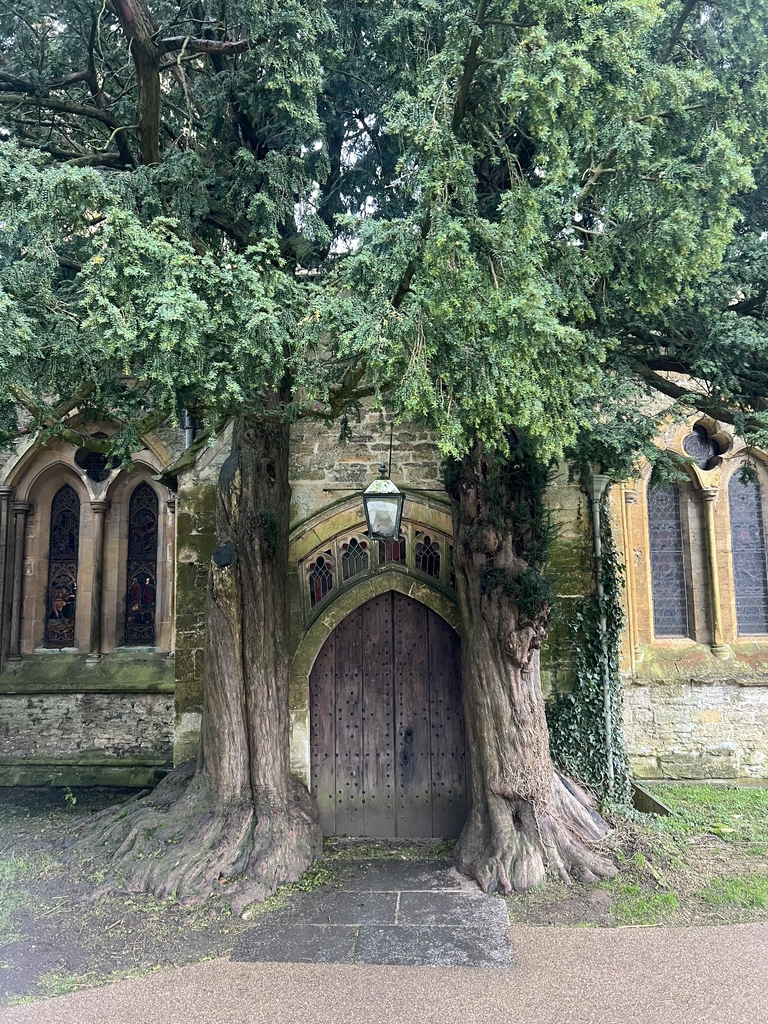
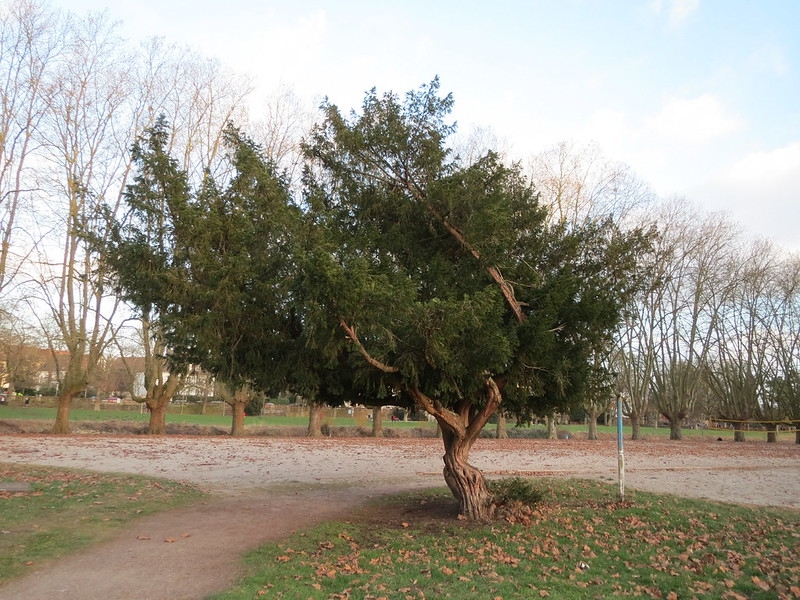
English yew is a large, needled, evergreen conifer with a conical or pyramidal shape. It is a tree in the yew family (Taxaceae). It is native to Europe, western Asia and North Africa. The species epithet, baccata, is Latin for "berry-like" and references the berry-like arils (fleshy structures cradling the seeds) of the female plant.
English yew prefers moist, fertile, sandy or loamy soils with a neutral pH. It grows best in full sun or partial shade. It is intolerant of wet or poorly drained sites as well as extremely hot or cold temperatures. Plant it in a sheltered area to reduce exposure to cold winter winds. It may reach 30 to 60 feet high and 15 to 25 feet wide. Pruning is well tolerated. The preferred method of propagation is stem cuttings as seeds require cold-warm stratification of 120 to 365 days.
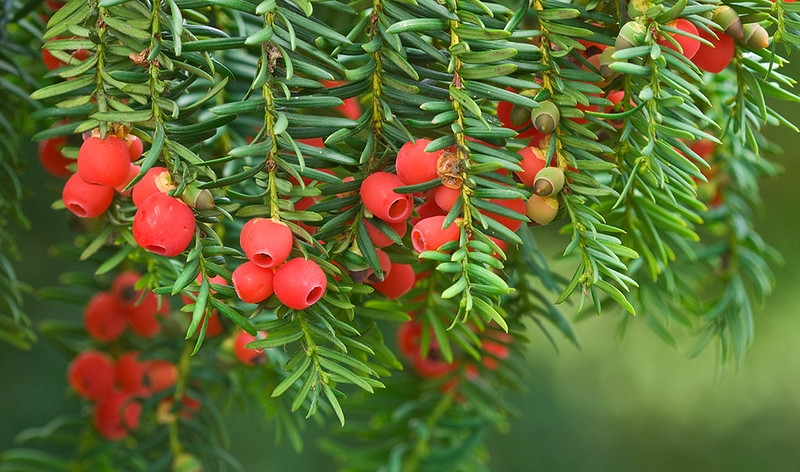
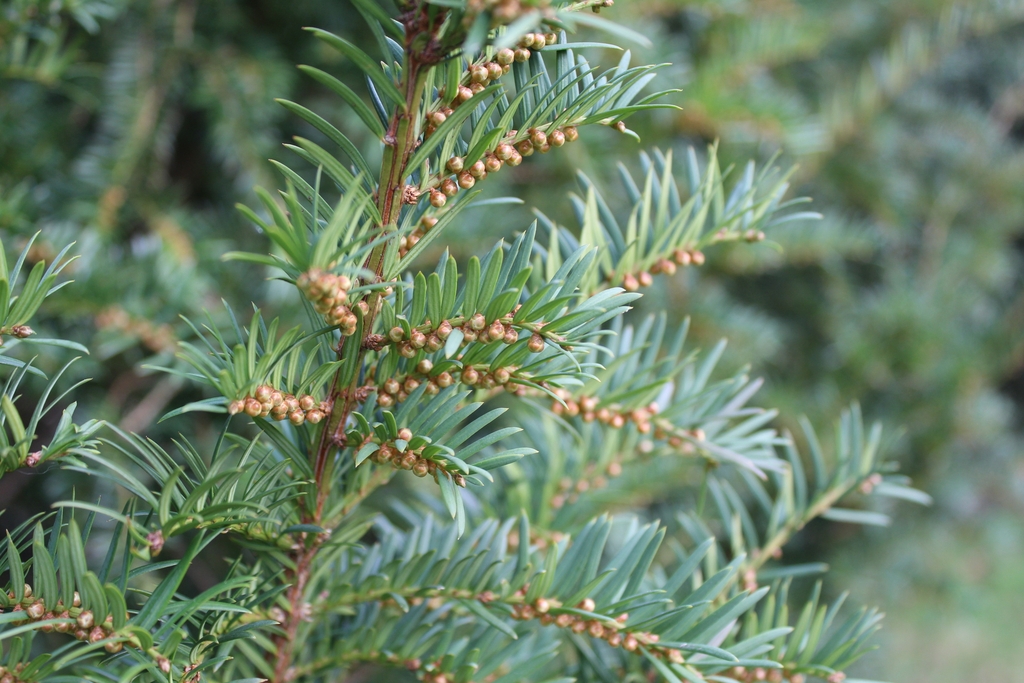
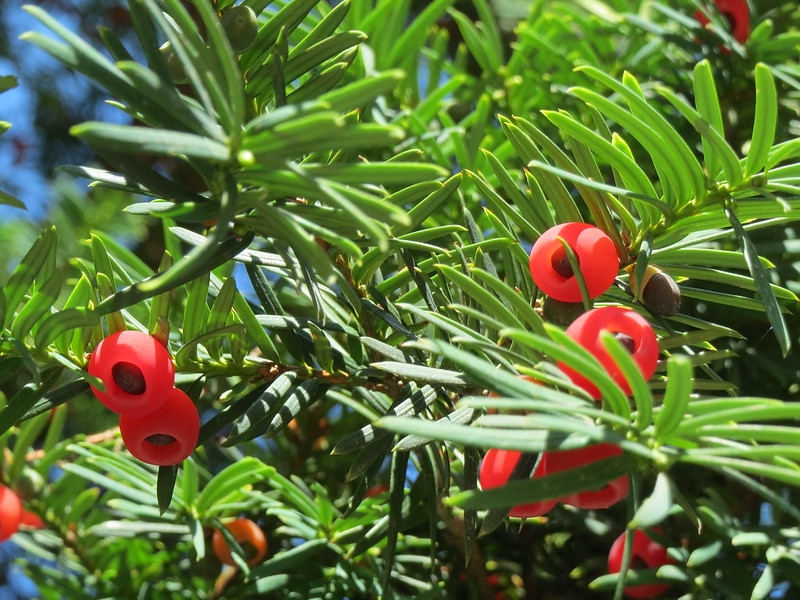
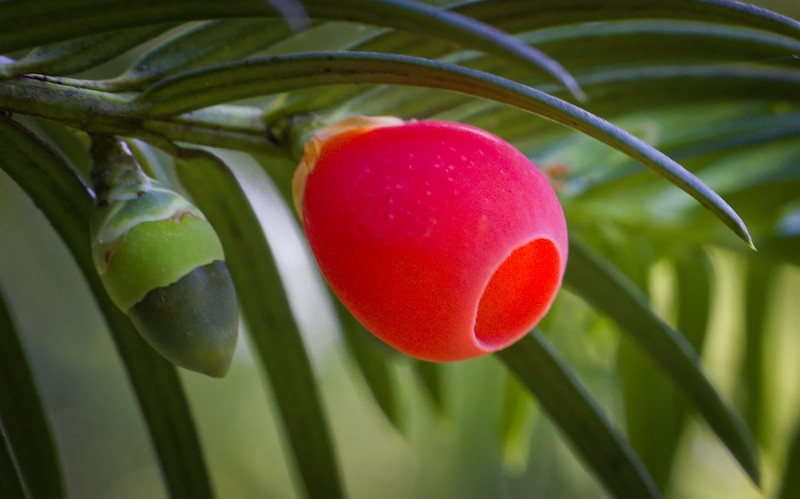
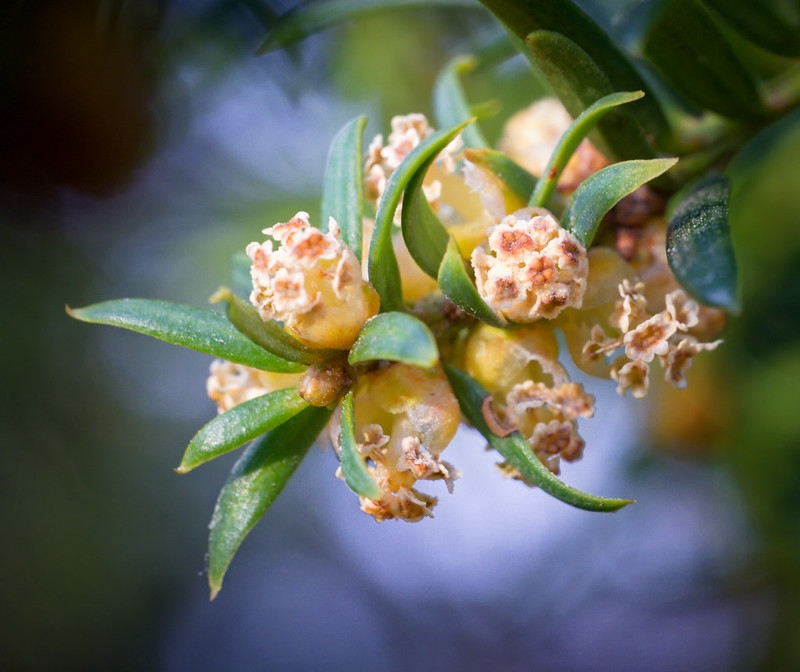
This yew is dioecious, which means both male and female plants are required to produce the showy red arils. Male plants produce small, pollen-producing cones. Female plants produce single-seeded, fleshy cones that develop into naked seeds partially covered by showy red arils. Birds eat the arils and disperse the seeds.
Cultivars of this species are available as dwarf, compact, variegated or columnar. Consider planting an English yew on a slope/bank, in a woodland setting or a winter garden. It also works well as an accent, foundation planting, hedge or privacy screen. It is an excellent subject for topiary.
Quick ID Hints:
- Evergreen, conifer tree or shrub with wide-spreading branches.
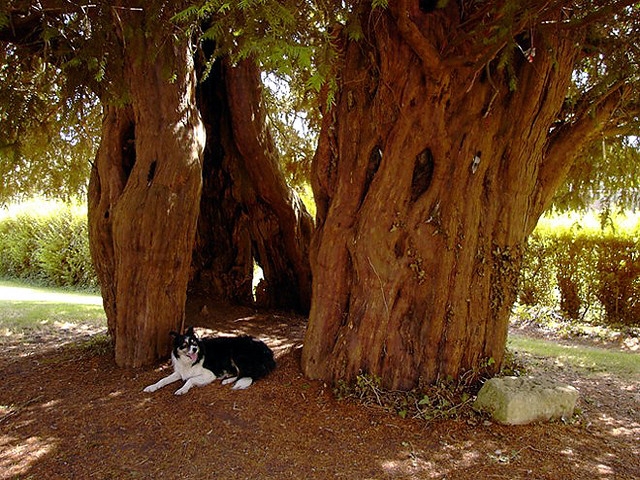
- Mature trees have scaly reddish-brown bark.
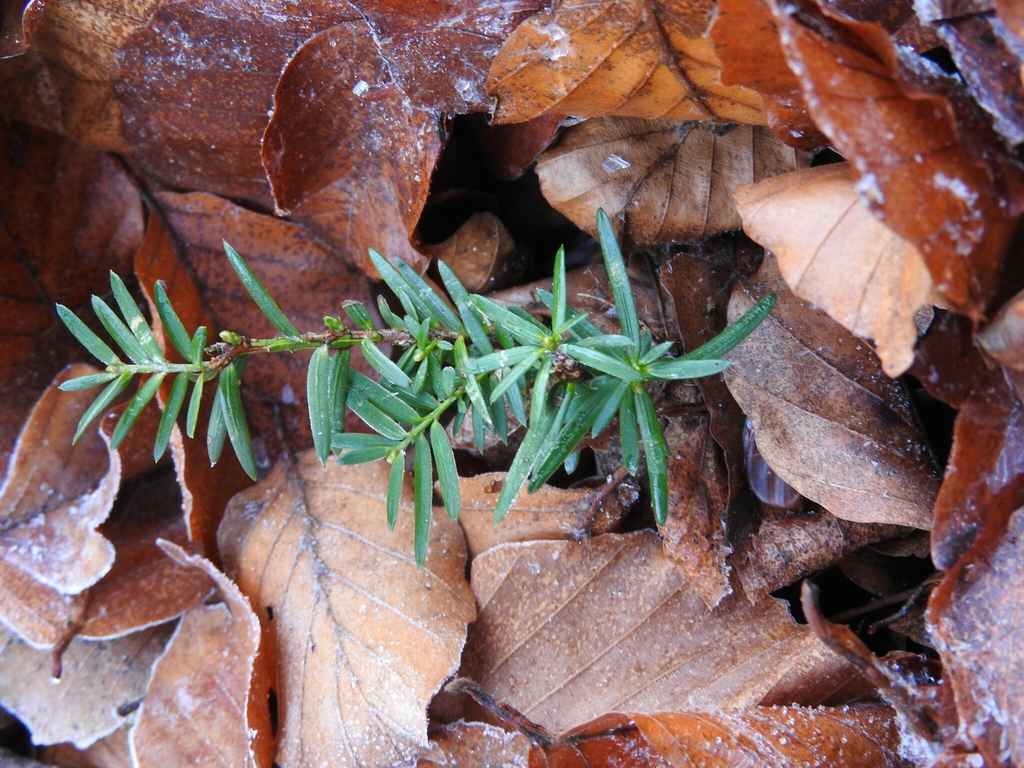
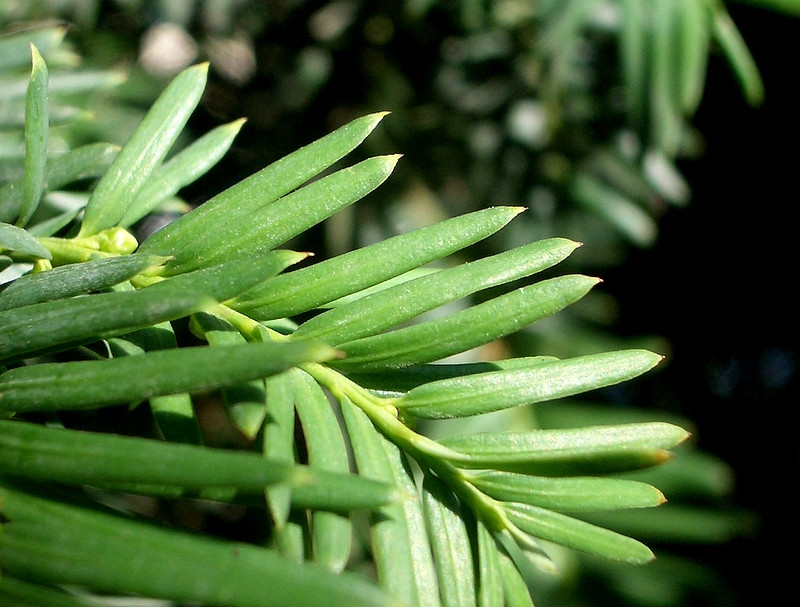
- Shiny dark green, linear, needle-like leaves that measure about 0.5 to 1.5 inches long.
- The leaves have a yellowish-green underside.
- The male plant has a yellowish cone at the leaf axils and is non-seed bearing.
- The female plant has a red fleshy cup-shaped covering or aril that encapsulates the seed.
Insect, Diseases and Other Plant Problems: Root rot, winter burn and twig and needle blights may occur. Potential pests include mealybugs, scale, pine needle scale, black vine weevils. Also these pests of conifers: Arborvitae leafminer, bagworms, balsam twig aphid balsam woolly adelgid, eastern spruce gall adelgid, introduced pine sawfly, juniper webworm, Nantucket pine tip moth, pine bark adelgid, redheaded pine sawfly, spittlebugs, spruce spider mite, white pine aphid.
VIDEO created by Ryan Contreras for “Landscape Plant Materials I: Deciduous Hardwoods and Conifers or Landscape Plant Materials II: Spring Flowering Trees and Shrubs” a plant identification course offered by the Department of Horticulture at Oregon State University
- Profile Video:
- See this plant in the following landscape :
- Cultivars / Varieties:
-
- 'Amersfoort'
dwarf shrub, upright with irregular habit - 'Fastigiata'
upright, narrow column, needles dark green - 'Repandens'
dwarf, spreading form with horizontal branches - 'Repandens Aurea'
low growing, variegated leaves green with yellow to cream edging - 'Standishii'
columnar tree or shrub, compact, leaves golden-yellow to yellow-green on the undersides
- 'Amersfoort'
- 'Amersfoort', 'Fastigiata', 'Repandens', 'Repandens Aurea', 'Standishii'
- Tags:


- Cultivars / Varieties:
-
- 'Amersfoort'
dwarf shrub, upright with irregular habit - 'Fastigiata'
upright, narrow column, needles dark green - 'Repandens'
dwarf, spreading form with horizontal branches - 'Repandens Aurea'
low growing, variegated leaves green with yellow to cream edging - 'Standishii'
columnar tree or shrub, compact, leaves golden-yellow to yellow-green on the undersides
- 'Amersfoort'
- 'Amersfoort', 'Fastigiata', 'Repandens', 'Repandens Aurea', 'Standishii'
- Tags:
-
-
Attributes:
- Genus:
- Taxus
- Species:
- baccata
- Family:
- Taxaceae
- Uses (Ethnobotany):
- The English yew has been used as an ornamental, for timber, bow making, and medicinal purposes. It has played a part in religious traditions in Europe also. The Greeks made funeral wreaths from the plant. The Celts used their wood to make funeral artifacts. An anticancer drug known as Taxol was developed from the yew bark and was approved in the 1990s.
- Life Cycle:
- Woody
- Recommended Propagation Strategy:
- Seed
- Stem Cutting
- Country Or Region Of Origin:
- Europe, Western Asia, and Northern Africa
- Distribution:
- Native: Albania, Algeria, Austria, Baltic States, Belarus, Belgium, Bulgaria, Central European Russia, Czechoslovakia, Denmark, East European Russia, Finland, France, Germany, Great Britain, Greece, Hungry, Italy, Morocco, Netherlands, North Caucasus, North European Russia, Northwest European Russia, Norway, Poland, Romania, Sicily, South European Russia, Spain, Sweden, Switzerland, Trans Caucasus, Turkey, Ukraine, and Yugoslavia. Introduced--Madeira and US--NY
- Wildlife Value:
- Birds eat the fleshy arils and disperse the seeds.
- Play Value:
- Wildlife Food Source
- Dimensions:
- Height: 30 ft. 0 in. - 60 ft. 0 in.
- Width: 15 ft. 0 in. - 25 ft. 0 in.
-
-
Whole Plant Traits:
- Plant Type:
- Poisonous
- Shrub
- Tree
- Woody Plant Leaf Characteristics:
- Broadleaf Evergreen
- Needled Evergreen
- Habit/Form:
- Conical
- Pyramidal
- Maintenance:
- Low
-
-
Cultural Conditions:
- Light:
- Full sun (6 or more hours of direct sunlight a day)
- Partial Shade (Direct sunlight only part of the day, 2-6 hours)
- Soil Texture:
- Loam (Silt)
- Sand
- Soil pH:
- Neutral (6.0-8.0)
- Soil Drainage:
- Good Drainage
- Moist
- USDA Plant Hardiness Zone:
- 6a, 6b, 7a, 7b
-
-
Fruit:
- Fruit Color:
- Gold/Yellow
- Red/Burgundy
- Fruit Value To Gardener:
- Showy
- Display/Harvest Time:
- Fall
- Fruit Length:
- < 1 inch
- Fruit Width:
- < 1 inch
- Fruit Description:
- Male bear pollen-producing cones the axils of the leaves. Female plants bear single seeds that are partially enclosed by arils. The seeds are poisonous.
-
-
Flowers:
- Flower Description:
- Non-flowering
-
-
Leaves:
- Woody Plant Leaf Characteristics:
- Broadleaf Evergreen
- Needled Evergreen
- Leaf Color:
- Gold/Yellow
- Green
- Leaf Type:
- Needles
- Leaf Shape:
- Linear
- Hairs Present:
- No
- Leaf Length:
- 1-3 inches
- Leaf Width:
- < 1 inch
- Leaf Description:
- The leaves are shiny, green, flat, needled, linear, and arranged in two vertical columns on opposite sides of the stem. They are 0.4 to 1.6 inches in length and 0.08 to 0.12 inches wide. The upper surface is dark green, and the lower surface is yellowish-green.
-
-
Bark:
- Bark Color:
- Dark Brown
- Red/Burgundy
- Bark Description:
- The bark is thin, scaly, and reddish-brown.
-
-
Stem:
- Stem Is Aromatic:
- No
-
-
Landscape:
- Landscape Location:
- Slope/Bank
- Woodland
- Landscape Theme:
- Winter Garden
- Design Feature:
- Accent
- Foundation Planting
- Hedge
- Screen/Privacy
- Specimen
- Attracts:
- Songbirds
- Problems:
- Poisonous to Humans
- Problem for Cats
- Problem for Children
- Problem for Dogs
- Problem for Horses
-
-
Poisonous to Humans:
- Poison Severity:
- High
- Poison Symptoms:
- Symptoms include dry mouth, vomiting, vertigo, abdominal pain, vertigo, difficulty breathing, irregular heart rhythms, low blood pressure, and unconsciousness. Cardiac and respiratory failure and death can occur. If any of the bark, leaves, or seeds of the English Yew are ingested, urgent medical treatment is needed. The plant is highly poisonous and can be fatal to humans, domestic animals, and livestock.
- Poison Toxic Principle:
- taxines, taxiphyllin (a cyanogenic glycoside)
- Causes Contact Dermatitis:
- No
- Poison Part:
- Bark
- Leaves
- Seeds
- Stems



