


Rose Laurel Nerium oleander
- Phonetic Spelling
- NEAR-ee-um OH-lee-an-der
- This plant has high severity poison characteristics.
- See below
- Description
-
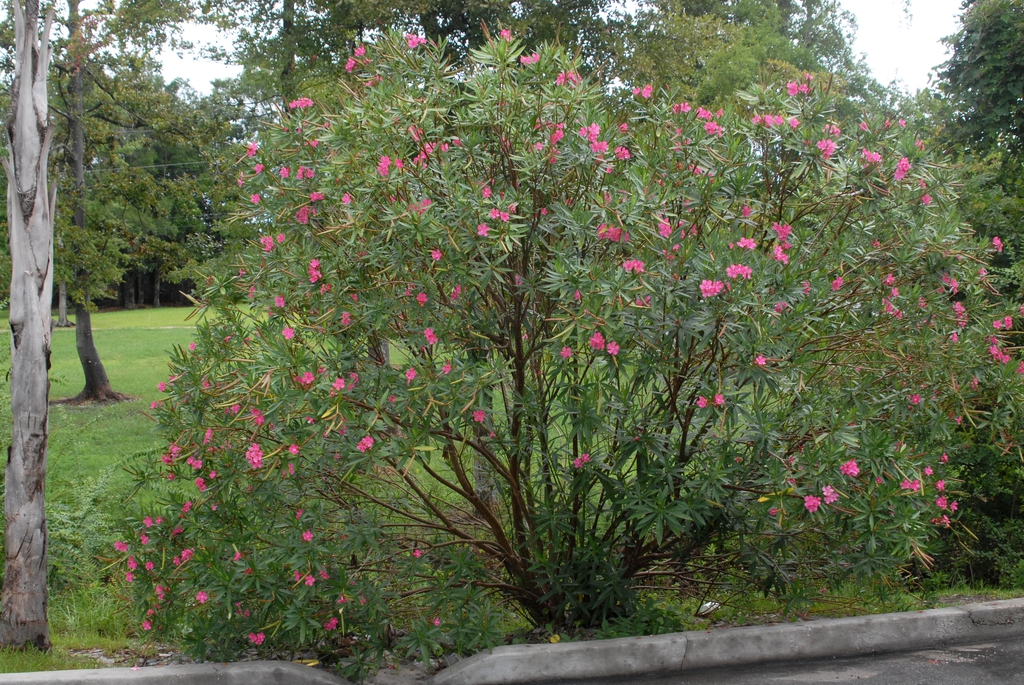
Oleander is a rapidly growing, rounded, broadleaf evergreen, woody perennial shrub native to Europe and Asia. It is a member of the dogbane family (Apocynaceae). The species epithet is derived from the genus name for olive (Olea) and references the leaves, which resemble those of the olive tree.
It prefers full sun to partial shade and well-drained, fertile soil, although it will adapt to other soil conditions. It is intolerant of temperatures at or below 32 degrees F and may be damaged by cold winters. Prune back frost-damaged and dead branches once winter passes. Regular light pruning after flowering improves its shape. Propagate oleander by seed or stem cutting.
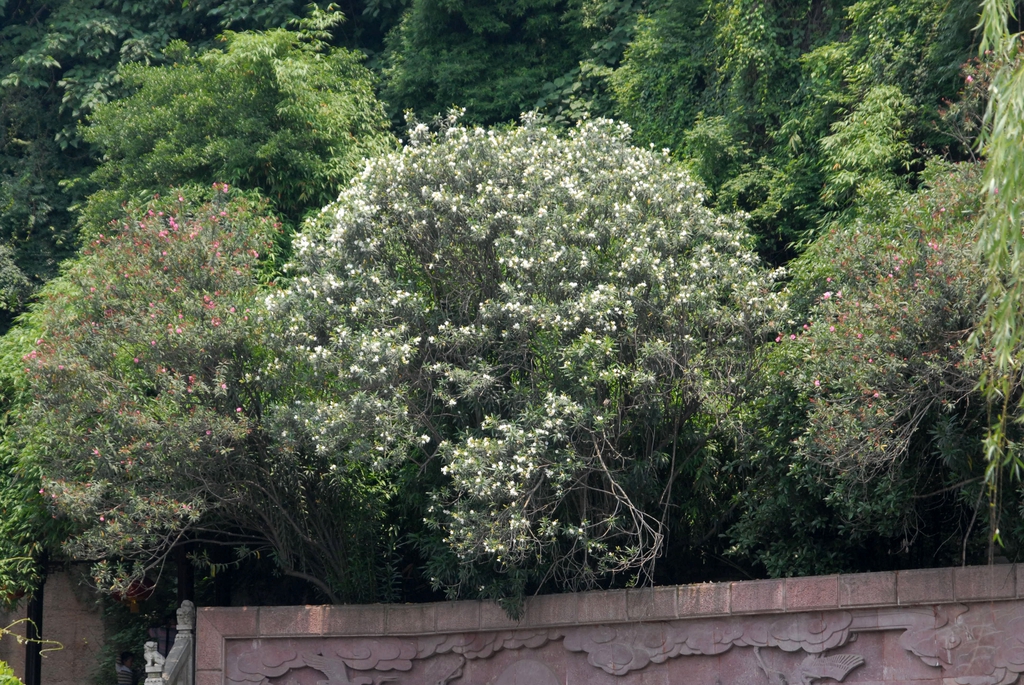
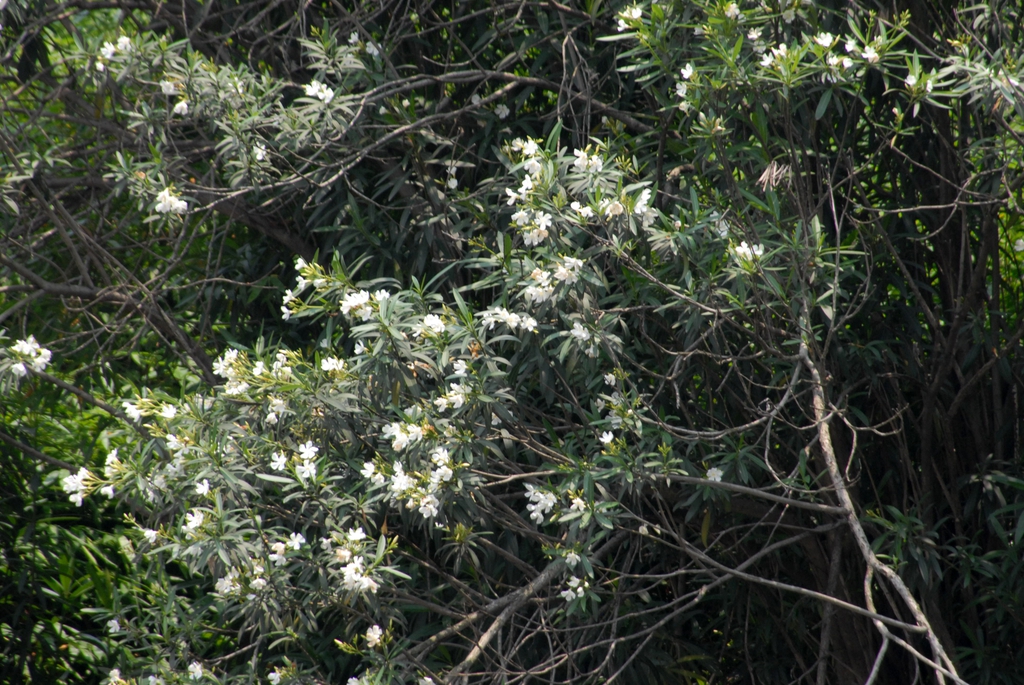
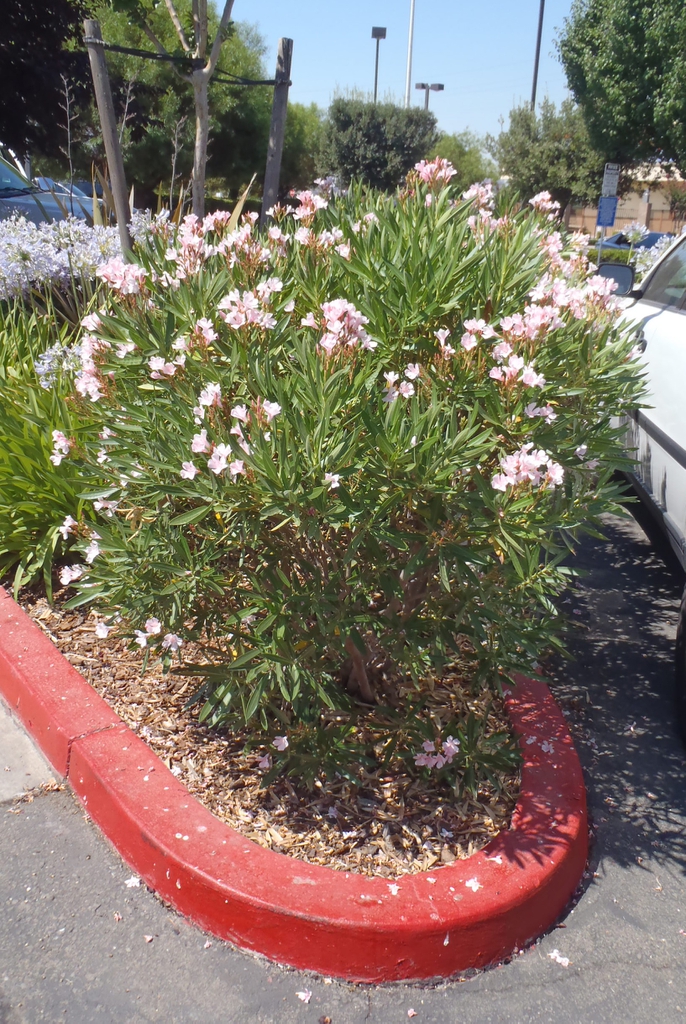
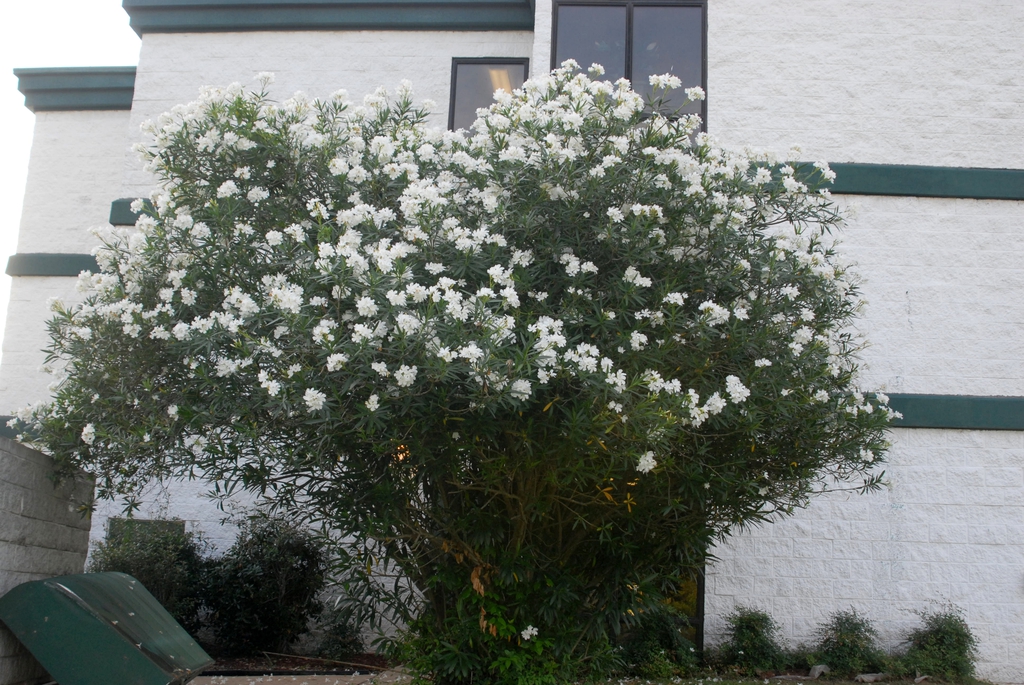
Oleander blooms in late spring to late summer, and it comes in a variety of flower colors, from pink to peach to white. The flowers are fragrant and showy and appear on new growth, so refrain from pruning after early fall to avoid removing next year’s flower buds. It grows 5 to 19.5 feet tall and 6 to 10 feet wide. Dwarf cultivars are available.
This shrub is highly deer and salt-tolerant, including salt spray, so it works well in coastal gardens. Its large size makes it an ideal choice for use as a screening plant, foundation plant, or in the back of a border. Also consider it for a patio or pool hardscape, drought-tolerant, nighttime or winter gardens (in the appropriate hardiness zone). In cold climates, oleander can be grown in a container that is moved indoors for the winter or as a houseplant.
This plant is highly poisonous. Do not burn this plant, as the smoke is injurious. Do not consume any part of this plant.
Quick ID Hints:
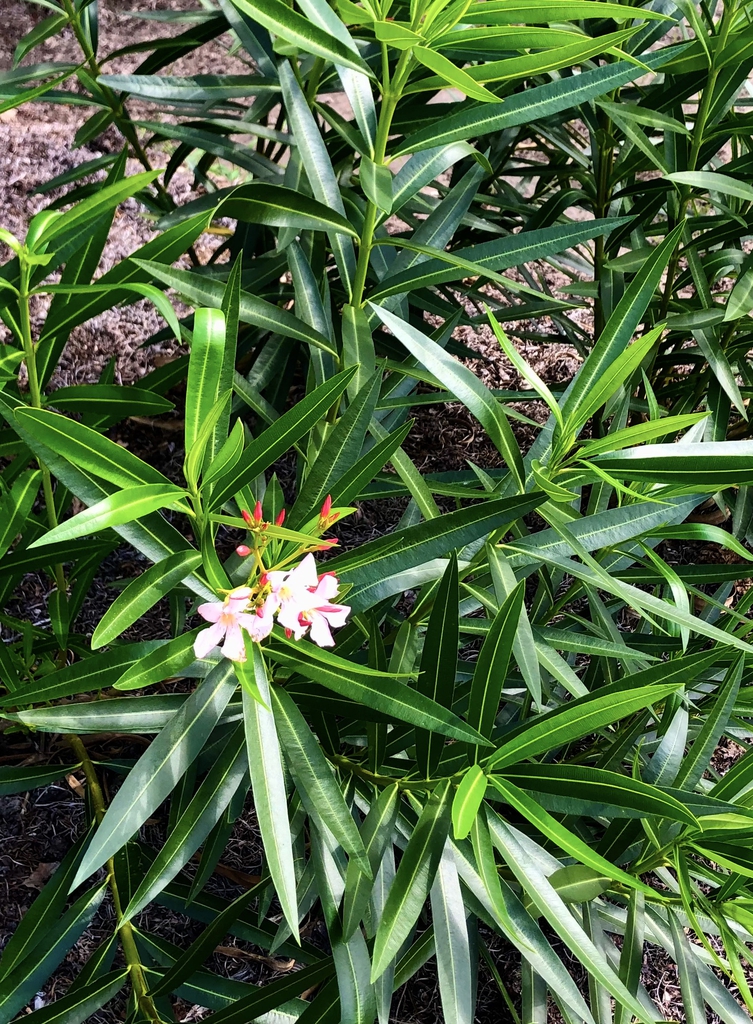
- Linear-lanceolate leaves are 4 to 7 inches long and less than an inch wide.
- Narrow leaves are opposite or in whorls of 3 or 4.
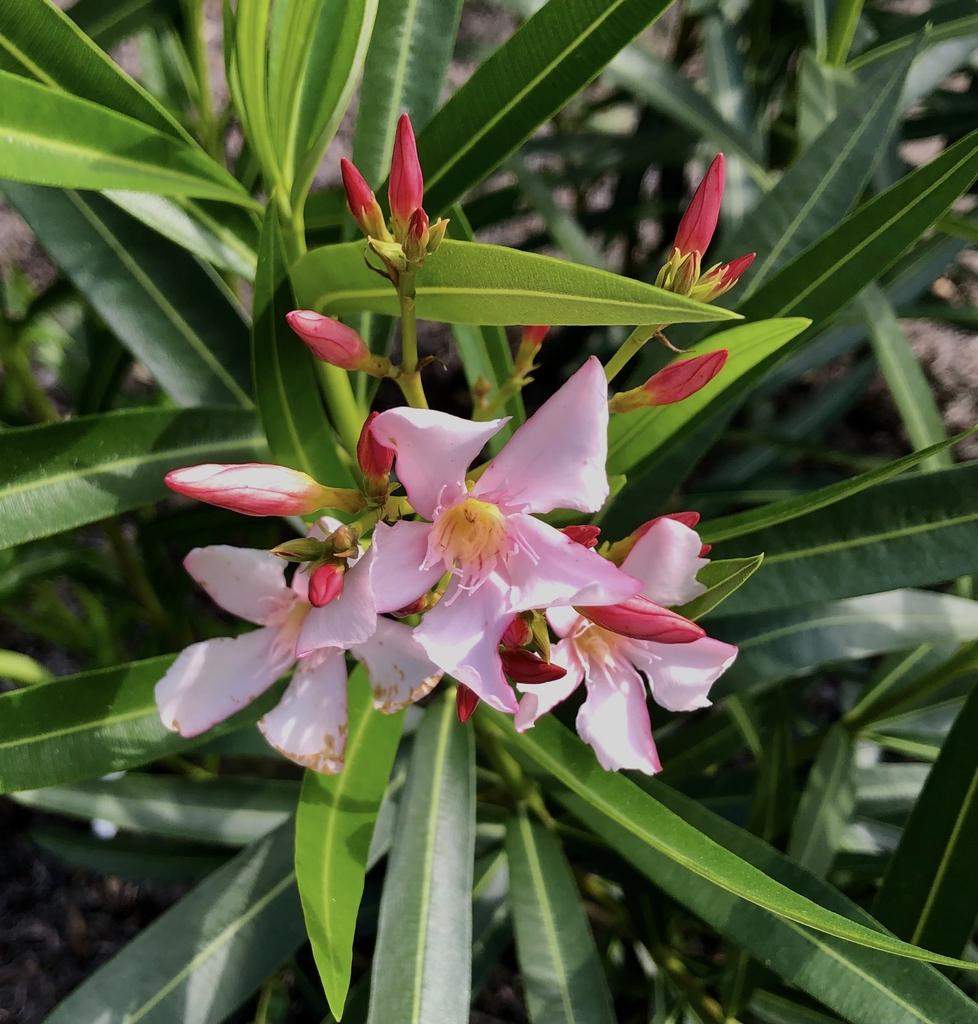
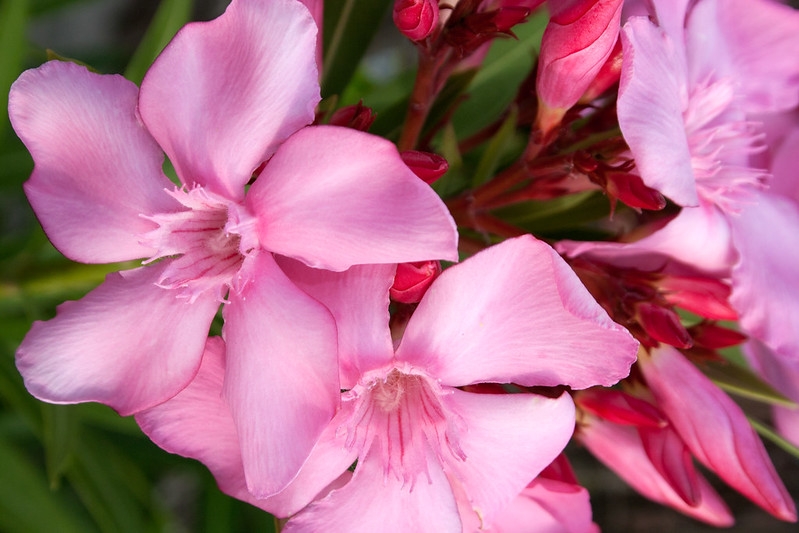
- It has showy, terminal, 5-petaled flowers that are 1 to 1.5 inches in size and are in cymes. The flowers have a corona.
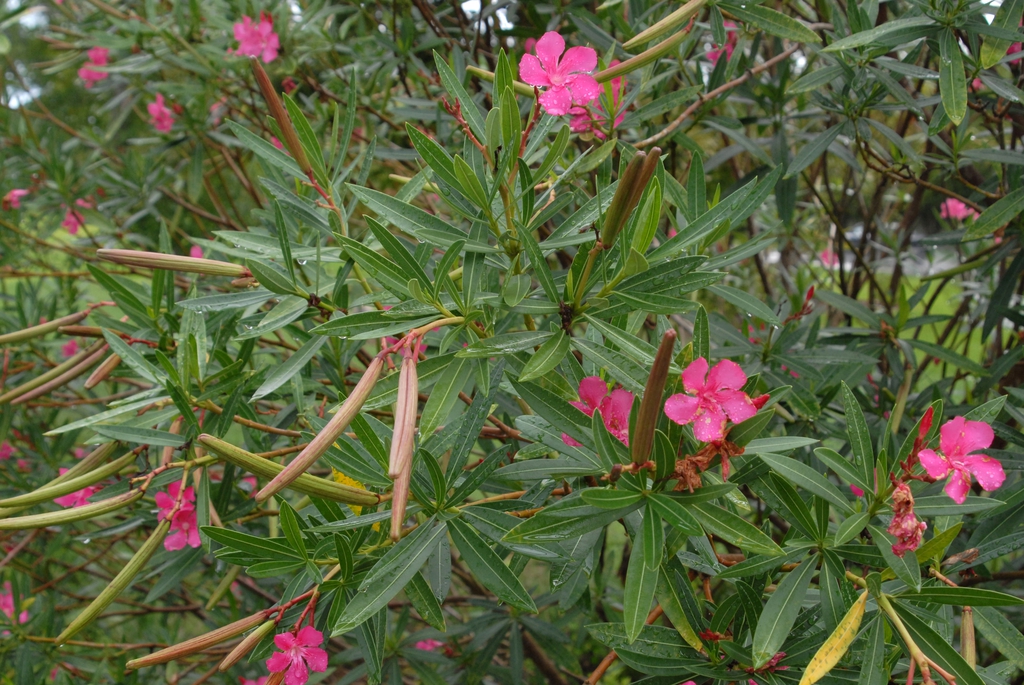
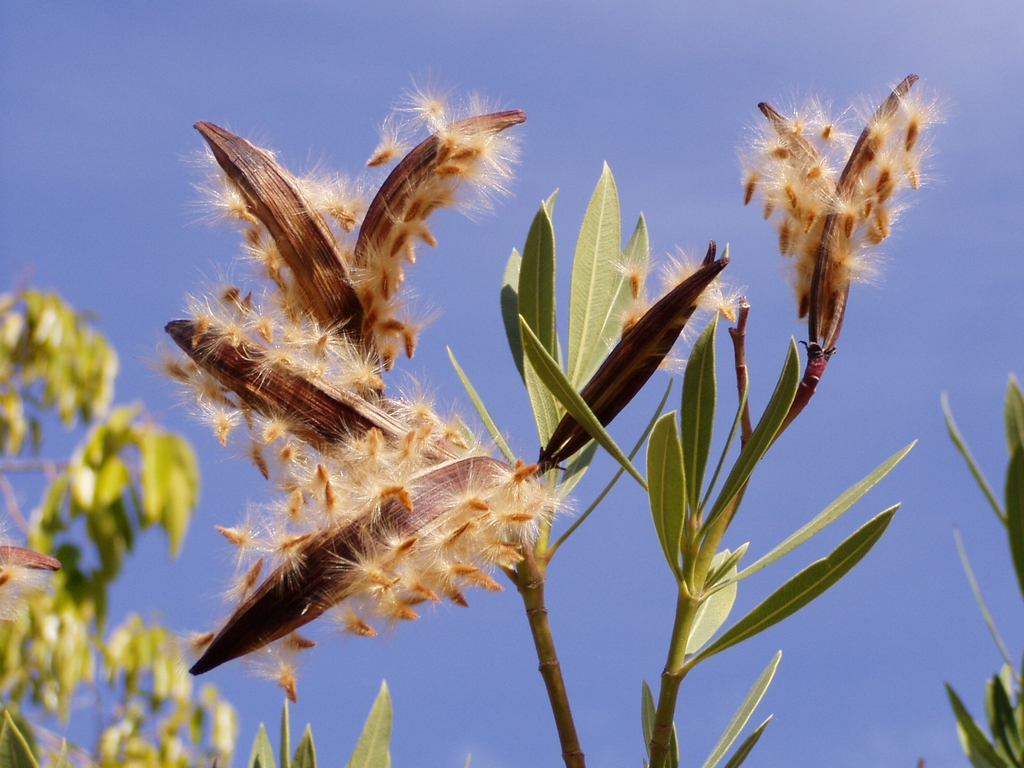
- Fruit is a pair of follicles, each of which splits open along one side.
Insects, Diseases and Other Plant Problems: Aphids, caterpillars, mealybugs and scale are occasional pests. Armillaria, leaf spot, and sooty mold occasionally occur.
- Profile Video:
- See this plant in the following landscape :
- Cultivars / Varieties:
-
- 'Calypso'
Low flammability. - 'Hardy Pink'
Withstands cold temperatures better - 'Petite Pink'
Dwarf form with light pink flowers
- 'Calypso'
- 'Calypso', 'Hardy Pink', 'Petite Pink'
- Tags:


 Download Image





- Cultivars / Varieties:
-
- 'Calypso'
Low flammability. - 'Hardy Pink'
Withstands cold temperatures better - 'Petite Pink'
Dwarf form with light pink flowers
- 'Calypso'
- 'Calypso', 'Hardy Pink', 'Petite Pink'
- Tags:
-
-
Attributes:
- Genus:
- Nerium
- Species:
- oleander
- Family:
- Apocynaceae
- Life Cycle:
- Woody
- Recommended Propagation Strategy:
- Seed
- Stem Cutting
- Country Or Region Of Origin:
- Europe, Asia
- Fire Risk Rating:
- low flammability
- Particularly Resistant To (Insects/Diseases/Other Problems):
- Texas Root Rot and Verticillium
- Dimensions:
- Height: 5 ft. 0 in. - 19 ft. 6 in.
- Width: 6 ft. 0 in. - 10 ft. 0 in.
-
-
Whole Plant Traits:
- Plant Type:
- Houseplant
- Perennial
- Poisonous
- Shrub
- Woody Plant Leaf Characteristics:
- Broadleaf Evergreen
- Habit/Form:
- Clumping
- Erect
- Rounded
- Growth Rate:
- Rapid
- Maintenance:
- Low
- Texture:
- Medium
-
-
Cultural Conditions:
- Light:
- Full sun (6 or more hours of direct sunlight a day)
- Partial Shade (Direct sunlight only part of the day, 2-6 hours)
- Soil Texture:
- Clay
- High Organic Matter
- Loam (Silt)
- Sand
- Shallow Rocky
- Soil Drainage:
- Good Drainage
- Moist
- Occasionally Dry
- Available Space To Plant:
- 6-feet-12 feet
- NC Region:
- Coastal
- USDA Plant Hardiness Zone:
- 8a, 8b, 9a, 9b, 10a, 10b
-
-
Fruit:
- Fruit Color:
- Brown/Copper
- Green
- Display/Harvest Time:
- Fall
- Summer
- Fruit Type:
- Follicle
- Fruit Length:
- > 3 inches
- Fruit Description:
- Fruits are a slender pair of pod-like follicles that are 5 to 7 inches long, green, and have small, fringed seeds. They are not particularly attractive and can lead to litter clean up, so dead-head flowers to prevent seed heads from forming.
-
-
Flowers:
- Flower Color:
- Cream/Tan
- Gold/Yellow
- Orange
- Pink
- White
- Flower Inflorescence:
- Cyme
- Flower Value To Gardener:
- Fragrant
- Showy
- Flower Bloom Time:
- Spring
- Summer
- Flower Shape:
- Funnel
- Flower Petals:
- 4-5 petals/rays
- Flower Size:
- 1-3 inches
- Flower Description:
- Flowers are white, dark pink, salmon or apricot. They are 5-petaled, single, or true double. Corollas are funnelform and have a slender tube. A corona surrounds the mouth of the tube. Stamens are attached below the throat. The inflorescence is a terminal cyme. They bloom from late spring to late summer.
-
-
Leaves:
- Woody Plant Leaf Characteristics:
- Broadleaf Evergreen
- Leaf Color:
- Green
- Leaf Feel:
- Leathery
- Leaf Value To Gardener:
- Long-lasting
- Leaf Type:
- Simple
- Leaf Arrangement:
- Opposite
- Whorled
- Leaf Shape:
- Lanceolate
- Linear
- Leaf Margin:
- Entire
- Hairs Present:
- No
- Leaf Length:
- 3-6 inches
- Leaf Description:
- Leaves are opposite or in whorls of 3 or 4, simple, linear-lanceolate, sharply acute, entire, and are 4 to 7 inches long. Leaves have prominent pinnate midribs above and short petioles. They are leathery and dark green in color.
-
-
Bark:
- Bark Color:
- Dark Brown
- Green
- Surface/Attachment:
- Furrowed
- Smooth
-
-
Stem:
- Stem Color:
- Green
- Stem Is Aromatic:
- No
- Stem Description:
- Strong cane-like stems. Twigs are stout and shiny green.
-
-
Landscape:
- Landscape Location:
- Coastal
- Container
- Houseplants
- Patio
- Pool/Hardscape
- Landscape Theme:
- Butterfly Garden
- Drought Tolerant Garden
- Nighttime Garden
- Winter Garden
- Design Feature:
- Border
- Foundation Planting
- Screen/Privacy
- Small Tree
- Attracts:
- Butterflies
- Resistance To Challenges:
- Deer
- Drought
- Heat
- Pollution
- Poor Soil
- Salt
- Urban Conditions
- Wind
- Problems:
- Contact Dermatitis
- Poisonous to Humans
- Problem for Cats
- Problem for Dogs
- Problem for Horses
-
-
Poisonous to Humans:
- Poison Severity:
- High
- Poison Symptoms:
- Highly toxic, may be fatal if eaten! Nausea, vomiting, stomach pain, dizziness, slowed pulse, irregular heartbeat, dilation of pupils, bloody diarrhea, and drowsiness, depression, death. Poisonous either fresh or dry.
- Poison Toxic Principle:
- Cardiac glycosides: nerioside and oleandroside; saponins, and other unknown compounds
- Causes Contact Dermatitis:
- Yes
- Poison Part:
- Bark
- Flowers
- Fruits
- Leaves
- Roots
- Sap/Juice
- Seeds
- Stems