



Indian Grass Molinia caerulea
Other Common Name(s):
Previously known as:
- Aira caerulea
- Melica caerulea
- Molinia caerulea var. sylvatica
- Phonetic Spelling
- moh-LEEN-ee-ah seh-ROO-lee-ah
- Description
-
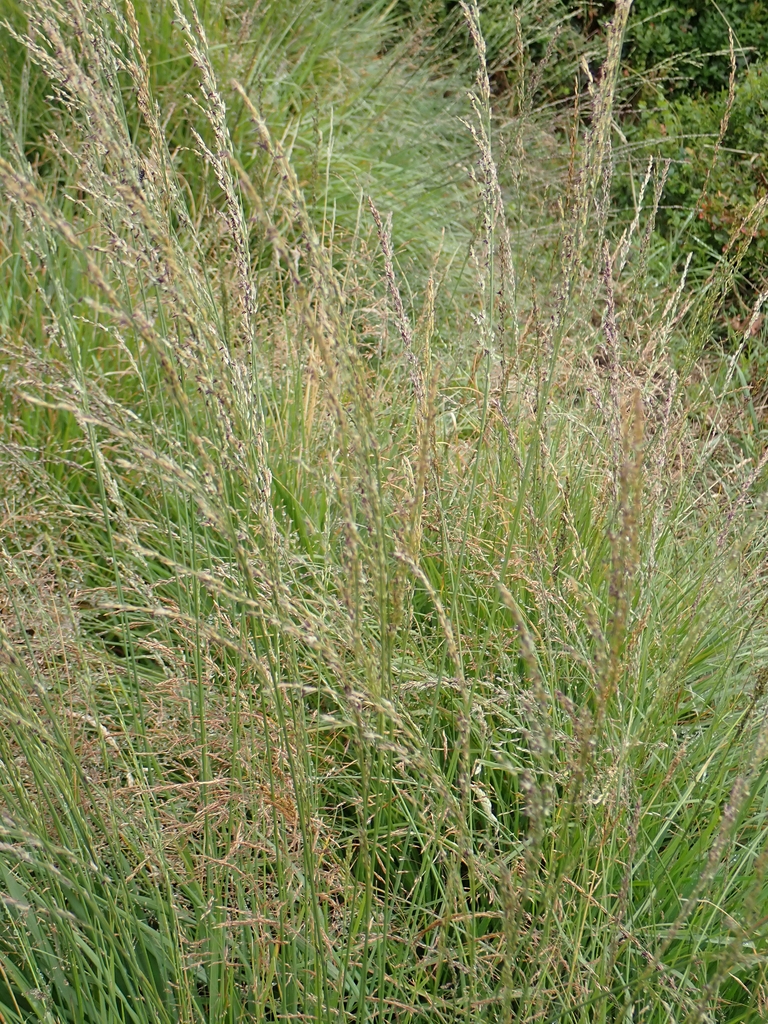
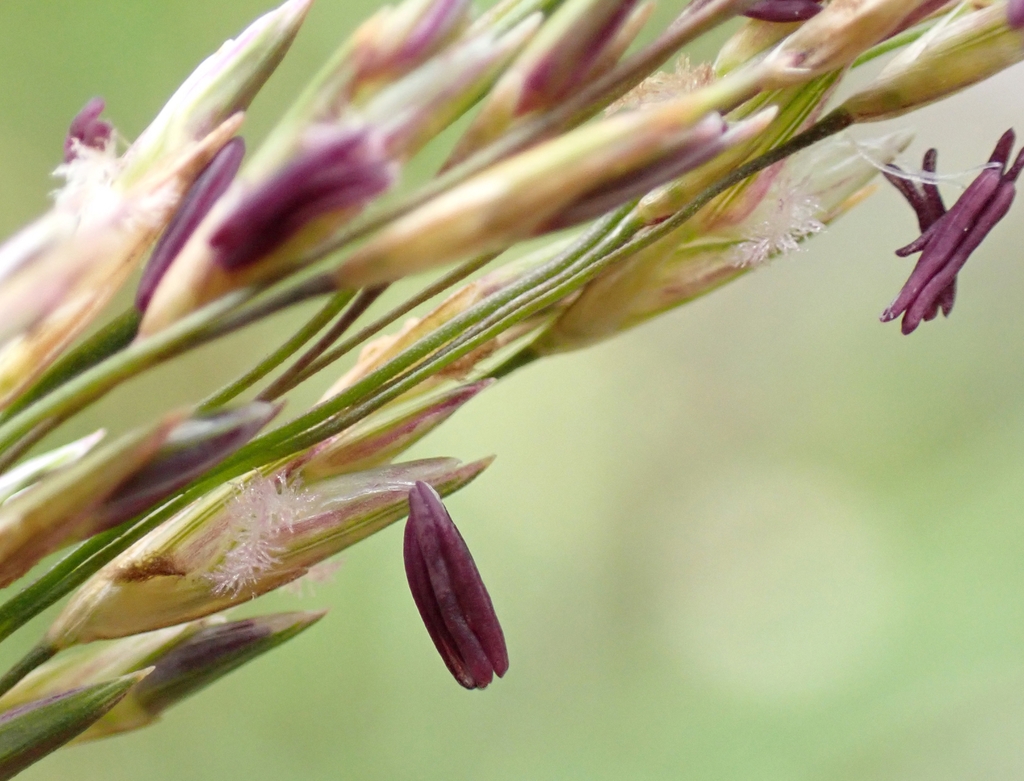
Purple moor grass is an upright, dense, ornamental, warm-season perennial grass native to Europe, West Siberia and Kazakhstan, the Mediterranean region, and Ethiopia, and a member of the grass family (Poaceae). This grass is often found in moist sites such as moors, bogs, and along lakes. It grows 1 to 2 feet tall and has a clumping habit. The leaf blades are flat and narrow, growing up to 18 inches long and 0.25 inches wide. Panicles of showy, airy, green and white flowers with a purple tint are borne atop an erect to arching flower stalk and rise above the leaves in mid-summer. The foliage and flower stalks become golden yellow to orangish-yellow as the seed sets, and then transition to a light tan. The foliage and flower stalks typically break down and fall over in late fall, providing little winter interest. The genus name Molinia honors a Jesuit historian of Chile, Juan Ignacio Molina. The specific epithet caerula is Latin and means dark blue.
Prefers full sun and moist to wet, well-drained, fertile, acidic soil. Performs best in cool summer climates. It does not flower well when grown in hot summer weather. It is hardy in zones 5 through 8, slow-growing, and tolerates low fertility. Cut any surviving foliage down to the ground in early spring or late February through March, just before the new leaf blades appear. In spring, propagate by division.
Purple moor grass may be planted as an accent, specimen, or mass. Its golden fall color will add interest along a pond or in a meadow. It may also be used as a border planting.
Insects, Diseases, and Other Plant Problems: No significant insect pests or diseases. Slow-growing and can take 2 to 3 years to get established. Does not perform well in hot summer climates.
- See this plant in the following landscape :
- Cultivars / Varieties:
-
- 'Edith Dudszus'
Grows up to 28 inches tall, with purplish- black stems and purple flowers - 'Heidebraut'
Grows 1.5 to 2 ft. tall, with long purple flower spikes and tan seedheads - 'Moorhexe'
Grows 2 to 3 ft. tall, with narrow green leaf blades, spiky dark purple flowers, and purple-brown seedheads - 'Poul Pederson'
Hardy zones 4 through 9; compact, bushy foliage at the base of the plant, with purple flowers - 'Strahlenquelle'
Grows up to 5 ft. tall, compact, with long purple flower spikes - 'Variegata'
Variegated green and creamy white foliage, striped lengthwise
- 'Edith Dudszus'
- 'Edith Dudszus', 'Heidebraut', 'Moorhexe', 'Poul Pederson', 'Strahlenquelle', 'Variegata'
- Tags:


- Cultivars / Varieties:
-
- 'Edith Dudszus'
Grows up to 28 inches tall, with purplish- black stems and purple flowers - 'Heidebraut'
Grows 1.5 to 2 ft. tall, with long purple flower spikes and tan seedheads - 'Moorhexe'
Grows 2 to 3 ft. tall, with narrow green leaf blades, spiky dark purple flowers, and purple-brown seedheads - 'Poul Pederson'
Hardy zones 4 through 9; compact, bushy foliage at the base of the plant, with purple flowers - 'Strahlenquelle'
Grows up to 5 ft. tall, compact, with long purple flower spikes - 'Variegata'
Variegated green and creamy white foliage, striped lengthwise
- 'Edith Dudszus'
- 'Edith Dudszus', 'Heidebraut', 'Moorhexe', 'Poul Pederson', 'Strahlenquelle', 'Variegata'
- Tags:
-
-
Attributes:
- Genus:
- Molinia
- Species:
- caerulea
- Family:
- Poaceae
- Life Cycle:
- Perennial
- Recommended Propagation Strategy:
- Division
- Seed
- Country Or Region Of Origin:
- Europe to West Siberia and Kazakhstan, Mediterranean, Ethiopia
- Distribution:
- Native: Albania, Algeria, Austria, Baltic States, Belarus, Belgium, Bulgaria, Central European Russia, Czechoslovakia, Denmark, East European Russia, Ethiopia, Finland, France, Germany, Great Britain, Greece, Hungary, Ireland, Italy, Kazakhstan, Lebanon-Syria, Morocco, Netherlands, North Caucasus, North European Russia, Northwest European Russia, Norway, NW. Balkan Peninsula, Poland, Portugal, Romania, South European Russia, Spain, Sweden, Switzerland, Transcaucasus, Tunisia, Turkey, Ukraine, and West Siberia. Introduced: Japan, Newfoundland, Nova Scotia, Ontario, Quebec, and the United States--Connecticut, Maine, Massachusetts, New Jersey, New York, Oregon, Pennsylvania, Rhode Island, Vermont, and Wisconsin.
- Wildlife Value:
- Attracts birds.
- Play Value:
- Attractive Flowers
- Colorful
- Textural
- Dimensions:
- Height: 2 ft. 0 in. - 3 ft. 0 in.
- Width: 1 ft. 0 in. - 1 ft. 6 in.
-
-
Whole Plant Traits:
- Plant Type:
- Ornamental Grasses and Sedges
- Perennial
- Woody Plant Leaf Characteristics:
- Deciduous
- Habit/Form:
- Arching
- Clumping
- Erect
- Mounding
- Growth Rate:
- Slow
- Maintenance:
- Low
- Texture:
- Medium
-
-
Cultural Conditions:
- Light:
- Full sun (6 or more hours of direct sunlight a day)
- Soil Texture:
- Clay
- Loam (Silt)
- Sand
- Soil pH:
- Acid (<6.0)
- Neutral (6.0-8.0)
- Soil Drainage:
- Good Drainage
- Moist
- Occasionally Wet
- Available Space To Plant:
- 3 feet-6 feet
- NC Region:
- Mountains
- USDA Plant Hardiness Zone:
- 5a, 5b, 6a, 6b, 7a, 7b, 8a, 8b
-
-
Fruit:
- Fruit Type:
- Caryopsis
-
-
Flowers:
- Flower Color:
- Brown/Copper
- Gold/Yellow
- Green
- Orange
- Purple/Lavender
- White
- Flower Inflorescence:
- Panicle
- Spike
- Flower Value To Gardener:
- Good Cut
- Good Dried
- Showy
- Flower Bloom Time:
- Fall
- Summer
- Flower Description:
- Dense spike-like or loose panicles of green and white with a purple tint bloom in mid-summer and rise high above foliage, moving freely with the wind. Modest flowering in hot, dry weather. Fades to a tawny yellow in fall, breaking off in early winter.
-
-
Leaves:
- Woody Plant Leaf Characteristics:
- Deciduous
- Leaf Color:
- Green
- Leaf Feel:
- Smooth
- Leaf Value To Gardener:
- Long-lasting
- Showy
- Deciduous Leaf Fall Color:
- Gold/Yellow
- Leaf Type:
- Sheath
- Leaf Arrangement:
- Rosulate
- Leaf Shape:
- Linear
- Hairs Present:
- Yes
- Leaf Length:
- > 6 inches
- Leaf Width:
- < 1 inch
- Leaf Description:
- Grows in a dense, low mound of basal foliage and has a moderate to fine texture. The leaf sheaths are smooth, may have sparse marginal hairs, with each sheath measuring up to 18 inches long and 0.25 inches wide. They are flat and narrow, turning golden yellow in fall. Breaks down in early winter.
-
-
Stem:
- Stem Is Aromatic:
- No
- Stem Form:
- Straight
- Stem Surface:
- Smooth (glabrous)
- Stem Description:
- The culms are upright, slender to stout, stiff, and smooth.
-
-
Landscape:
- Landscape Location:
- Meadow
- Naturalized Area
- Pond
- Landscape Theme:
- Cottage Garden
- Rain Garden
- Water Garden
- Design Feature:
- Accent
- Border
- Mass Planting
- Specimen
- Attracts:
- Songbirds
- Resistance To Challenges:
- Black Walnut
- Deer
- Erosion
- Pollution
- Poor Soil
- Urban Conditions
- Wet Soil


