


Medeola virginiana
Common Name(s):
Previously known as:
- Gyromia virginica
- Medeola virginica
- Phonetic Spelling
- med-EE-oh-luh vir-jin-ee-AN-uh
- Description
-
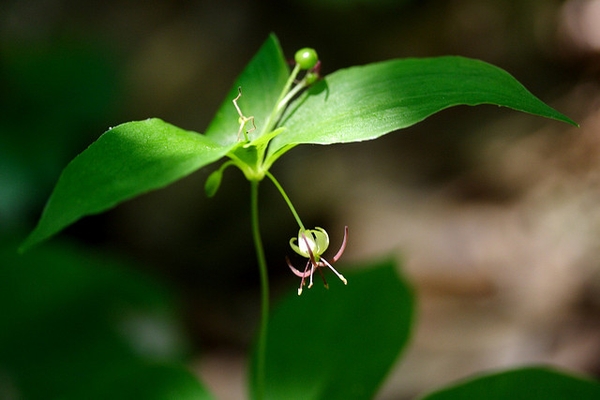
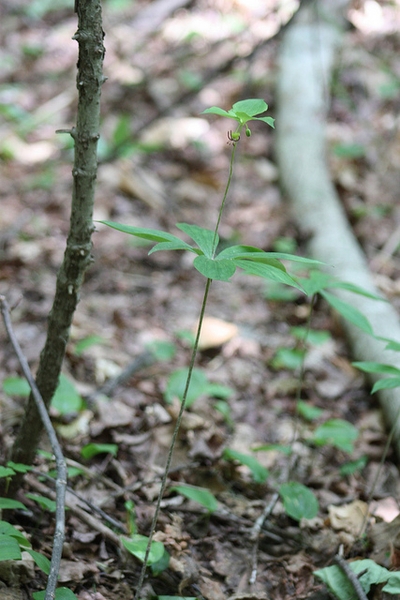
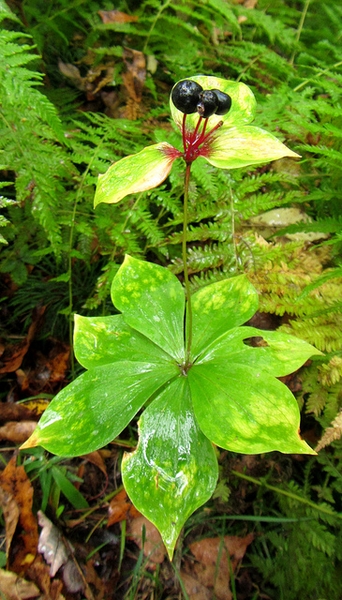
Indian cucumber-root is a native herbaceous perennial wildflower found in Eastern Canada and the East Central and Eastern United States in woodlands, ravines, and valleys. It grows 1 to 2 feet tall and has upright, hairy, unbranched stems. On flowering plants, the leaves grow in two tiers and are whorled, ovate to oblanceolate, with acute tips. Non-flowering plants have only one tier of leaves. The flowers bloom in late spring and are small, greenish to yellow, with a dangling or nodding habit. They emerge from a whorl of three leaves at the top of the stem. Berry-like fruits are initially green, then ripen to a bluish-purple in late summer. The roots are small, white, tuberous, and brittle, measuring 2 inches long and about 0.25 inches wide. Indian cucumber-root belongs to the lily family (Liliaceae). The genus name Medeola honors Medea of Greek mythology. The specific epithet viriginiana means of Virginia.
Prefers partial shade to full shade and moist to slightly dry, organically rich, well-drained, acidic soil. Indian cucumber-root can be propagated by seed; however, it is intolerant of transplanting. It is also intolerant of bright sunlight and prefers a tree canopy for shade. This slow-growing plant can take two years to germinate and up to five years before producing flowers.
In North Carolina, Indian cucumber-root is commonly found in the Mountains and Piedmont regions and only in portions of the western Coastal Plains. It is reported as endangered in Florida, Illinois, and Louisiana and vulnerable in Mississippi.
Best appreciated in its natural habitat. Otherwise, consider a woodland or naturalized setting to provide adequate shade.
Insects, Diseases, and Other Plant Problems: No significant insect pests or diseases.
- See this plant in the following landscape :
- Cultivars / Varieties:
-
- Tags:


- Cultivars / Varieties:
-
- Tags:
-
-
Attributes:
- Genus:
- Medeola
- Species:
- virginiana
- Family:
- Liliaceae
- Uses (Ethnobotany):
- Native Americans used the root for food and medicine.
- Life Cycle:
- Perennial
- Recommended Propagation Strategy:
- Seed
- Country Or Region Of Origin:
- Eastern Canada to the East Central & Eastern United States
- Distribution:
- Native: Canada-- New Brunswick, Nova Scotia, Ontario, Prince Edward Island, Quebec; United States--Alabama, Connecticut, Delaware, District of Columbia, Florida, Georgia, Illinois, Indiana, Kentucky, Louisiana, Maine, Maryland, Massachusetts, Michigan, Mississippi, Missouri, New Hampshire, New Jersey, New York, North Carolina, Ohio, Pennsylvania, Rhode Island, South Carolina, Tennessee, Vermont, Virginia, West Virginia, and Wisconsin; Introduced: Bermuda
- Wildlife Value:
- Attracts birds.
- Edibility:
- The thickened rootstalk of this plant may be eaten raw, resembling somewhat the taste of cucumber. It may also be used in salads. Although Native Americans used the rootstalk for food, this is no longer recommended because plants are becoming quite scarce in many regions.
- Dimensions:
- Height: 1 ft. 0 in. - 2 ft. 0 in.
- Width: 1 ft. 0 in. - 1 ft. 6 in.
-
-
Whole Plant Traits:
- Plant Type:
- Herbaceous Perennial
- Native Plant
- Wildflower
- Habit/Form:
- Erect
- Growth Rate:
- Slow
- Maintenance:
- Low
- Texture:
- Medium
-
-
Cultural Conditions:
- Light:
- Deep shade (Less than 2 hours to no direct sunlight)
- Partial Shade (Direct sunlight only part of the day, 2-6 hours)
- Soil Texture:
- Loam (Silt)
- Sand
- Soil pH:
- Acid (<6.0)
- Soil Drainage:
- Good Drainage
- Moist
- Available Space To Plant:
- 12 inches-3 feet
- NC Region:
- Coastal
- Mountains
- Piedmont
- USDA Plant Hardiness Zone:
- 3a, 3b, 4a, 4b, 5a, 5b, 6a, 6b, 7a, 7b, 8a, 8b
-
-
Fruit:
- Fruit Color:
- Black
- Blue
- Green
- Fruit Value To Gardener:
- Showy
- Display/Harvest Time:
- Fall
- Fruit Type:
- Berry
- Fruit Length:
- < 1 inch
- Fruit Width:
- < 1 inch
- Fruit Description:
- Green berries ripen to a dark bluish-black from September through October in North Carolina. The berries remain on the plant until they dry and fall to the ground. Each berry contains 2-6 dark brown seeds. It may take up to 18 months before they germinate.
-
-
Flowers:
- Flower Color:
- Brown/Copper
- Gold/Yellow
- Green
- Flower Inflorescence:
- Umbel
- Flower Bloom Time:
- Spring
- Summer
- Flower Petals:
- Tepals
- Flower Size:
- < 1 inch
- Flower Description:
- Small, nodding, greenish-yellow flowers appear at the top of a slender, woolly, unbranched stem in early spring. Each bloom measures 0.5 inches in diameter and has 6 recurved tepals, 6 stamens, and 3 styles. The flowers nod or droop from the axil of the upper leaf whorl. Flowers bloom from mid-April to mid-June in North Carolina.
-
-
Leaves:
- Leaf Color:
- Green
- Deciduous Leaf Fall Color:
- Purple/Lavender
- Leaf Type:
- Simple
- Leaf Arrangement:
- Whorled
- Leaf Shape:
- Oblanceolate
- Oblong
- Ovate
- Leaf Margin:
- Entire
- Hairs Present:
- No
- Leaf Length:
- 3-6 inches
- Leaf Width:
- 1-3 inches
- Leaf Description:
- Flowering plants have leaves arranged in two tiers along the stem. The small, upper whorl of three green leaves is ovate, and each leaf measures 1-3 inches long. The larger lower whorl of 5 to 9 green leaves is near the middle of the stem, and each leaf is oblong to oblanceolate and measures 2.5-5 inches long. The margins are entire. When fruits are ripe, the upper whorl of leaves becomes scarlet at their base. Non-flowering plants have only 1 whorl of leaves and never produce the second whorl.
-
-
Stem:
- Stem Color:
- Green
- Stem Is Aromatic:
- No
- Stem Buds:
- Hairy
- Stem Form:
- Straight
- Stem Surface:
- Hairy (pubescent)
- Stem Description:
- The green stems are upright, unbranched, and have white hairs.
-
-
Landscape:
- Landscape Location:
- Naturalized Area
- Woodland
- Landscape Theme:
- Native Garden
- Rain Garden
- Water Garden
- Design Feature:
- Mass Planting
- Specimen
- Attracts:
- Small Mammals
- Songbirds
- Resistance To Challenges:
- Wet Soil