


Gypsophila elegans
Common Name(s):
- Phonetic Spelling
- jip-SOF-il-uh ELL-eh-ganz
- Description
-
Annual baby's breath is a flowering plant native to Asia and Europe in the carnation family (Caryophyllaceae). It can be found growing along roadsides and other disturbed ares mainly with sandy or rocky soils.
Annual baby's breath grows 1 to 2 feet tall and 1.5 to 2 feet wide, preferring full sun in moist, sandy loam soils. It will adapt to other soils as long as they are well-drained and partial shade, although blooming will be reduced. Plants will grow quickly from seed, just lightly covered with soil. Successive plantings every 3 to 4 weeks until July will extend the bloom season. It is frequently found in wildflower mixtures and has moderate drought tolerance.
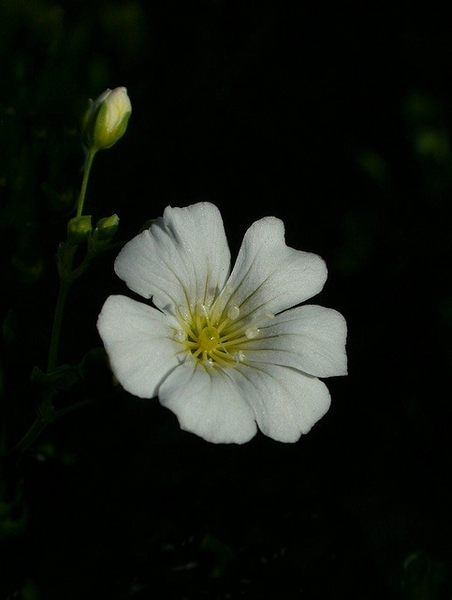
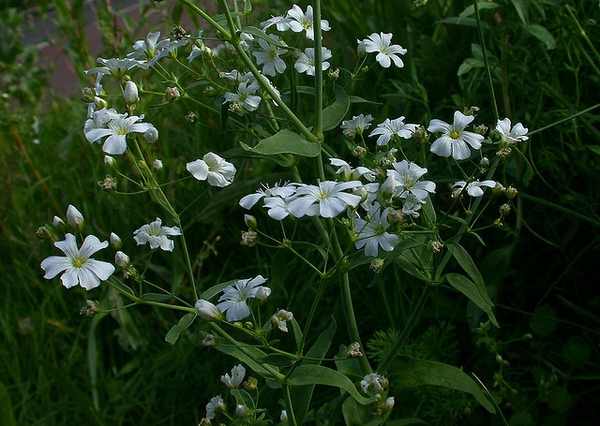
The blooms are larger and more open than the perennial form used by florists, providing light airy clusters held above the foliage in spring to early summer. The nectar-rich flowers attract bees and butterflies.
Use this plant in the perennial border and allow to grow up between blue and pink flowers for added effect. Use in a cottage, English or pollinator garden or in a container.
Insects, Diseases, and Other Plant Problems: Watch for aphids, slugs and snails. Potential diseases are stem and root rot, especially in too wet conditions. Be aware that the plant has the potential to escape gardens into the wild.
- See this plant in the following landscape :
- Cultivars / Varieties:
-
- Tags:


- Cultivars / Varieties:
-
- Tags:
-
-
Attributes:
- Genus:
- Gypsophila
- Species:
- elegans
- Family:
- Caryophyllaceae
- Life Cycle:
- Annual
- Recommended Propagation Strategy:
- Seed
- Country Or Region Of Origin:
- Southern Ukraine to West & Northern Iran
- Wildlife Value:
- Flowers attract bees and butterflies
- Dimensions:
- Height: 1 ft. 6 in. - 2 ft. 0 in.
- Width: 1 ft. 6 in. - 2 ft. 0 in.
-
-
Whole Plant Traits:
- Plant Type:
- Annual
- Habit/Form:
- Erect
- Growth Rate:
- Rapid
- Maintenance:
- Medium
-
-
Cultural Conditions:
- Light:
- Full sun (6 or more hours of direct sunlight a day)
- Partial Shade (Direct sunlight only part of the day, 2-6 hours)
- Soil Texture:
- High Organic Matter
- Loam (Silt)
- Sand
- Soil pH:
- Alkaline (>8.0)
- Neutral (6.0-8.0)
- Soil Drainage:
- Good Drainage
- Occasionally Dry
- Available Space To Plant:
- Less than 12 inches
- NC Region:
- Coastal
- Mountains
- Piedmont
-
-
Fruit:
- Fruit Color:
- Brown/Copper
- Display/Harvest Time:
- Summer
- Fruit Type:
- Capsule
- Fruit Length:
- < 1 inch
- Fruit Width:
- < 1 inch
- Fruit Description:
- Four-valve capsule splits to release many brown to black kidney-shaped seeds
-
-
Flowers:
- Flower Color:
- Pink
- White
- Flower Inflorescence:
- Cyme
- Flower Value To Gardener:
- Good Cut
- Good Dried
- Showy
- Flower Bloom Time:
- Spring
- Summer
- Flower Shape:
- Star
- Flower Petals:
- 4-5 petals/rays
- 6 petals/rays
- Flower Size:
- < 1 inch
- Flower Description:
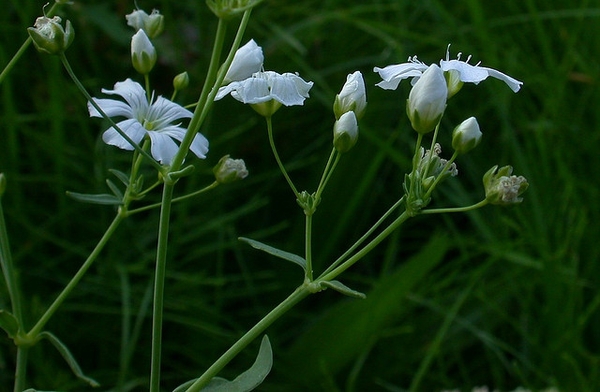
- Profusion of clusters of small 5-petaled white flowers on thread-like stems. Flowers are occasionally pale pink.
-
-
Leaves:
- Leaf Color:
- Green
- Leaf Feel:
- Smooth
- Leaf Type:
- Simple
- Leaf Arrangement:
- Opposite
- Leaf Shape:
- Lanceolate
- Leaf Margin:
- Entire
- Hairs Present:
- No
- Leaf Length:
- 1-3 inches
- Leaf Width:
- < 1 inch
- Leaf Description:
- Gray-green to blue-green leaves are smooth, narrow, lance-shaped to linear. They are 1.5 to 3 inches long. Proximal leaves clasp the stems.
-
-
Stem:
- Stem Is Aromatic:
- No
- Stem Surface:
- Covered with a powdery bloom (glaucous)
- Stem Description:
- Wiry green stems are smooth to glaucous
-
-
Landscape:
- Landscape Location:
- Container
- Meadow
- Naturalized Area
- Landscape Theme:
- Cottage Garden
- Cutting Garden
- Drought Tolerant Garden
- English Garden
- Pollinator Garden
- Rock Garden
- Design Feature:
- Border
- Mass Planting
- Attracts:
- Bees
- Butterflies
- Resistance To Challenges:
- Deer