



Glyceria maxima 'Variegata'
Common Name(s):
- Phonetic Spelling
- glih-SEER-ee-ah MAX-ih-ma vay-ree-eh-GAY-tah
- Description
-
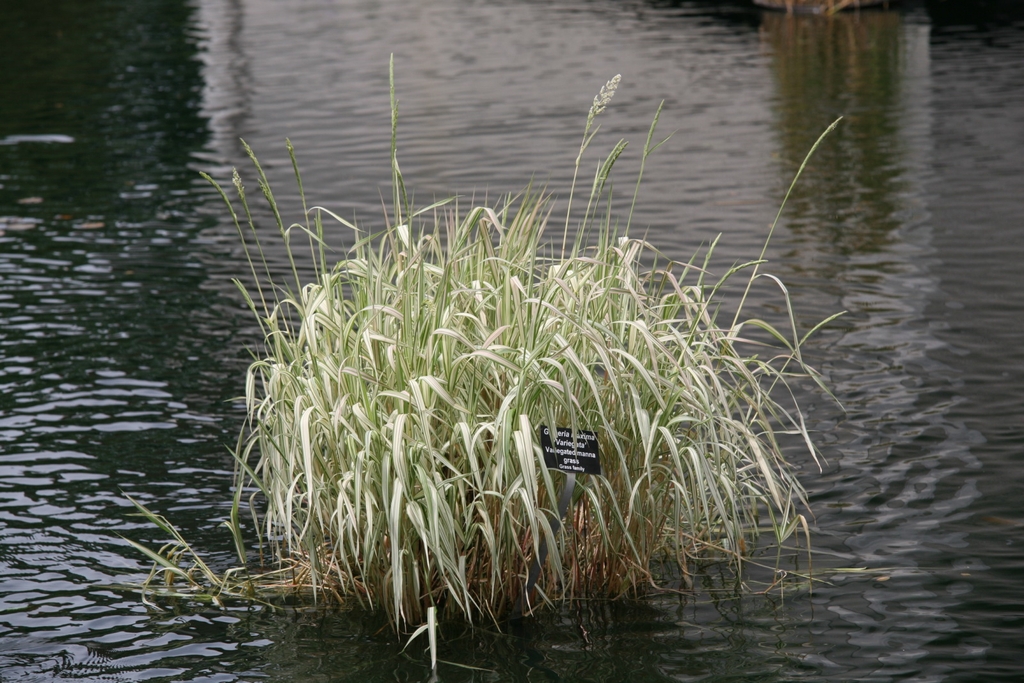
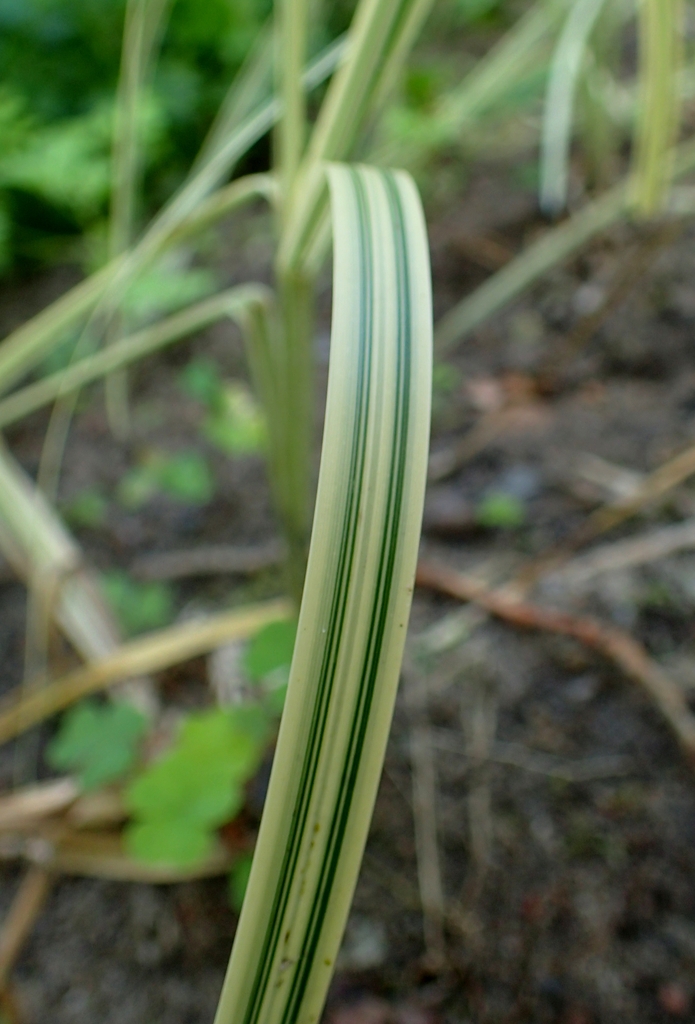
Variegated manna grass is an ornamental, semi-aquatic, spreading, mounding, herbaceous perennial grass cultivar that may be planted along ponds, streams, or in a water garden. It grows upright, 2 to 3 feet tall and 1 to 2 feet wide, spreading by rhizomes and can become aggressive. Its eye-catching leaves are long, narrow, strap-like, and green with creamy stripes and may be tinged with pink at the leaf base. During the fall, the foliage turns tan. Panicles of purplish-green spikes appear during the summer and are borne on an erect to ascending culm. This plant is a member of the grass family (Poaceae).
Prefers full sun and moisture-retentive or poorly drained soils. It can tolerate being submerged in up to 1 foot of water. It is adaptable to most soil and pH types. It is winter hardy in zones 4 to 9. In frost-free climates, it may remain evergreen. It has the potential to become aggressive and may be difficult to remove. It is wet-soil-, clay-soil-, and urban-condition-tolerant. The plant will die back over the winter and reemerge in the spring. To prevent overcrowding, it may be best to divide the plant every 2 to 3 years.
The species, Glyceria maxima, is known to be invasive in New Zealand, Australia, and North America.
Consider variegated manna grass for use in a rain garden, water garden, or nearby ponds and streams. It could be used as container planting for a patio.
Insects, Diseases, and Other Plant Problems: No significant insect pests or diseases. It grows fast and may become aggressive or weedy.
- See this plant in the following landscape :
- A Sampling of Shade Gardens
- Cultivars / Varieties:
-
- Tags:


- Cultivars / Varieties:
-
- Tags:
-
-
Attributes:
- Genus:
- Glyceria
- Species:
- maxima
- Family:
- Poaceae
- Life Cycle:
- Perennial
- Play Value:
- Colorful
- Dimensions:
- Height: 2 ft. 0 in. - 3 ft. 0 in.
- Width: 1 ft. 0 in. - 2 ft. 0 in.
-
-
Whole Plant Traits:
- Plant Type:
- Ornamental Grasses and Sedges
- Water Plant
- Woody Plant Leaf Characteristics:
- Deciduous
- Habit/Form:
- Arching
- Clumping
- Erect
- Mounding
- Spreading
- Growth Rate:
- Rapid
- Maintenance:
- Medium
- Texture:
- Coarse
-
-
Cultural Conditions:
- Light:
- Full sun (6 or more hours of direct sunlight a day)
- Soil Texture:
- Clay
- Loam (Silt)
- Sand
- Soil pH:
- Acid (<6.0)
- Alkaline (>8.0)
- Neutral (6.0-8.0)
- Soil Drainage:
- Frequent Standing Water
- Moist
- Occasionally Wet
- Available Space To Plant:
- 12 inches-3 feet
- NC Region:
- Coastal
- Mountains
- Piedmont
- USDA Plant Hardiness Zone:
- 4a, 4b, 5a, 5b, 6a, 6b, 7a, 7b, 8a, 8b, 9a, 9b
-
-
Fruit:
- Fruit Type:
- Caryopsis
-
-
Flowers:
- Flower Color:
- Green
- Purple/Lavender
- Flower Inflorescence:
- Insignificant
- Panicle
- Flower Bloom Time:
- Summer
- Flower Description:
- Loose and then dense, oblong panicles with spiklets of purplish-green flowers. Blooms during summer.
-
-
Leaves:
- Woody Plant Leaf Characteristics:
- Deciduous
- Leaf Color:
- Cream/Tan
- Green
- Variegated
- Leaf Feel:
- Rough
- Deciduous Leaf Fall Color:
- Cream/Tan
- Leaf Type:
- Sheath
- Leaf Shape:
- Lanceolate
- Leaf Margin:
- Entire
- Hairs Present:
- No
- Leaf Length:
- > 6 inches
- Leaf Width:
- 1-3 inches
- Leaf Description:
- The leaves are long, narrow, strap-like, variegated, with entire margins. The sheath color is green with creamy stripes. The base of the leaf may be pink-tinged. The fall color is tan.
-
-
Stem:
- Stem Is Aromatic:
- No
-
-
Landscape:
- Landscape Location:
- Coastal
- Container
- Pond
- Riparian
- Landscape Theme:
- Rain Garden
- Water Garden
- Resistance To Challenges:
- Urban Conditions
- Wet Soil
- Problems:
- Weedy


