



Geranium procurrens
Common Name(s):
- Phonetic Spelling
- jer-AY-nee-um pro-KUR-renz
- Description
-
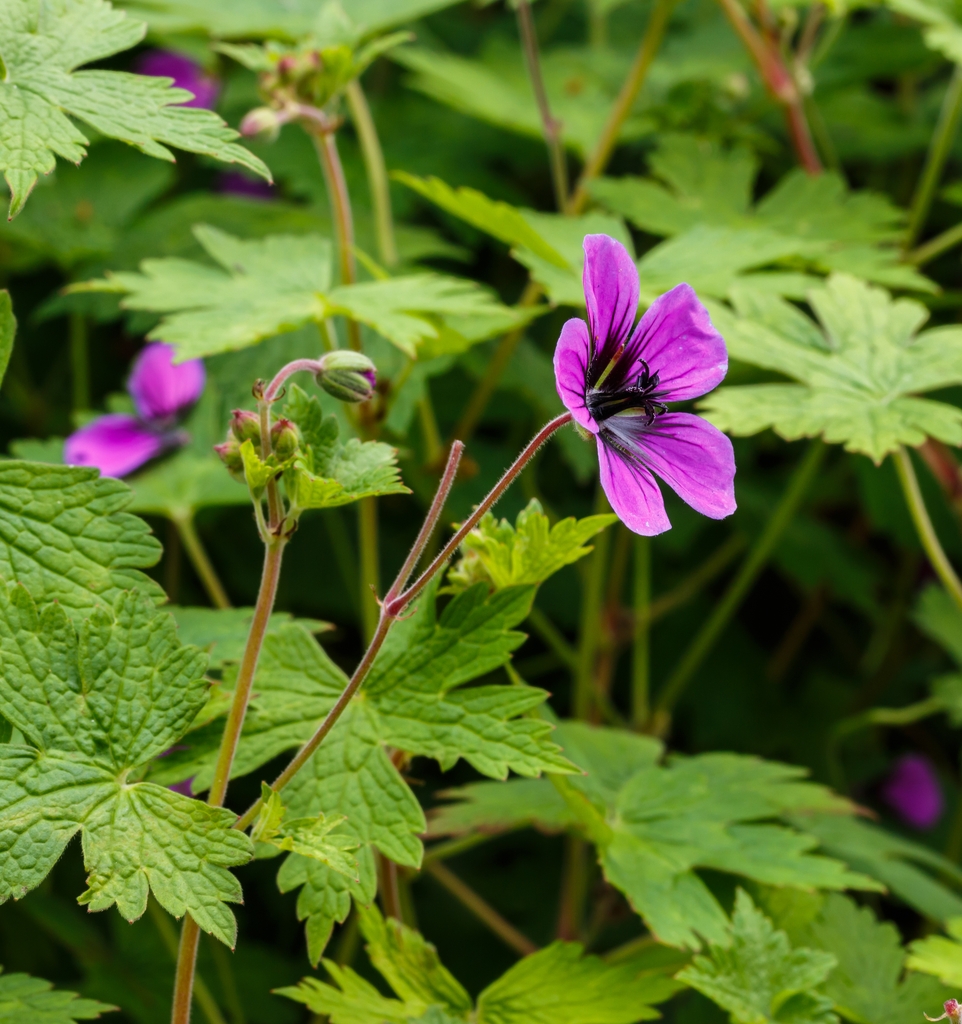
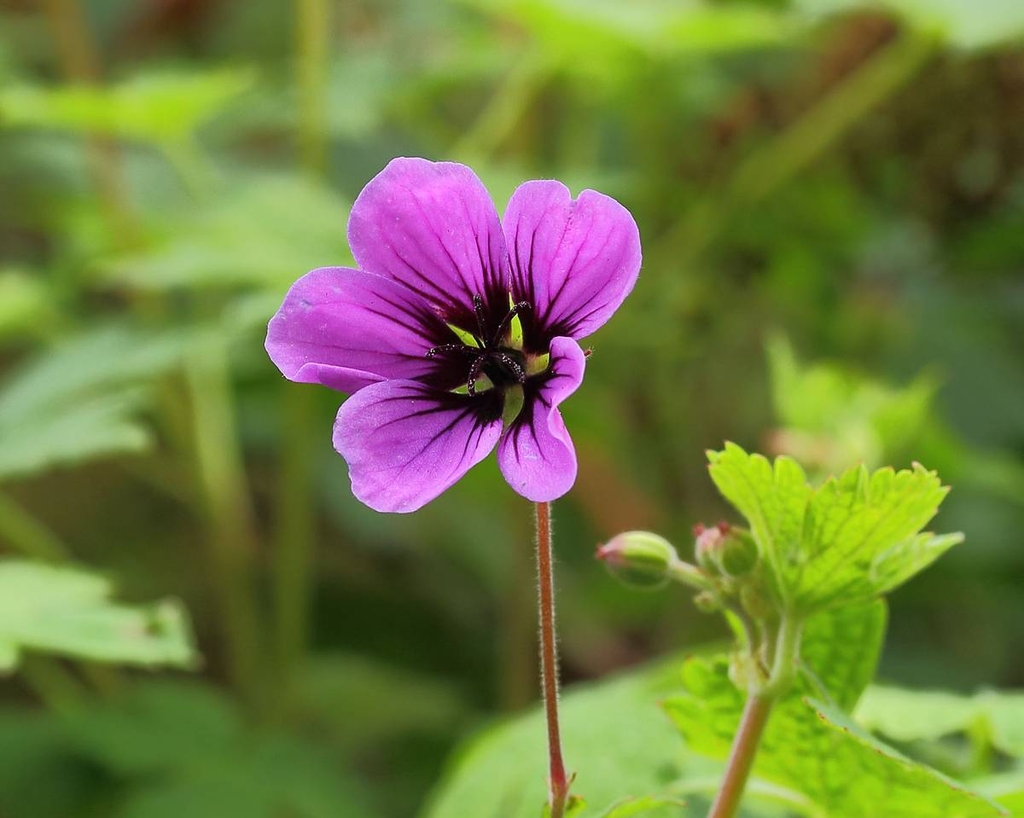
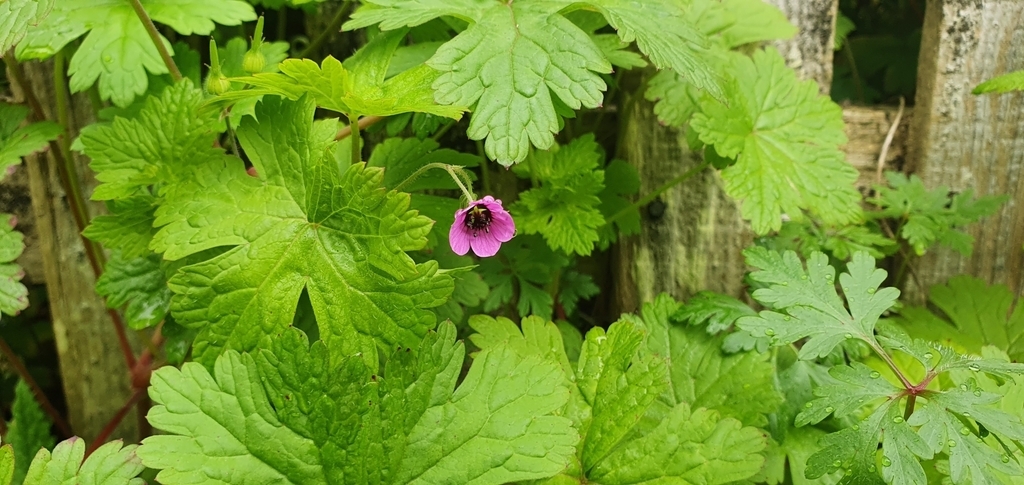
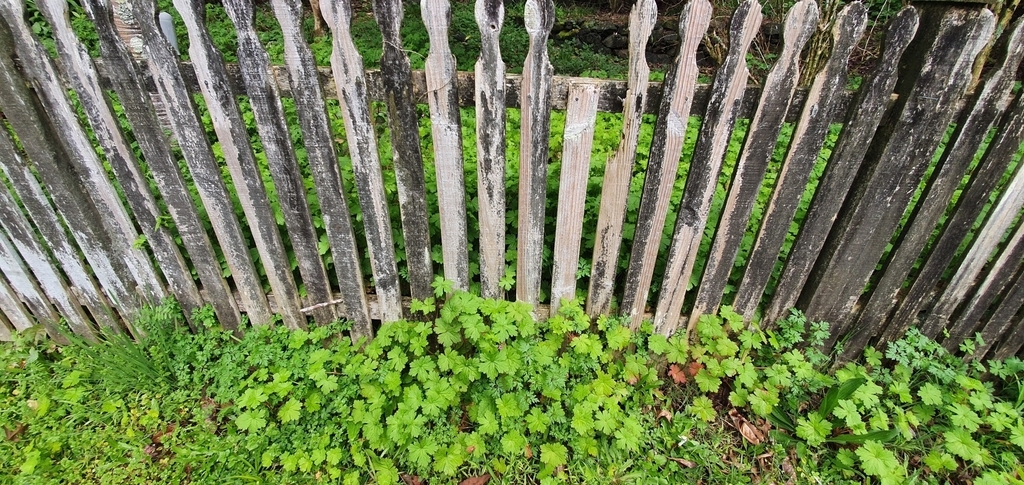
Trailing geranium is a deciduous, herbaceous perennial with a compact, prostrate to semi-upright, trailing or scrambling habit, found in the Himalayas of Southern Tibet and Nepal, as well as in Assam at 6,800 to 11,400 feet. It grows 1 to 2 feet tall and up to 3 feet wide, with long greenish-red, hairy trailing stems. It has green, segmented, deeply lobed leaves, and solitary, 5-petaled, dark red-purple or magenta flowers with dark purple veining and a black central eye. Blooming occurs in late summer to early fall and attracts pollinators. It is a member of the geranium family (Geraniaceae). The genus name, Geranium, is derived from the Greek word geranos, meaning crane. The fruits of this plant have a pointed beak just like a crane; hence, the common name cranesbill. The specific epithet, procurrens, is Latin, meaning "to run forward' and likely refers to the plant's scrambling habit.
The plant prefers full sun to partial shade and moist, well-drained, acidic, fertile soil. It prefers cool summers and most likely would not tolerate the heat and humidity of the Southeastern United States. The plant can tolerate temperatures down to -10 degrees F. Deadheading will encourage reblooming. This plant forms new colonies by creeping across the soil and rooting along the way. Propagated by division, cuttings, or seeds.
Trailing geranium is an attractive groundcover for flower borders and cottage gardens.
Insects, Diseases, and Other Plant Problems: No significant problems. Monitor of weevils, sawflies, slugs, and snails. May be susceptible to powdery mildew and downy mildew.
- See this plant in the following landscape :
- Cultivars / Varieties:
-
- ‘Ann Folkard’ (G. procurrens x G. psilstemon)
trailing, twining, bright yellowish-green leaves, magenta flowers with a black central eye, - 'Ann Thomson' (G. procurrens x G. psilstemon)
heat tolerant, clumping habit, bright yellow foliage, and violet flowers
'Dilys' (G. sanguineum x G. procurrens)

rich green leaves, pinkish-purple, 5 -petaled flowers with dark purple eyes and veins, - ‘Ann Folkard’ (G. procurrens x G. psilstemon)
- ‘Ann Folkard’ (G. procurrens x G. psilstemon), 'Ann Thomson' (G. procurrens x G. psilstemon), 'Dilys' (G. sanguineum x G. procurrens)
- Tags:


- Cultivars / Varieties:
-
- ‘Ann Folkard’ (G. procurrens x G. psilstemon)
trailing, twining, bright yellowish-green leaves, magenta flowers with a black central eye, - 'Ann Thomson' (G. procurrens x G. psilstemon)
heat tolerant, clumping habit, bright yellow foliage, and violet flowers
'Dilys' (G. sanguineum x G. procurrens)
rich green leaves, pinkish-purple, 5 -petaled flowers with dark purple eyes and veins, - ‘Ann Folkard’ (G. procurrens x G. psilstemon)
- ‘Ann Folkard’ (G. procurrens x G. psilstemon), 'Ann Thomson' (G. procurrens x G. psilstemon), 'Dilys' (G. sanguineum x G. procurrens)
- Tags:
-
-
Attributes:
- Genus:
- Geranium
- Species:
- procurrens
- Family:
- Geraniaceae
- Life Cycle:
- Perennial
- Recommended Propagation Strategy:
- Seed
- Country Or Region Of Origin:
- Nepal to Southern Tibet and Assam
- Distribution:
- Native: Assam, East Himalaya, Nepal, Tibet
- Wildlife Value:
- Attracts pollinators, such as bees and butterflies.
- Play Value:
- Attractive Flowers
- Attracts Pollinators
- Colorful
-
-
Whole Plant Traits:
- Plant Type:
- Herbaceous Perennial
- Habit/Form:
- Mounding
- Prostrate
- Spreading
- Growth Rate:
- Medium
- Maintenance:
- Low
- Texture:
- Medium
-
-
Cultural Conditions:
- Light:
- Full sun (6 or more hours of direct sunlight a day)
- Soil Texture:
- Clay
- High Organic Matter
- Loam (Silt)
- Sand
- Soil pH:
- Acid (<6.0)
- Neutral (6.0-8.0)
- Soil Drainage:
- Good Drainage
- Moist
- Available Space To Plant:
- 3 feet-6 feet
- NC Region:
- Mountains
- USDA Plant Hardiness Zone:
- 5a, 5b, 6a, 6b, 7a, 7b, 8a, 8b
-
-
Fruit:
- Fruit Type:
- Schizocarp
-
-
Flowers:
- Flower Color:
- Pink
- Purple/Lavender
- Flower Inflorescence:
- Solitary
- Flower Value To Gardener:
- Showy
- Flower Bloom Time:
- Fall
- Summer
- Flower Shape:
- Funnel
- Flower Petals:
- 4-5 petals/rays
- Flower Size:
- < 1 inch
- Flower Description:
- The flowers are dark red-purple or magenta, 5-petaled with darker veins, and a black center, measuring 1 to 1.5 inches across.
-
-
Leaves:
- Leaf Color:
- Green
- Deciduous Leaf Fall Color:
- Brown/Copper
- Red/Burgundy
- Leaf Margin:
- Lobed
- Hairs Present:
- No
- Leaf Length:
- 1-3 inches
- Leaf Width:
- 1-3 inches
- Leaf Description:
- The leaves are green, deeply lobed, and cut into shallow segments. It has up to 5 to 7 lobes. The fall color is bronze or reddish tinted.
-
-
Stem:
- Stem Color:
- Green
- Red/Burgundy
- Stem Is Aromatic:
- No
- Stem Surface:
- Hairy (pubescent)
- Stem Description:
- The stems are long, hairy, greenish-red, and trailing.
-
-
Landscape:
- Landscape Location:
- Container
- Naturalized Area
- Landscape Theme:
- Cottage Garden
- English Garden
- Design Feature:
- Border
- Attracts:
- Bees
- Butterflies



