



Sarracenia purpurea subsp. venosa
Common Name(s):
Previously known as:
- Sarracenia parviflora
- Sarracenia purpurea var. venosa
- Sarracenia venosa
- Phonetic Spelling
- sar-uh-SEN-ee-uh pur-PUR-ee-uh ven-OH-suh
- Description
-
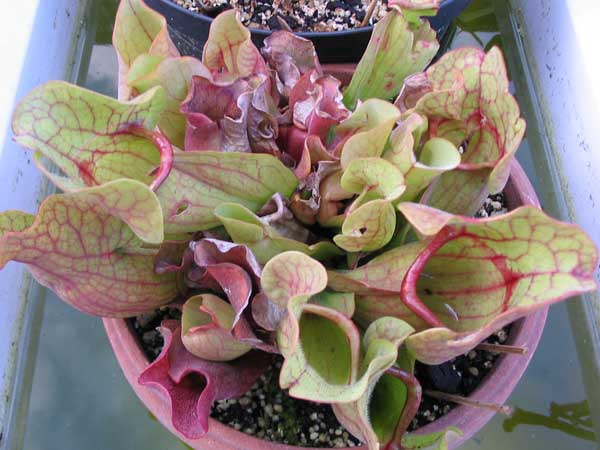
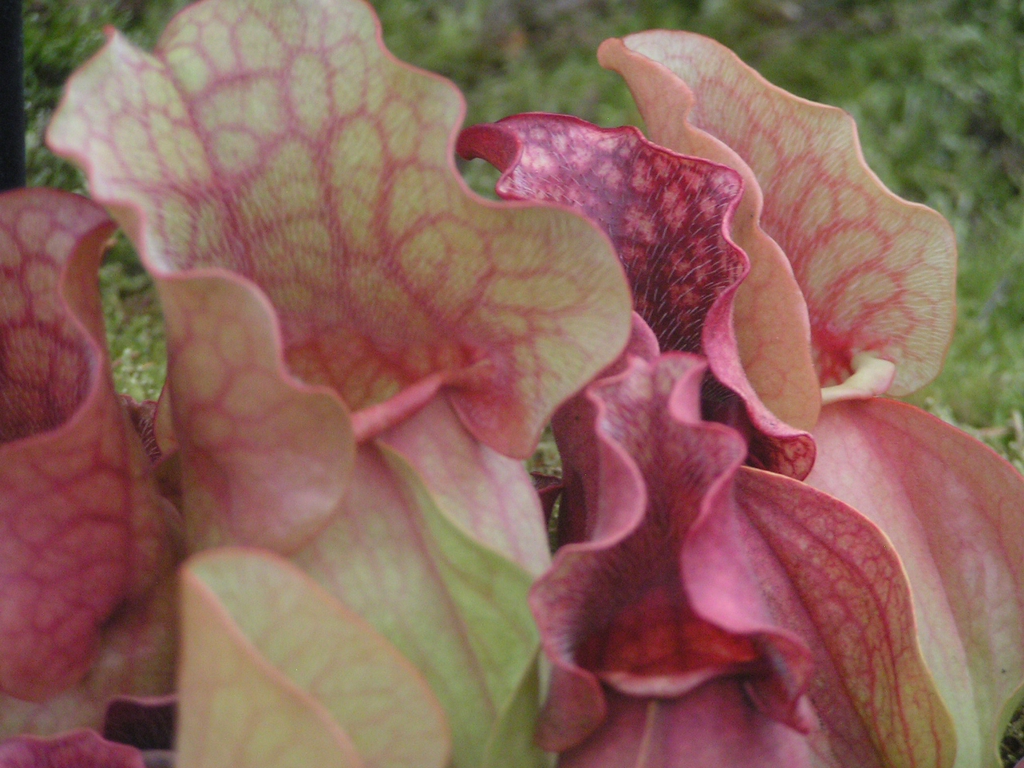
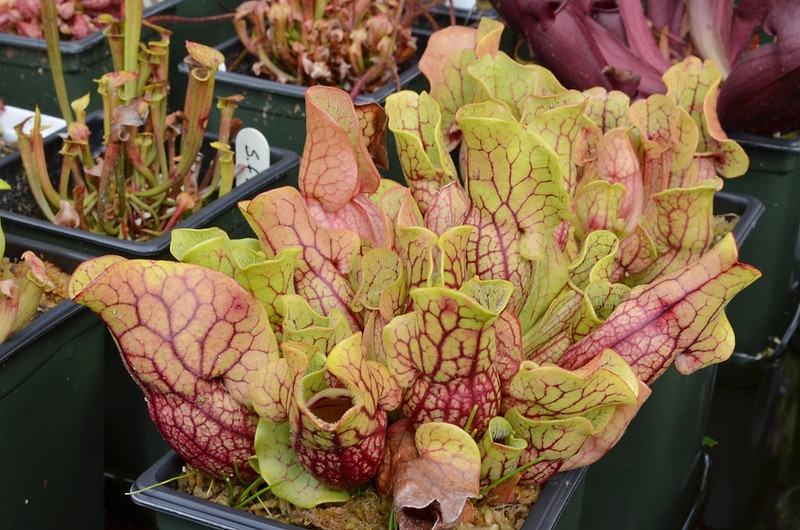
The southern pitcher plant is a subspecies of the purple pitcher plant (Sarracenia purpurea). It is a compact, carnivorous herbaceous perennial in the pitcher plant family (Sarraceniaceae). The southern pitcher plant is restricted to Virginia, the Carolinas and Georgia. The subspecific epithet is Latin and means “with veins,” likely referring to the colored veins in the lid (although the veins in this subspecies are not any more prominent than those of other pitcher plant species).
The southern pitcher plant has the same horticultural needs as the purple pitcher plant. It prefers full sun during the growing season and requires moist to wet, acidic soils of sand or sand and peat. Rainwater or distilled water must be used in place of tap water, as the plants are sensitive to minerals and chemicals in household water. The plants should not be fertilized, nor should it be “fed” insects or food. Allow the plant to trap its own food. This species can be grown in a container, but it must never be allowed to dry out.
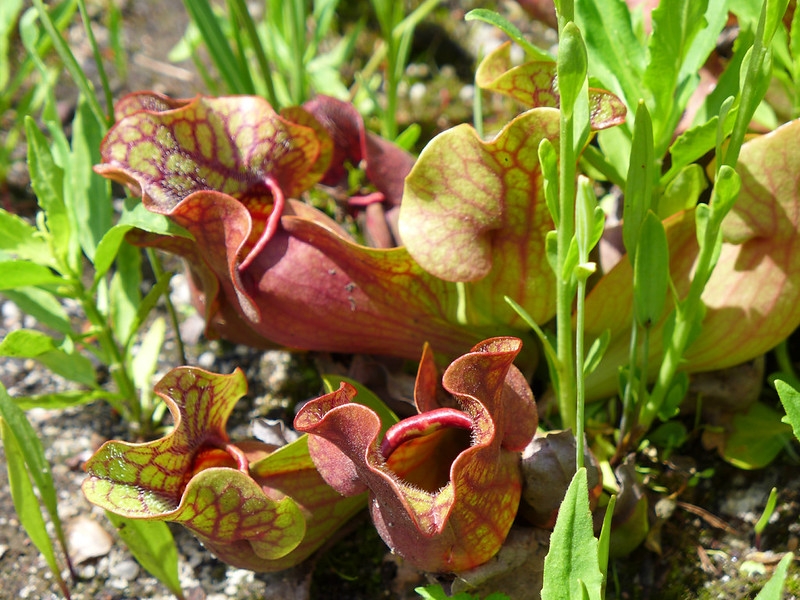
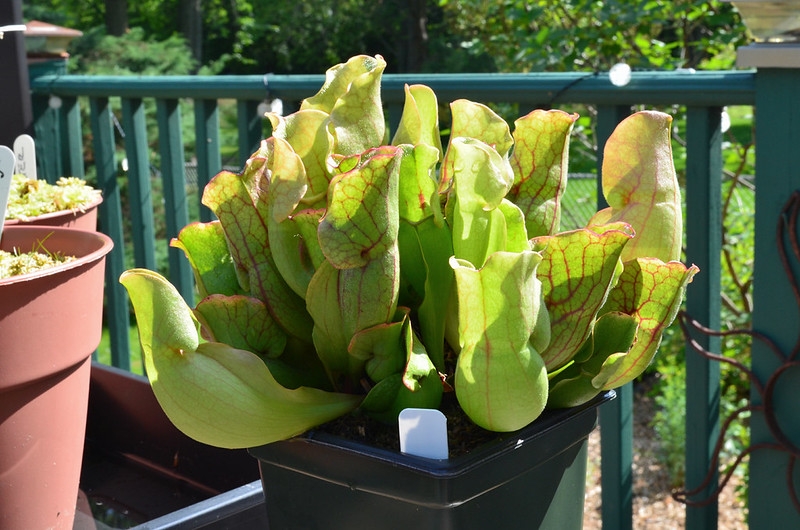
Like the purple pitcher plant, the southern pitcher plant has procumbent leaves that recline on the surface of the ground with the trap opening upward. In this species, the mouth is open to the sky, and the inside of the pitcher is lined with downward pointing hairs. The two differ in that the southern pitcher plant has pitchers that are more than three times longer than they are wide and the outer surface is covered with short, stiff hairs. The purple pitcher plant has smooth pitcher than are less than three times longer than they are wide. The southern pitcher plant grows in rosettes in moist, swampy soil that is usually high in sphagnum moss and acid and low in nutrients such as nitrogen. It can survive seasonal flooding. The root system consists of a short crown with shallow fibrous roots and slender rhizomes. Offsets from the rhizomes create small colonies of plants. The flowers are solitary, nodding and deep red. The fruit is a capsule with many small seeds. Seeds will germinate after a period of cold stratification. Like all pitcher plants, this species is protected in the wild. Never collect plants from the wild. They should be purchased from a reputable carnivorous plant nursery.
Southern pitcher plants are excellent additions to a carnivorous plant garden, rain or bog garden, or a pollinator garden. Like all carnivorous plants, they are great additions to a children’s garden.
Insects, Diseases and Other Plant Problems: Pitcher plants are generally not bothered by pests, but monitor for aphids, scale, mealybugs, moth larvae, leaf spots, and root rot.
VIDEO created by Andy Pulte for “Landscape Plant Identification, Taxonomy and Morphology” a plant identification course offered by the Department of Plant Sciences, University of Tennessee.
- Profile Video:
- See this plant in the following landscape :
- Cultivars / Varieties:
-
- Tags:


- Cultivars / Varieties:
-
- Tags:
-
-
Attributes:
- Genus:
- Sarracenia
- Species:
- purpurea
- Family:
- Sarraceniaceae
- Life Cycle:
- Perennial
- Recommended Propagation Strategy:
- Division
- Seed
- Country Or Region Of Origin:
- North Carolina to Georgia
- Distribution:
- Florida Panhandle and Louisiana
- Wildlife Value:
- A nectar source for insects. It is the host plant for the larvae of the epauletted pitcher plant moth (Exyra fax).
- Play Value:
- Attracts Pollinators
- Dimensions:
- Height: 0 ft. 6 in. - 1 ft. 4 in.
- Width: 1 ft. 0 in. - 2 ft. 0 in.
-
-
Whole Plant Traits:
- Plant Type:
- Carnivorous
- Herbaceous Perennial
- Native Plant
- Habit/Form:
- Clumping
- Prostrate
- Growth Rate:
- Medium
- Maintenance:
- High
-
-
Cultural Conditions:
- Light:
- Full sun (6 or more hours of direct sunlight a day)
- Partial Shade (Direct sunlight only part of the day, 2-6 hours)
- Soil Texture:
- Clay
- Loam (Silt)
- Sand
- Soil pH:
- Acid (<6.0)
- Soil Drainage:
- Frequent Standing Water
- Moist
- Occasionally Wet
- NC Region:
- Coastal
- Piedmont
- USDA Plant Hardiness Zone:
- 6a, 6b, 7a, 7b, 8a, 8b
-
-
Fruit:
- Fruit Color:
- Brown/Copper
- Display/Harvest Time:
- Summer
- Fruit Type:
- Capsule
- Fruit Description:
- Each flower is followed by a 5-parted seed capsule. Fruits are available June-July.
-
-
Flowers:
- Flower Color:
- Red/Burgundy
- Flower Inflorescence:
- Solitary
- Flower Value To Gardener:
- Fragrant
- Showy
- Flower Bloom Time:
- Spring
- Flower Shape:
- Star
- Flower Petals:
- 4-5 petals/rays
- Colored Sepals
- Flower Size:
- 1-3 inches
- Flower Description:
- Flowers are reddish-purple in color and bloom April-May. A single flower sits on a leafless, 8 to 15 inch stalk well above the leaves. Flower stalks are crooked at the top, and the globular, 5-petaled, 2 inch red flower hangs down. Flowers may be mildly aromatic.
-
-
Leaves:
- Leaf Color:
- Gold/Yellow
- Green
- Purple/Lavender
- Variegated
- Leaf Value To Gardener:
- Showy
- Deciduous Leaf Fall Color:
- Brown/Copper
- Leaf Type:
- Simple
- Hairs Present:
- No
- Leaf Length:
- > 6 inches
- Leaf Description:
- Modified leaves form a basal rosette of decumbent to upright 4 to 10 inch pitchers with upward-facing open ends and a layer of fine hairs on the outer surface. The length of the pitcher is typically less than three times the diameter of the opening. The pitcher color is usually green with purple-burgundy near the flared lip and a prominent net-like pattern of veins.
-
-
Stem:
- Stem Is Aromatic:
- No
- Stem Surface:
- Smooth (glabrous)
-
-
Landscape:
- Landscape Location:
- Container
- Pond
- Landscape Theme:
- Children's Garden
- Native Garden
- Pollinator Garden
- Water Garden
- Design Feature:
- Accent
- Specimen
- Attracts:
- Moths
- Pollinators
- Songbirds
- Resistance To Challenges:
- Heat



