


Narcissus pseudonarcissus
Common Name(s):
- Phonetic Spelling
- nar-SIS-us soo-doh-nar-SIS-us
- This plant has low severity poison characteristics.
- See below
- Description
-
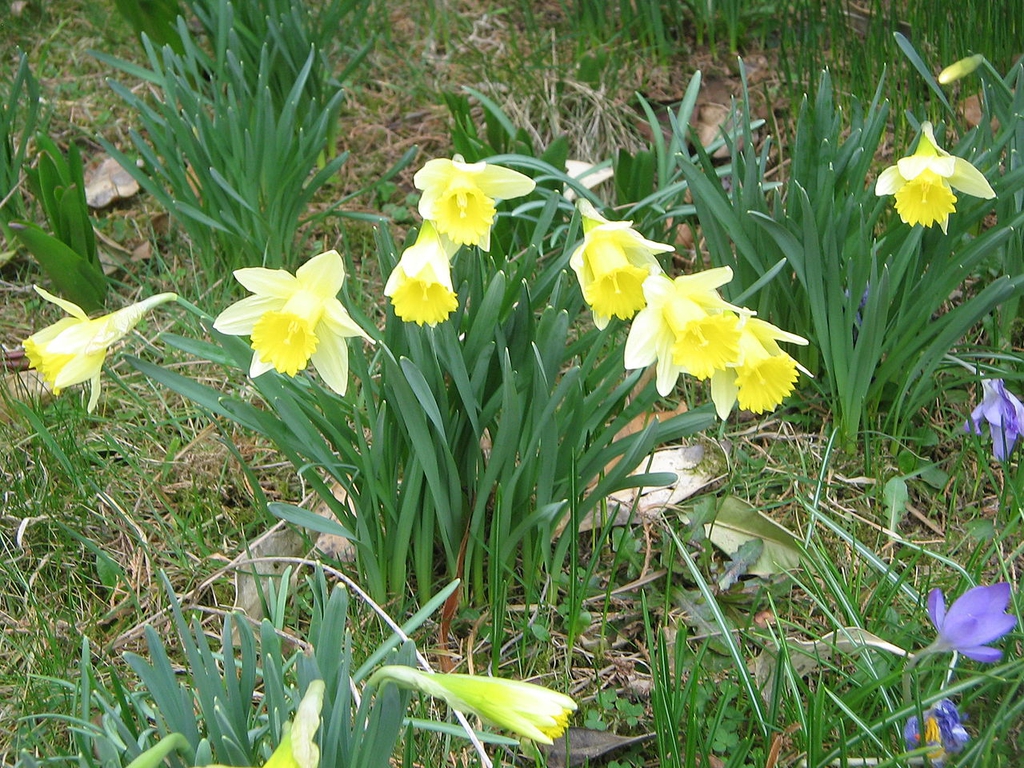
Trumpet Daffodil is a herbaceous perennial, flowering bulb in the onion family that grows up to 1 and 1/2 feet tall. This plant blooms in early spring with single flowers that have a corona tube as long as or longer than petal length, a distinguishing feature of this plant. It is a relatively slow growing plant, reaching maturity in 2 to 5 years.
Trumpet Daffodil does best in moist, well-draining, soil in full sun or partial shade. This plant is tolerant of heat and drought. It is intolerant of extremely wet conditions. It benefits from the addition of bone meal or superphosphate added to the planting hole.
This plant has a spreading habit and is good for naturalizing. Daffodils bloom year after year and are best planted in quantity in beds, borders, wild gardens, open woodland areas, in front of shrubs or massed under trees. Plant 6 weeks before the first freeze, 4 to 5 inches below the soil surface. Deadhead flowers to prevent seeding, but cut foliage back only after it has browned naturally.
Quick ID Hints:
- Corona (trumpet) is as long or longer than perianth segments
- 1 flower per stem
- Usually concolorous and yellow
Insects, Diseases, and Other Plant Problems:
This plant is pest and disease resistant due to poisonous alkaloids content. Watch for slugs, snails and bulb mites. Bulb rot can occur in wet soils.
VIDEO Created by Elisabeth Meyer for "Edibles, Bulbs, and Houseplants", a plant identification course developed in partnership with Longwood Gardens.
- Profile Video:
- See this plant in the following landscape s :
- Davidson County Extension Demonstration Garden Functional Foundation Landscape
- Cultivars / Varieties:
-
- 'February Gold'
Long trumpet and petals like cyclamen, 14 to 16 inches tall, early bloomer.
- 'February Gold'
- 'February Gold'
- Tags:


- Cultivars / Varieties:
-
- 'February Gold'
Long trumpet and petals like cyclamen, 14 to 16 inches tall, early bloomer.
- 'February Gold'
- 'February Gold'
- Tags:
-
-
Attributes:
- Genus:
- Narcissus
- Species:
- pseudonarcissus
- Family:
- Amaryllidaceae
- Uses (Ethnobotany):
- A yellow dye is obtained from the flowers.
- Life Cycle:
- Bulb
- Perennial
- Recommended Propagation Strategy:
- Division
- Country Or Region Of Origin:
- Western Europe
- Distribution:
- Eastern Canada and the United States south to Florida and west to Texas. Italy, Russia, Australia.
- Particularly Resistant To (Insects/Diseases/Other Problems):
- Resistant to pest and disease.
- Dimensions:
- Height: 1 ft. 0 in. - 1 ft. 6 in.
- Width: 0 ft. 9 in. - 1 ft. 0 in.
-
-
Whole Plant Traits:
- Plant Type:
- Bulb
- Herbaceous Perennial
- Habit/Form:
- Clumping
- Erect
- Spreading
- Growth Rate:
- Slow
- Maintenance:
- Low
-
-
Cultural Conditions:
- Light:
- Full sun (6 or more hours of direct sunlight a day)
- Partial Shade (Direct sunlight only part of the day, 2-6 hours)
- Soil Texture:
- Clay
- High Organic Matter
- Loam (Silt)
- Soil pH:
- Acid (<6.0)
- Neutral (6.0-8.0)
- Soil Drainage:
- Good Drainage
- Moist
- Available Space To Plant:
- Less than 12 inches
- USDA Plant Hardiness Zone:
- 4a, 4b, 5a, 5b, 6a, 6b, 7a, 7b, 8a, 8b
-
-
Flowers:
- Flower Color:
- Gold/Yellow
- Flower Inflorescence:
- Solitary
- Umbel
- Flower Value To Gardener:
- Showy
- Flower Bloom Time:
- Spring
- Flower Shape:
- Trumpet
- Flower Size:
- 3-6 inches
- Flower Description:
- Flowers are scapose, horiztonal to drooping or ascending, fragrant, up to 4" in diameter, and subtended by a one-valved, membranous spathe. Flowers have a perianth tubular base with 6 segments. Perianth segments are yellow or white, spreading, elliptic-oblong, entire, and .8-1.4". Corona is yellow or white, conspicuous, subentire to 6-lobes, and .6-1.7" in size.
-
-
Leaves:
- Leaf Color:
- Gray/Silver
- Green
- Leaf Shape:
- Linear
- Leaf Margin:
- Entire
- Hairs Present:
- No
- Leaf Width:
- < 1 inch
- Leaf Description:
- Leaves are upright, strap-like, basal, linear, entire, erect, glaucous, flat, and less than an inch wide.
-
-
Stem:
- Stem Is Aromatic:
- No
-
-
Landscape:
- Landscape Location:
- Lawn
- Naturalized Area
- Slope/Bank
- Design Feature:
- Border
- Mass Planting
- Small groups
- Resistance To Challenges:
- Deer
- Diseases
- Drought
- Heat
- Insect Pests
- Rabbits
- Problems:
- Problem for Cats
- Problem for Dogs
- Problem for Horses
-
-
Poisonous to Humans:
- Poison Severity:
- Low
- Poison Symptoms:
- Vomiting, salvation, diarrhea; large ingestions cause convulsions, low blood pressure, tremors, and cardiac arrhythmias. Bulbs are the most poisonous part
- Poison Toxic Principle:
- Lycorine and other alkaloids
- Causes Contact Dermatitis:
- No
- Poison Part:
- Flowers
- Leaves
- Roots