


Sweet False Chamomile Matricaria chamomilla
Other Common Name(s):
Previously known as:
- Chamomilla recutita
- Matricaria recutita
- Phonetic Spelling
- mah-trih-KAIR-ree-ah kam-oh-MIL-luh
- This plant has low severity poison characteristics.
- See below
- Description
-
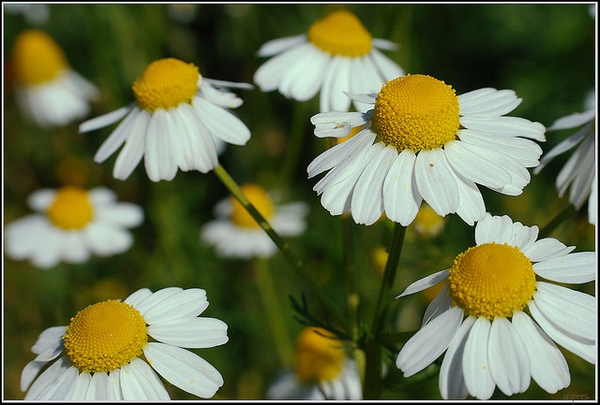
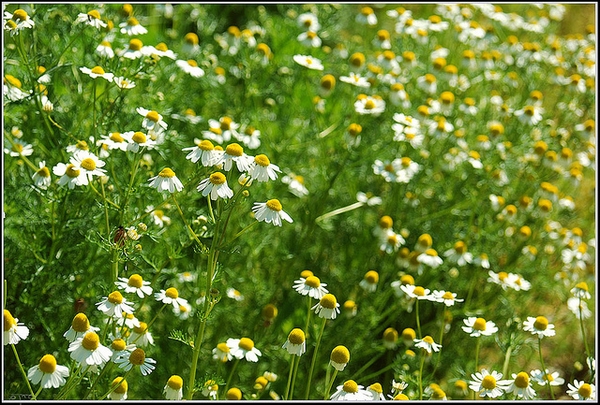
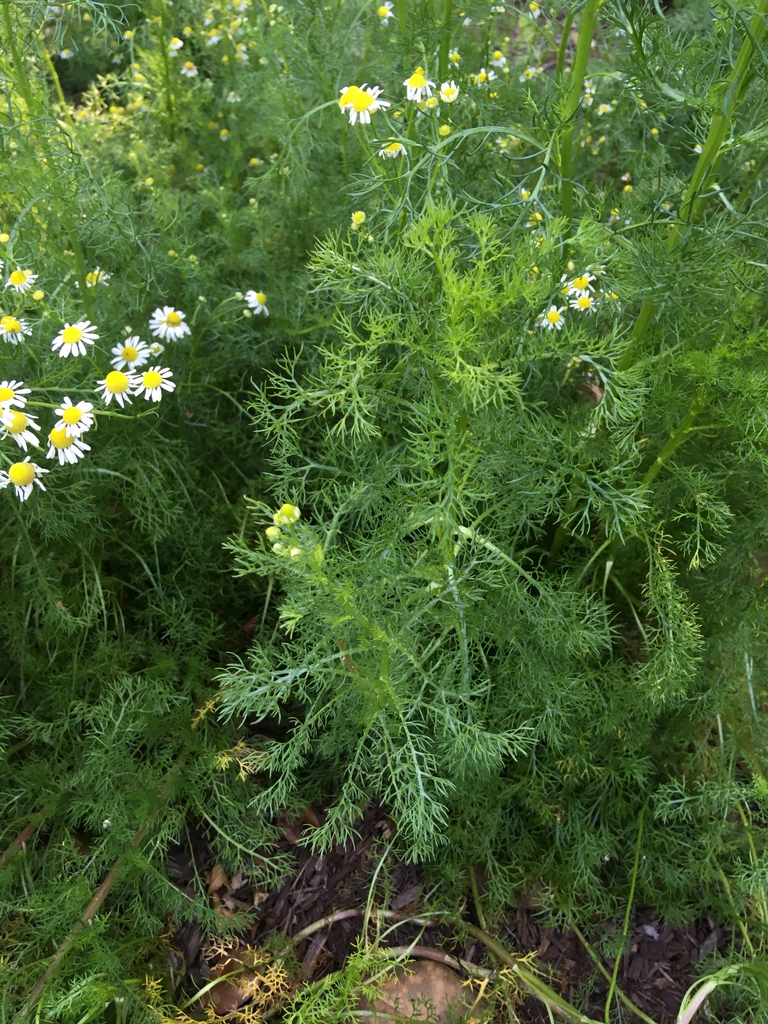
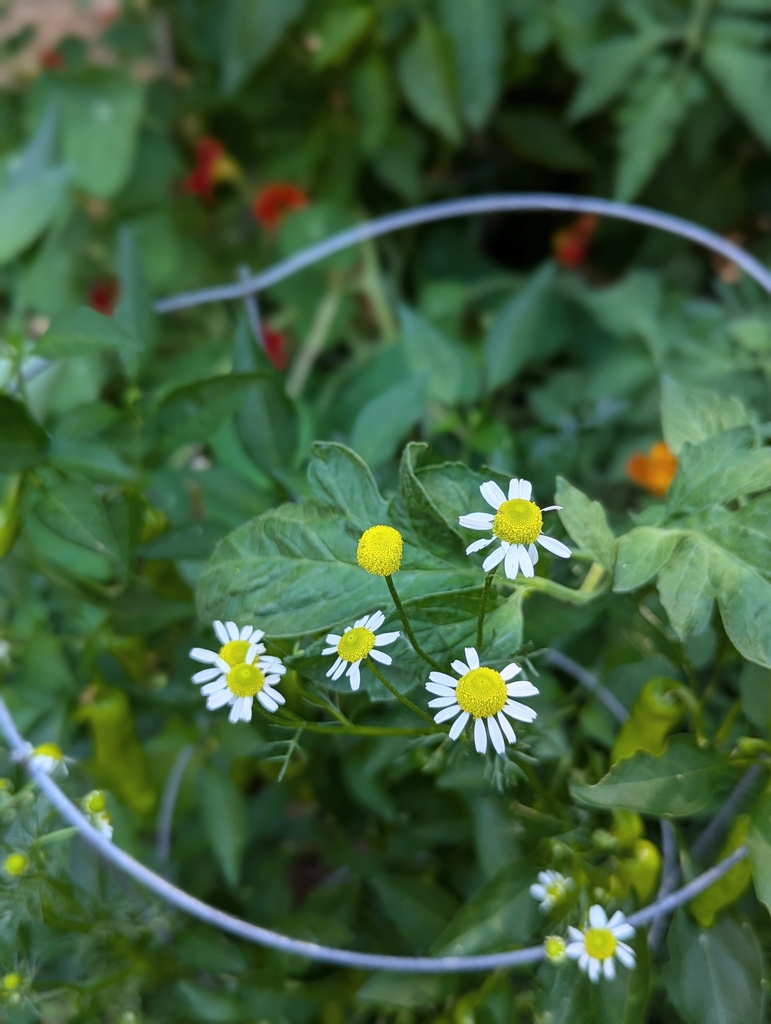
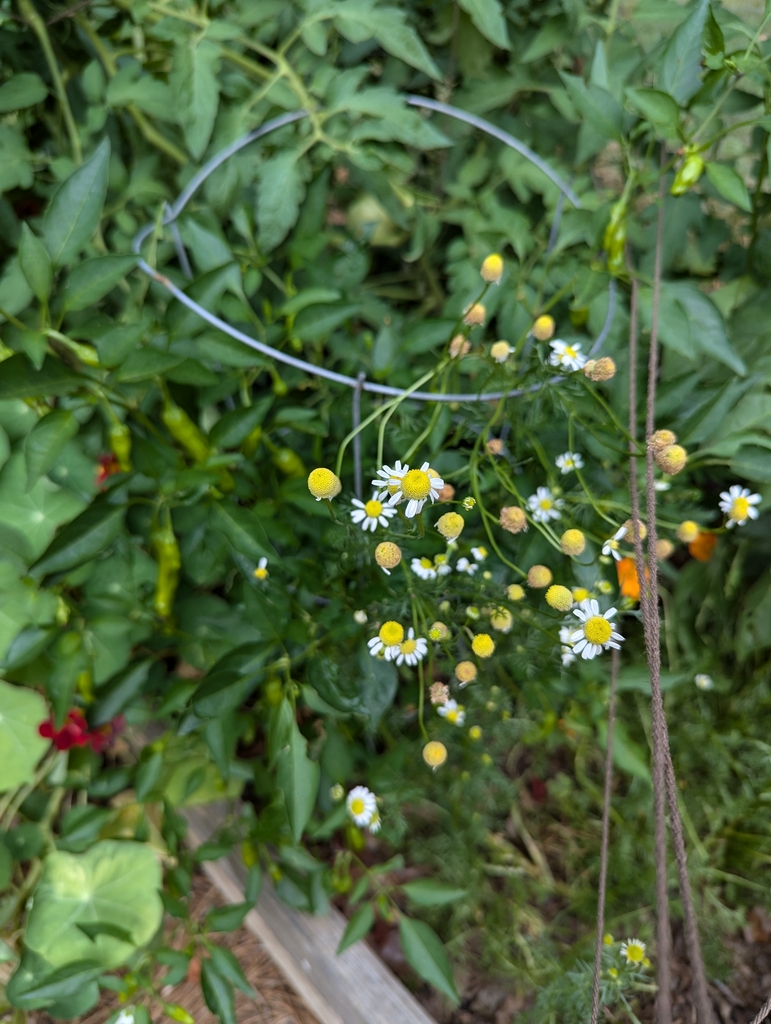
German chamomile is an annual herb in the daisy family (Asteraceae) native to Macaronesia, North Africa, and temperate Eurasia to Indo-China. It is found in disturbed areas, along roadsides, fields, and meadows. This plant produces erect, branched stems and grows up to 2 feet tall, with fragrant, bitter-tasting, long, narrow, finely divided leaves. Small, fragrant daisy-like flowers bloom from early to mid-summer. The blooms have white petal rays surrounding a golden yellow center disc of tubular florets. German chamomile is easily identified by its scented flowerheads, hollow center disc, and linear to filiform leaves. Its seeds ripen in late summer or early fall. This species is popular as an herbal tea. It is also a medicinal herb and an ornamental. The specific epithet chamomilla is derived from two Greek words meaning "earth apple" because of its apple-like fragrance.
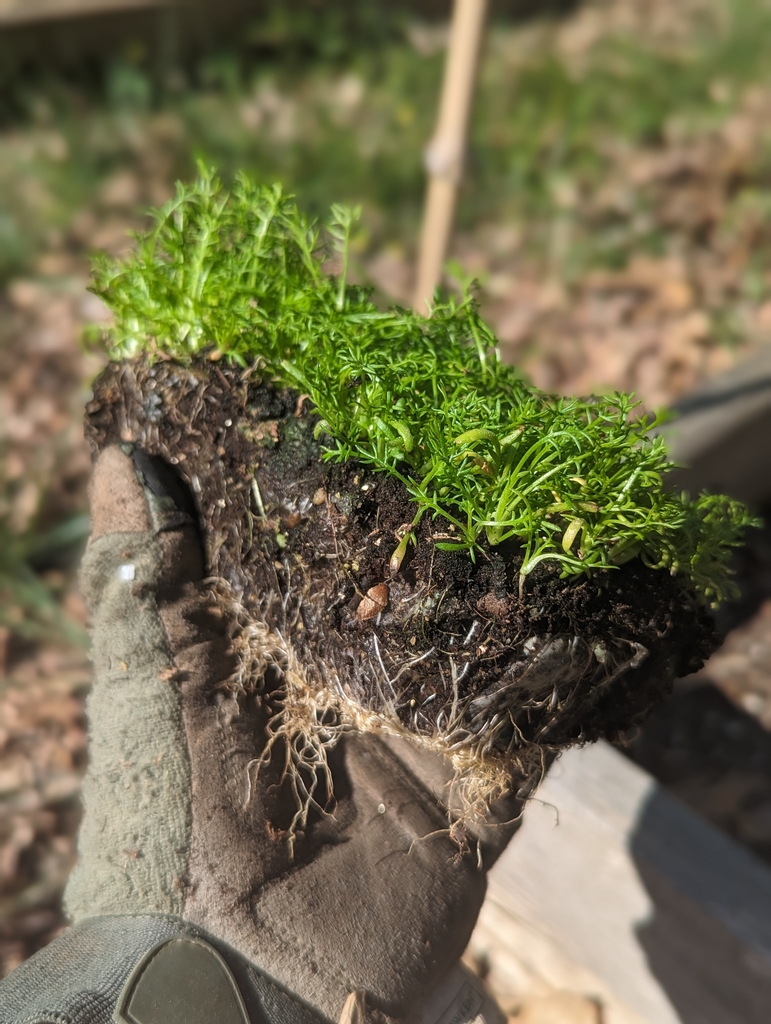
This plant thrives in full sun and moist to dry, well-drained, sandy, loamy soil, but it is best to avoid soils that are rich, heavy, or wet. It is poor-soil tolerant. German chamomile can be propagated from seeds, but tends not to transplant well. Best grown in individual containers indoors for 6 to 8 weeks before the last frost in spring. If planting outdoors, do so just before the last frost date.
The showy, aromatic flowers provide a long summer bloom season. This plant is best used for tea, potpourri, garnishes, and crafts. The tea has long been thought to provide a sedating effect, and it is more often used for tea than its cousin, Roman or English Chamomile.
Use it in an herb garden, in the crevices of a rock garden, or along a border front or walkway. Enjoy the fragrance by tucking this plant in a small space in your cottage garden or near a patio or seating area.
Insects, Diseases, and Other Plant Problems: No serious insect or disease problems. Monitor for aphids. May be susceptible to fungal diseases such as powdery mildew.
Allergic skin reactions or oral swelling can occur in those with ragweed allergies.
Toxic to dogs, cats, and horses.
VIDEO Created by Laura Barth for "Vegetables, Herbs, Fruits, and Nuts," a plant identification course developed in partnership with Longwood Gardens.
- Profile Video:
- See this plant in the following landscape :
- Cultivars / Varieties:
-
- Tags:



- Cultivars / Varieties:
-
- Tags:
-
-
Attributes:
- Genus:
- Matricaria
- Species:
- chamomilla
- Family:
- Asteraceae
- Uses (Ethnobotany):
- Used as a medicinal herb in Eastern and Southern Europe. It is an anti-inflammatory, antispasmodic, and antiseptic agent. The oil is used for perfumes, cosmetics, and aromatherapy.
- Life Cycle:
- Annual
- Recommended Propagation Strategy:
- Seed
- Country Or Region Of Origin:
- Macaronesia, North Africa, and temperate Eurasia to Indo-China
- Distribution:
- Native: Afghanistan, Albania, Algeria, Austria, Belarus, Belgium, Bulgaria, Central European Russia, China North-Central, China South-Central, China Southeast, Cyprus, Czechoslovakia, Denmark, East European Russia, Egypt, Finland, France, Germany, Greece, Hungary, Iran, Iraq, Italy, Kazakhstan, Korea, Lebanon-Syria, Manchuria, Mongolia, Morocco, Myanmar, Netherlands, North Caucasus, Northwest European Russia, Norway, Pakistan, Palestine, Portugal, Romania, Sinai, South European Russia, Spain, Sweden, Switzerland, Transcaucasus, Turkey, Ukraine, Uzbekistan, Vietnam, West Himalaya, West Siberia, Xinjiang, and Yakutiya. Introduced: Alberta, Bolivia, British Columbia, Colombia, Costa Rica, Cuba, Dominican Republic, Ecuador, El Salvador, Ethiopia, Great Britain, Greenland, Guatemala, Gulf States, Honduras, Ireland, Manitoba, Mexico Southeast, New South Wales, New Zealand North, New Zealand South, Newfoundland, Nicaragua, North European Russia, Nova Scotia, Ontario, Paraguay, Peru, Poland, Quebec, Saskatchewan, South Australia, Tasmania, Tunisia, Uruguay, and the United States-- AL, AZ, AR, CA, CT, DC, IL, IN, IA, KS, KY, ME, MD, MA, MI, MN, MS, MO, NJ, NY, ND, OH, OR, PA, RI, TN, TX, UT, VT, VA, WA, and WI;
- Wildlife Value:
- The flowers attract mostly bees and flies. Small butterflies, wasps, and beetles are seen less frequent.
- Play Value:
- Attractive Flowers
- Attracts Pollinators
- Colorful
- Easy to Grow
- Fragrance
- Edibility:
- Flowers for tea and other culinary uses.
- Dimensions:
- Height: 0 ft. 6 in. - 2 ft. 0 in.
- Width: 0 ft. 6 in. - 2 ft. 0 in.
-
-
Whole Plant Traits:
- Plant Type:
- Annual
- Herb
- Woody Plant Leaf Characteristics:
- Deciduous
- Habit/Form:
- Erect
- Mounding
- Growth Rate:
- Rapid
- Maintenance:
- Low
- Texture:
- Medium
-
-
Cultural Conditions:
- Light:
- Full sun (6 or more hours of direct sunlight a day)
- Soil Texture:
- Loam (Silt)
- Sand
- Soil pH:
- Acid (<6.0)
- Alkaline (>8.0)
- Neutral (6.0-8.0)
- Soil Drainage:
- Good Drainage
- Moist
- Occasionally Dry
- Available Space To Plant:
- Less than 12 inches
- NC Region:
- Coastal
- Mountains
- Piedmont
-
-
Fruit:
- Fruit Color:
- Brown/Copper
- Gray/Silver
- Display/Harvest Time:
- Fall
- Fruit Type:
- Achene
- Fruit Length:
- < 1 inch
- Fruit Width:
- < 1 inch
- Fruit Description:
- The center disc produces achenes, dry, grayish-brown to tan seeds with 5 white ribs. The seeds are cone-shaped to oblong and 1mm long.
-
-
Flowers:
- Flower Color:
- Gold/Yellow
- Green
- White
- Flower Inflorescence:
- Head
- Flower Value To Gardener:
- Edible
- Fragrant
- Good Dried
- Long Bloom Season
- Showy
- Flower Bloom Time:
- Fall
- Summer
- Flower Shape:
- Radial
- Flower Petals:
- 7 - 20 petals/rays
- Flower Size:
- < 1 inch
- Flower Description:
- Daisy-like flowers bloom from June to October. Each bloom measures 0.5 to 1 inch in diameter, with 10 to 25 white petal rays and a center disc of yellow to greenish-yellow florets. The center disc is initially button-shaped and becomes dome-like as the bloom matures. The base of the flower has 3 layers of green bracts.
-
-
Leaves:
- Woody Plant Leaf Characteristics:
- Deciduous
- Leaf Color:
- Green
- Leaf Value To Gardener:
- Fragrant
- Leaf Type:
- Compound (Pinnately , Bipinnately, Palmately)
- Leaf Arrangement:
- Alternate
- Leaf Shape:
- Filiform
- Linear
- Leaf Margin:
- Entire
- Hairs Present:
- No
- Leaf Length:
- 1-3 inches
- Leaf Width:
- < 1 inch
- Leaf Description:
- The green to dark green leaves are 0.5 to 3 inches long, alternate, and bipinnatifid. The leaf segments are linear to filiform, smooth, and feathery. The leaves are sparingly placed along the stem and may be sessile or have short petioles.
-
-
Stem:
- Stem Color:
- Green
- Purple/Lavender
- Stem Is Aromatic:
- No
- Stem Cross Section:
- Round
- Stem Surface:
- Smooth (glabrous)
- Stem Description:
- The stems are light green to purplish-green, erect to ascending, and occur in multiples (1 to 8). The upper stem is many-branched.
-
-
Landscape:
- Landscape Location:
- Container
- Meadow
- Patio
- Rock Wall
- Small Space
- Walkways
- Landscape Theme:
- Cottage Garden
- Edible Garden
- Rock Garden
- Design Feature:
- Border
- Problems:
- Contact Dermatitis
- Problem for Cats
- Problem for Dogs
- Problem for Horses