


Russet Witch Liparis liliifolia
Other Common Name(s):
- Phonetic Spelling
- lip-AR-iss lil-ih-FOH-lee-uh
- Description
-
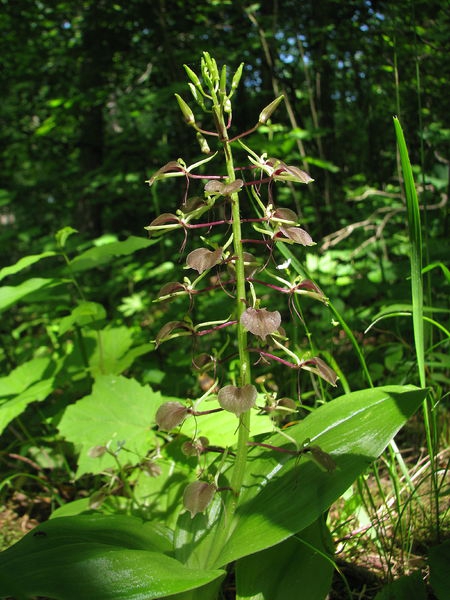
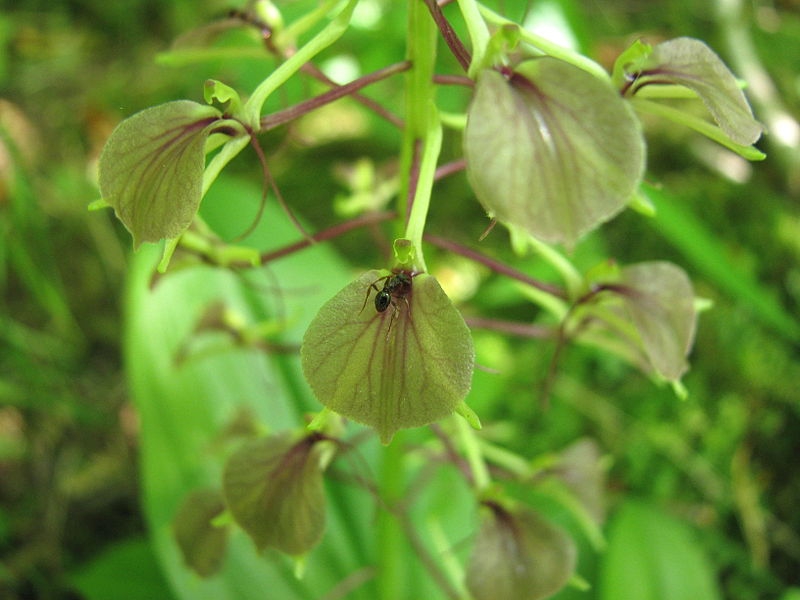
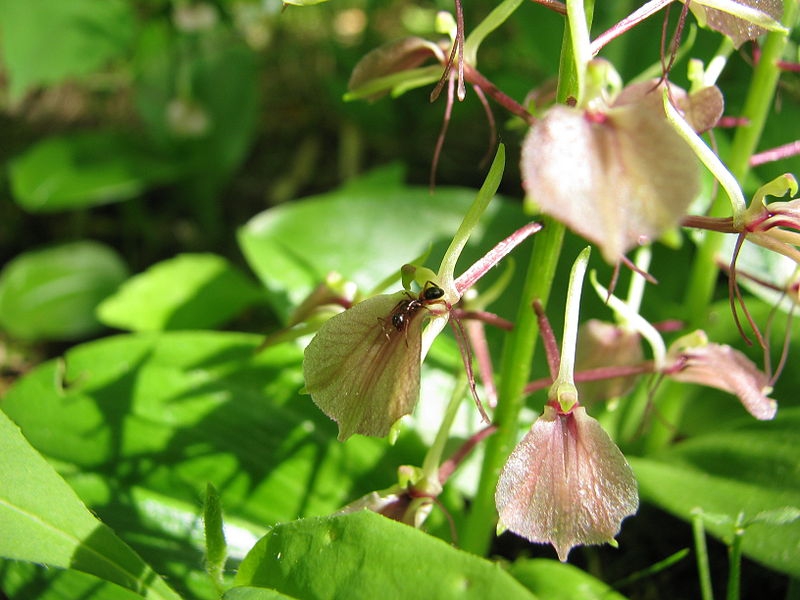
The Purple Twayblade is a flowering, perennial wildflower in the orchid family and native to Canada and the northern United States. While not common, it is native to North Carolina. It consists of a pair of basal leaves and a thin, reddish flowering stalk topped by a raceme of 5 to 30 brownish purple flowers The stout stem is hairless. The flowers are 3/4 to 1 inch across, each having 3 sepals and 3 petals on a short reproductive column. Two drooping lateral petals are pale purple in color and have a threadlike shape. The third petal is the lip of the flowers and is pale purple with faint purple veins. The genus name is from the greek, liparos, meaning fat or shining alluding to the greasy-looking leaves.
Purple Twayblade does best in partial sun to light shade with moist to dry well-drained soil. However, this orchid adapts to many soil types, including rich loam, sandy loam, glacial till, and thin rocky soil with a slightly acid pH. To germinate and grow, this plant's seeds require the presence of a strain of Rhizoctonia/Tulasnella fungus found across its range.
The basal leaves are browsed by both White-Tailed Deer and the Cottontail Rabbit.
Purple Twayblade can be found growing in moist forests, floodplains, and is common in North Carolina mountains, uncommon in the Piedmont, and rare in the Coastal Plain. It spreads through seeds transported by the wind. The root system is a bulbous corm with fibrous roots. A new corm develops adjacent to the old corm, from which future flowers and leaves are produced.
Insects, Diseases and Other Plant Problems:
It is listed as a vulnerable species in North Carolina and is not recommended for the home landscape.
- See this plant in the following landscape:
- Cultivars / Varieties:
-
- Tags:


- Cultivars / Varieties:
-
- Tags:
-
-
Attributes:
- Genus:
- Liparis
- Species:
- liliifolia
- Family:
- Orchidaceae
- Life Cycle:
- Perennial
- Recommended Propagation Strategy:
- Seed
- Country Or Region Of Origin:
- Canada, northeastern and north central United States.
- Distribution:
- Along the eastern coast of North America from Hudson Bay south to Georgia and west to Oklahoma and Michigan.
-
-
Whole Plant Traits:
- Plant Type:
- Bulb
- Epiphyte
- Herbaceous Perennial
- Native Plant
- Wildflower
- Habit/Form:
- Erect
- Growth Rate:
- Medium
- Maintenance:
- Low
- Texture:
- Coarse
-
-
Cultural Conditions:
- Light:
- Dappled Sunlight (Shade through upper canopy all day)
- Partial Shade (Direct sunlight only part of the day, 2-6 hours)
- Soil Texture:
- Loam (Silt)
- Sand
- Shallow Rocky
- Soil pH:
- Acid (<6.0)
- Neutral (6.0-8.0)
- Soil Drainage:
- Good Drainage
- Moist
- Occasionally Dry
- NC Region:
- Coastal
- Mountains
- Piedmont
- USDA Plant Hardiness Zone:
- 2a, 2b, 3a, 3b, 4a, 4b, 5a, 5b, 6a, 6b, 7a, 7b, 8a, 8b
-
-
Fruit:
- Display/Harvest Time:
- Fall
- Fruit Type:
- Capsule
- Fruit Description:
- Fertilized flowers produce seed capsules about ½ inch long. Individual capsules are erect on their pedicels; they are ellipsoid with several longitudinal veins. They split open to release numerous tiny seeds, which are distributed by the wind.
-
-
Flowers:
- Flower Color:
- Brown/Copper
- Gold/Yellow
- Flower Inflorescence:
- Raceme
- Flower Value To Gardener:
- Showy
- Flower Bloom Time:
- Spring
- Summer
- Flower Petals:
- 2-3 rays/petals
- Flower Size:
- < 1 inch
- Flower Description:
- Flowers bloom in the late spring through early summer. An erect raceme 4 to 10 inches tall bears 5 to 30 flowers. The central stem of the raceme is light green, hairless, and stout. Individual flowers ¾ to 1 inch across, consist of 3 sepals, 3 petals, and a short reproductive column. Each sepal a ½ inch long, greenish white, and linear in shape. The 2 lateral petals are a ½ inch long, pale purple, filiform (worm-like) in shape, and drooping. The lower petal is a ½ inch long, pale purple, obovate in shape with faint purple veins, and either flat or gently curved. The blooming period lasts 3 to 4 weeks for a colony of plants. The flowers bloom from the bottom of the raceme to its apex.
-
-
Leaves:
- Leaf Color:
- Green
- Leaf Feel:
- Rubbery
- Smooth
- Leaf Type:
- Simple
- Leaf Shape:
- Ovate
- Leaf Margin:
- Entire
- Hairs Present:
- No
- Leaf Length:
- 3-6 inches
- Leaf Width:
- 1-3 inches
- Leaf Description:
- The two green, shiny, smooth, oval-shaped basal leaves are slightly succulent, 3 to 6 inches long and one-half as much across and glabrous. The lower side of each basal leaf has a slight ridge, like the keel of a boat.
-
-
Stem:
- Stem Color:
- Green
- Stem Is Aromatic:
- No
- Stem Surface:
- Smooth (glabrous)
- Stem Description:
- The light green central stem is hairless.
-
-
Landscape:
- Landscape Location:
- Woodland
- Landscape Theme:
- Cottage Garden
- Native Garden
- Attracts:
- Small Mammals