



Red Ixora Ixora coccinea
Other Common Name(s):
Other plants called Red Ixora:
Previously known as:
- Pavetta coccinea
- Phonetic Spelling
- ik-ZOR-ah kock-SIN-ee-uh
- Description
-
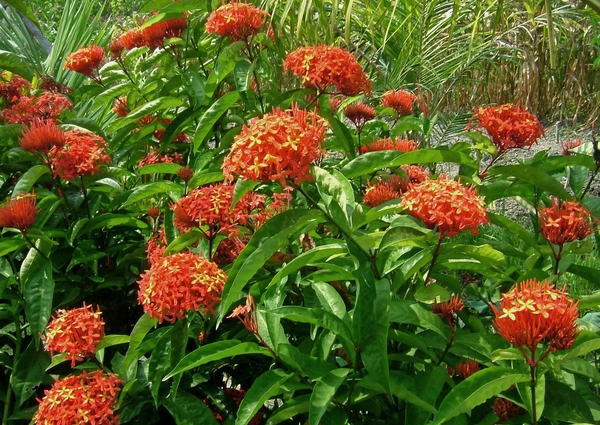
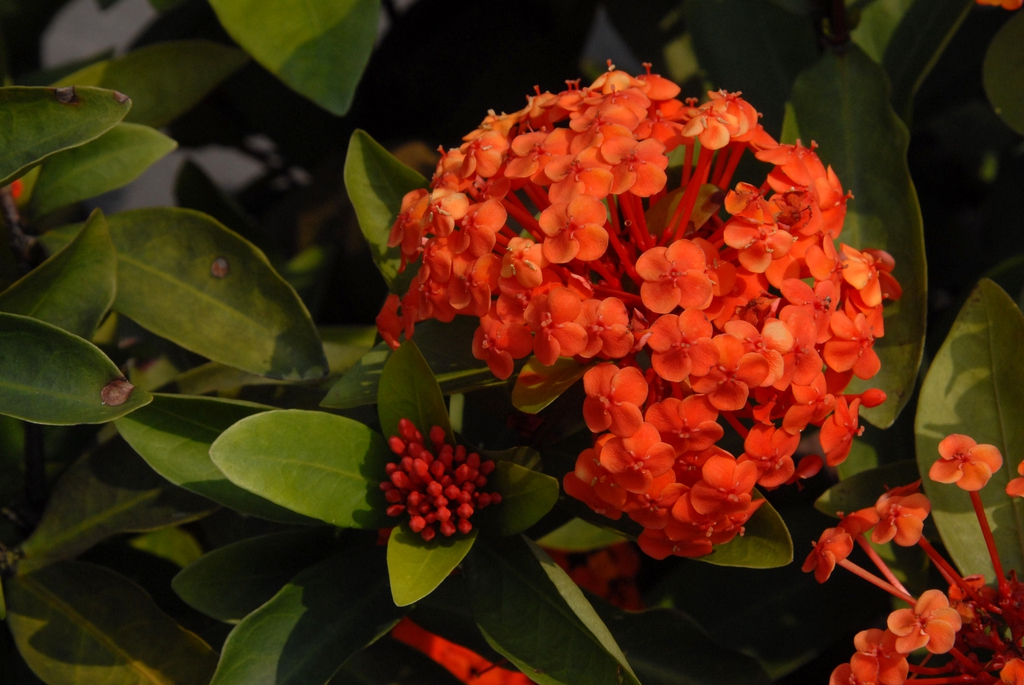
The jungle geranium is a tropical, flowering broadleaf evergreen shrub native to Western and Southern India, Sri Lanka, Bangladesh, and Indo-China. It is often seen growing in southern Florida. It grows 4 to 6 feet tall and 3 to 5 feet wide with a rounded, compact, multi-stemmed habit and has woody stems and leathery, dark green leaves. Its bright red tubular, 4-petaled flowers are borne on cymes, primarily during the summer months. Blooms also appear periodically throughout the year. Dark purple to black, round drupes appear after the flowers fade. It is a member of the coffee family (Rubiaceae). The genus name Ixora is New Latin and is derived from the Hindu word Ishvara, and derived from the Sanskrit word Isvara, meaning God, Supreme Being, ruler or lord. The specific epithet coccinea is Latin and means scarlet.
The jungle geranium prefers full sun in moist, well-drained, organically rich soils with an acidic pH. It can tolerate small amounts of afternoon shade. It is winter-hardy in zones 9 to 11 and is intolerant of temperatures below 50 degrees Fahrenheit. The shrub will die back in freezing temperatures and may regenerate in the spring. It may be grown in containers and brought indoors during the winter in colder climates; however, it may become susceptible to indoor plant problems such as scale, thrips, and mealybugs. Pruning may be required and is best done in late winter. Propagated by stem cuttings.
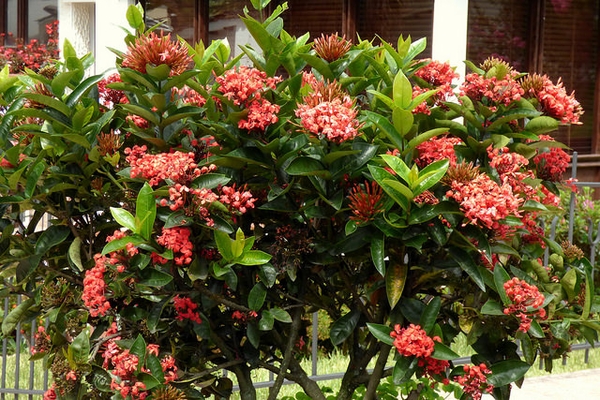
In a warm tropical climate, the jungle geranium may be used as foundation planting or a hedge. If grown indoors during the winter months as a container planting, it will require a bright sunny area.
Insects, Diseases, and Other Plant Problems: Aphids, thrips, scale, bagworms, nematodes, and mealybugs may be seen. Susceptible to sooty mold and mushroom root rot. Alkaline soils may cause chlorosis.
- See this plant in the following landscape :
- Cultivars / Varieties:
-
- 'Crimson King'
Bright red flowers - 'Fraseri'
Bright reddish-salmon colored blooms - Ixora coccinea var. caudata
Variety native to Vietnam - Ixora coccinea var. coccinea
Variety native to Western and South India, Sri Lanka, and Bangladesh to Indo-China - 'Nora Grant'
Large cultivar with hot pink flowers, very popular in Florida - 'Super King'
Larger cultivar with deep scarlet red flowers
- 'Crimson King'
- 'Crimson King', 'Fraseri', Ixora coccinea var. caudata, Ixora coccinea var. coccinea, 'Nora Grant', 'Super King'
- Tags:


- Cultivars / Varieties:
-
- 'Crimson King'
Bright red flowers - 'Fraseri'
Bright reddish-salmon colored blooms - Ixora coccinea var. caudata
Variety native to Vietnam - Ixora coccinea var. coccinea
Variety native to Western and South India, Sri Lanka, and Bangladesh to Indo-China - 'Nora Grant'
Large cultivar with hot pink flowers, very popular in Florida - 'Super King'
Larger cultivar with deep scarlet red flowers
- 'Crimson King'
- 'Crimson King', 'Fraseri', Ixora coccinea var. caudata, Ixora coccinea var. coccinea, 'Nora Grant', 'Super King'
- Tags:
-
-
Attributes:
- Genus:
- Ixora
- Species:
- coccinea
- Family:
- Rubiaceae
- Uses (Ethnobotany):
- In India, the flowers, leaves, roots, and stems are used in traditional and folk medicine. The plant is thought to have antioxidant, antibacterial, and anti-neoplastic properties. It is also thought to be gastric and hepatic-protective. The bark powder is used for treating burns and wounds.
- Life Cycle:
- Woody
- Recommended Propagation Strategy:
- Stem Cutting
- Country Or Region Of Origin:
- Western & South India, Sri Lanka, Bangladesh to Indo-China
- Distribution:
- Native: Bangladesh, Cambodia, India, Myanmar, Sri Lanka, Thailand, and Vietnam. Introduced: Andaman Island, Belize, Borneo, Caroline Island, Colombia, Comoros, Costa Rica, East Himalaya, El Salvador, Fiji, Gambia, Gilbert Island, Gulf of Guinea Island, Honduras, Malaya, Marianas, Marshall Islands, Mexico Southeast, Nicaragua, Panamá, Queensland, Senegal, and Western Australia.
- Wildlife Value:
- Attracts hummingbirds and butterflies.
- Play Value:
- Attractive Flowers
- Attracts Pollinators
- Colorful
- Edible fruit
- Screening
- Edibility:
- The ripened fruits are edible.
- Dimensions:
- Height: 4 ft. 0 in. - 6 ft. 0 in.
- Width: 3 ft. 0 in. - 5 ft. 0 in.
-
-
Whole Plant Traits:
- Plant Type:
- Shrub
- Woody Plant Leaf Characteristics:
- Broadleaf Evergreen
- Habit/Form:
- Multi-stemmed
- Rounded
- Growth Rate:
- Slow
- Maintenance:
- Low
- Texture:
- Medium
-
-
Cultural Conditions:
- Light:
- Full sun (6 or more hours of direct sunlight a day)
- Soil Texture:
- Loam (Silt)
- Soil pH:
- Acid (<6.0)
- Soil Drainage:
- Good Drainage
- Moist
- Available Space To Plant:
- 3 feet-6 feet
- USDA Plant Hardiness Zone:
- 9a, 9b, 10a, 10b, 11a, 11b
-
-
Fruit:
- Fruit Color:
- Black
- Purple/Lavender
- Fruit Value To Gardener:
- Edible
- Showy
- Display/Harvest Time:
- Fall
- Summer
- Fruit Type:
- Drupe
- Fruit Length:
- < 1 inch
- Fruit Width:
- < 1 inch
- Fruit Description:
- The fruits are round, fleshy, dark purple to black drupes, measuring less than 0.5 inches in diameter. They appear after flowering, usually late summer to late fall.
-
-
Flowers:
- Flower Color:
- Red/Burgundy
- Flower Inflorescence:
- Corymb
- Cyme
- Flower Value To Gardener:
- Showy
- Flower Bloom Time:
- Summer
- Flower Shape:
- Tubular
- Flower Petals:
- 4-5 petals/rays
- Flower Size:
- 1-3 inches
- Flower Description:
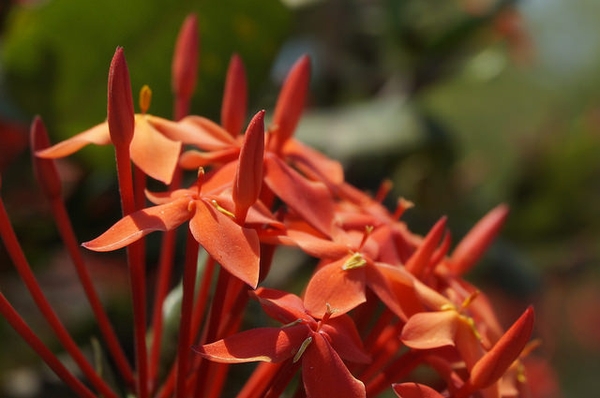
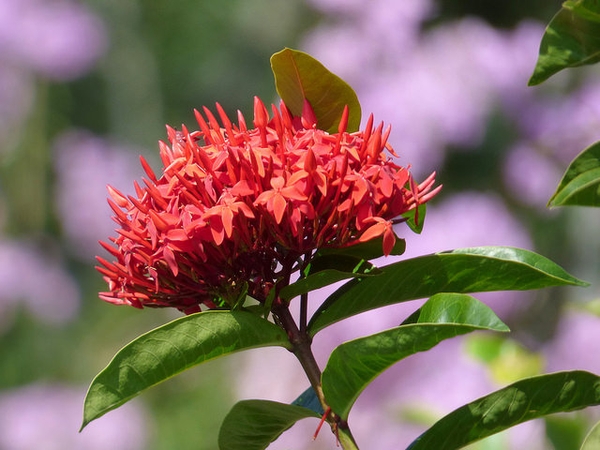
- The bright scarlet, red tubular, 4-petaled flowers appear in 4- to 6-inch clusters or corymb-like cymes at the end of the woody stems. The flowers are stalkless and are arranged in 8 to 15 pairs. Each bloom has 4 stamens at the throat of the flower tube, short filaments, and a protruding style.
-
-
Leaves:
- Woody Plant Leaf Characteristics:
- Broadleaf Evergreen
- Leaf Color:
- Green
- Leaf Feel:
- Glossy
- Leathery
- Leaf Type:
- Simple
- Leaf Arrangement:
- Opposite
- Leaf Shape:
- Elliptical
- Oblong
- Leaf Margin:
- Entire
- Hairs Present:
- No
- Leaf Length:
- 1-3 inches
- Leaf Width:
- 1-3 inches
- Leaf Description:
- The leaves are opposite, simple, dark green, glossy, leathery, elliptical to oblong, measuring 1.5 to 3 inches long and 0.5 to 2.25 inches wide, with entire margins. The leaves are usually stalkless and hairless. Young leaves are bronze colored, and then transition to dark green.
-
-
Bark:
- Bark Description:
- Woody
-
-
Stem:
- Stem Color:
- Red/Burgundy
- Stem Is Aromatic:
- No
- Stem Surface:
- Smooth (glabrous)
- Stem Description:
- The woody stems are hairless, reddish, and thin.
-
-
Landscape:
- Landscape Location:
- Container
- Landscape Theme:
- Winter Garden
- Design Feature:
- Foundation Planting
- Hedge
- Screen/Privacy
- Attracts:
- Bees
- Hummingbirds



