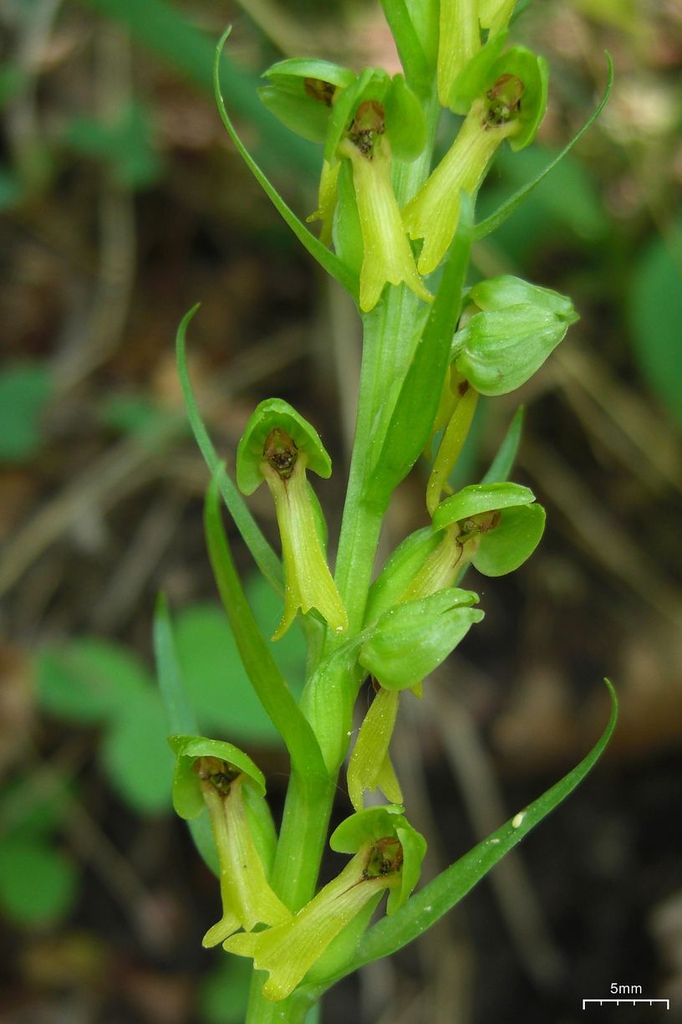


Dactylorhiza viridis var. virescens
Common Name(s):
Previously known as:
- Coeloglossum viride var. virescens
- Dactylorhiza viridis var. coreana
- Habenaria viridis var. bracteata
- Orchis virescens
- Phonetic Spelling
- dak-ty-lor-RY-zuh VEER-ih-diss veer-ES-enz
- Description
-
Long-bract frog orchid is an erect, native, flowering perennial found in the United States, Canada, China, Japan, and Korea. This orchid grows in coniferous and hardwood forests, tundra, prairies, meadows, thickets, coastal heaths, and bogs in shallow, moist areas that are wet in springtime. This plant grows 4 to 20 inches tall, has a smooth green stem and fleshy roots. Its leaves are green, obovate to lanceolate, and the flowers are displayed as green, spike-like, terminal racemes. It is a member of the orchid family (Orchidaceae). The genus name, Dactylorhiza, is derived from two Greek words: dactyl, meaning "finger," and rhiza, meaning "root." This refers to the plant's root system, which looks like finger-like tubers. The specific epithet, viridis, is Latin for "green." The variation name, virescens, means "becoming green."
Prefers partial shade, moist soils, and cool temperatures of coniferous forests. It is thrives in USDA Hardiness Zones 3 to 7, and may be found in the higher elevations of North Carolina.
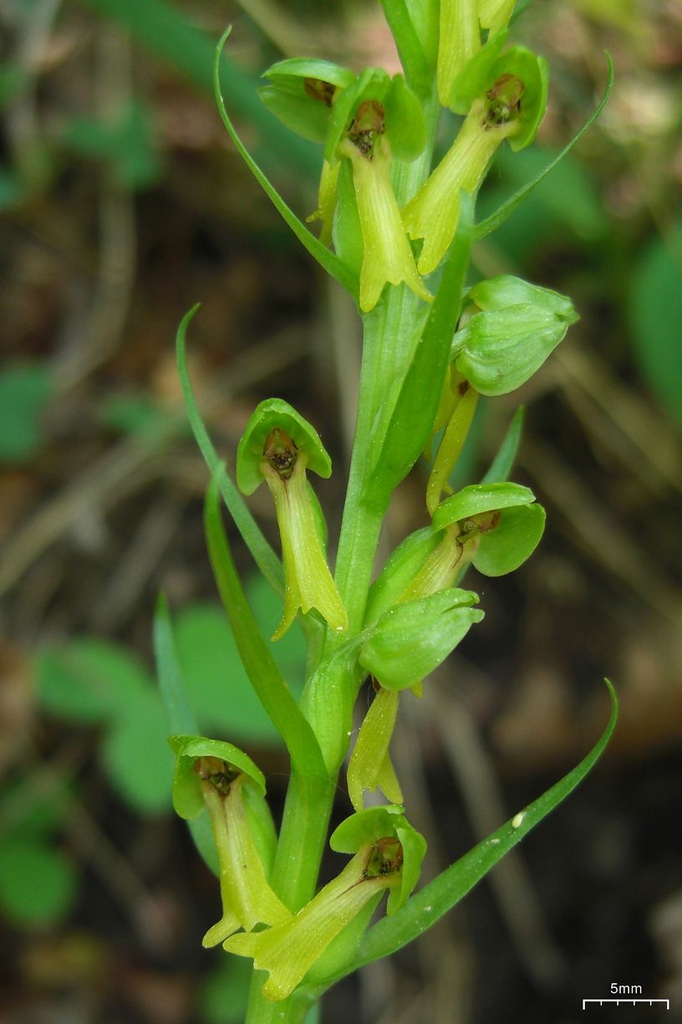
This is an unusual orchid, but it can be easily recognized by its long, green, sharp, pointed bracts at the base of each flower. Its flower also has a long, lower lip with a small central lobe and two other more prominent lobes, and a pouch-like spur at the base of the lower lip.
It is not recommended for home landscapes and is extremely rare in North Carolina. It is also reportedly rare in the Mid-Atlantic and Northeastern United States.
Insects, Diseases, and Other Plant Problems: Unknown
- See this plant in the following landscape :
- Cultivars / Varieties:
-
- Tags:

- Cultivars / Varieties:
-
- Tags:
-
-
Attributes:
- Genus:
- Dactylorhiza
- Species:
- viridis
- Family:
- Orchidaceae
- Uses (Ethnobotany):
- Used in traditional Chinese medicine.
- Life Cycle:
- Perennial
- Recommended Propagation Strategy:
- Seed
- Country Or Region Of Origin:
- Russian Far East to Japan, North America
- Distribution:
- Native--United States: AK, CO, CT, ID, IL, IN, IA, ME, MD, MA, MI, MN, MO, MT, NE, NH, NJ, NM, NY, NC, ND, OH, PA, RI, SD, TN, UT, VT, VA, WA, WV, WI, and WY. Canada: Alberta, British Columbia, Manitoba, New Brunswick, Newfoundland, Northwest Territories, Nova Scotia, Ontario, Prince Edward Island, Quebec, Saskatchewan, and Yukon. Aleutian Islands, China North-Central, Japan, Korea, Manchuria, and Primorye.
- Wildlife Value:
- This orchid is pollinated by wasps and small beetles.
-
-
Whole Plant Traits:
- Plant Type:
- Herbaceous Perennial
- Native Plant
- Wildflower
- Woody Plant Leaf Characteristics:
- Deciduous
-
-
Cultural Conditions:
- Light:
- Partial Shade (Direct sunlight only part of the day, 2-6 hours)
- Soil Texture:
- High Organic Matter
- Soil pH:
- Acid (<6.0)
- Alkaline (>8.0)
- Neutral (6.0-8.0)
- Soil Drainage:
- Frequent Standing Water
- Moist
- Occasionally Wet
- NC Region:
- Mountains
- USDA Plant Hardiness Zone:
- 3a, 3b, 4a, 4b, 5a, 5b, 6a, 6b, 7a, 7b
-
-
Fruit:
- Fruit Type:
- Capsule
- Fruit Length:
- < 1 inch
- Fruit Width:
- < 1 inch
- Fruit Description:
- The fruits are erect, oval, ribbed capsules, up to 0.5 inches by 0.25 inches in size.
-
-
Flowers:
- Flower Color:
- Gold/Yellow
- Green
- Flower Inflorescence:
- Raceme
- Spike
- Flower Bloom Time:
- Spring
- Summer
- Flower Shape:
- Lipped
- Flower Description:
- The flowers are green, but occasionally tinged with purple, red, or brown. They are displayed as spike-like, terminal racemes with many flowers. The flowers have upper and lateral sepals that form a hood, linear petals, an oblong lip, and a pouch-like spur. The flowers are 2/3 inches long. The leaf-like bracts are prominent and lanceolate to linear-shaped. Typically blooms from late spring to summer.
-
-
Leaves:
- Woody Plant Leaf Characteristics:
- Deciduous
- Leaf Color:
- Green
- Leaf Type:
- Simple
- Leaf Arrangement:
- Alternate
- Leaf Shape:
- Lanceolate
- Oblanceolate
- Obovate
- Ovate
- Leaf Margin:
- Entire
- Hairs Present:
- No
- Leaf Length:
- 3-6 inches
- Leaf Width:
- 1-3 inches
- Leaf Description:
- The green leaves are alternate, obovate to lanceolate, glabrous, measuring 2 to 5 inches long and 1.5 to 2.5 inches wide with entire margins. There are usually 2 to 6 leaves per stem. They are sessile, and the base of the leaf sheaths around the stem. The largest leaves occur along the middle of the stem, becoming smaller further up the stem.
-
-
Stem:
- Stem Color:
- Green
- Stem Is Aromatic:
- No
- Stem Surface:
- Smooth (glabrous)
- Stem Description:
- The stems are green, unbranched, and smooth.
-
-
Landscape:
- Landscape Location:
- Woodland
- Resistance To Challenges:
- Wet Soil