


Southeastern Tickseed Coreopsis gladiata
Other Common Name(s):
Previously known as:
- Bidens gladiata
- Coreopsis dichotoma
- Coreopsis helianthoides
- Coreopsis longifolia
- Coreopsis longifolia var. godfreyi
- Phonetic Spelling
- kor-ee-OP-sis glad-ee-AY-tuh
- Description
-
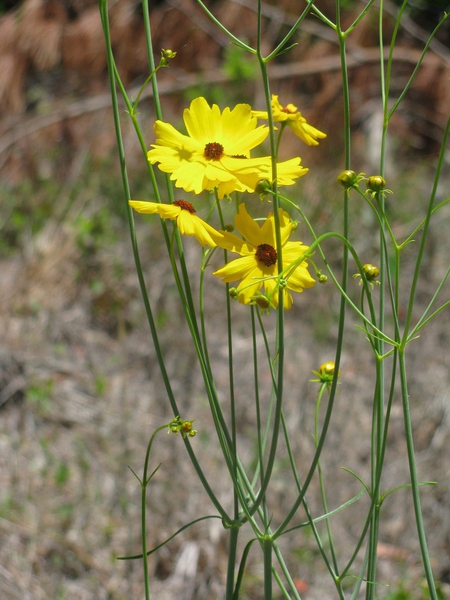
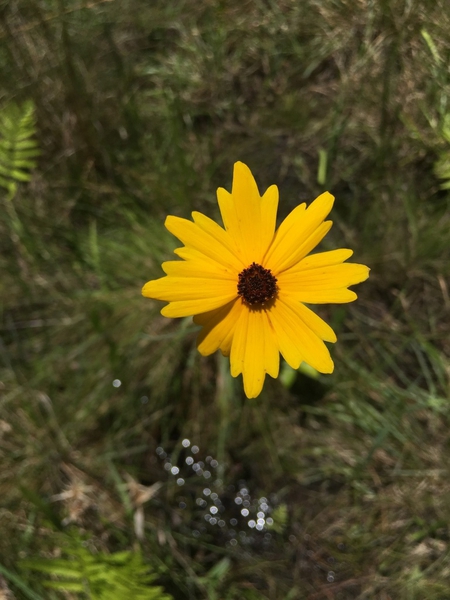
Coastal Plain tickseed is a herbaceous perennial wildflower of the Southeastern United States, and is found along the edge of swamps, floodplain forests, wet prairies, marshes, or ditches. In North Carolina, this plant has been found only in the sandhills in Hoke County. It was listed as significantly rare in 2024. It grows 2 to 2.5 feet tall and 1.5 to 2 feet wide in small clumps, and has a slender, erect, branching stem. The flowers appear in early September and consist of small, tubular centers of brown or maroon with yellow petal rays, attractive to butterflies, bees, and birds. It has both basal and cauline leaves that are medium green and elliptic to lanceolate. It is a member of the daisy family (Asteraceae). The genus name, Coreopsis, is derived from two Greek words: koris, meaning "bug," and opsis, meaning "like." This refers to the bug-like shape of the plant's seeds. The specific epithet, gladiata, means sword-shaped and refers to its leaves.
Prefers full sun to partial shade and moist to wet, sandy, acidic soils. It can tolerate brief periods of dry soil, but it is intolerant of salt spray.
The distinguishing feature of the Coastal Plain tickseed is its broad, elliptical leaves at the base and lower stem. Blooming occurs in the fall, while other species bloom in the spring or summer.
Coastal Plain tickseed seeds or plants are available for purchase in specialty nurseries in North Carolina or from native plant growers. Consider this species in your cottage garden or for naturalizing to add some bright yellow daisy-like flowers to your fall garden. Birds and small mammals will also appreciate the seeds produced.
Insects, Diseases, and Other Plant Problems: May be susceptible to aphids and spider mites. Monitor for powdery mildew, root rot, and crown rot. It can be damaged by browsing deer.
- See this plant in the following landscape :
- Cultivars / Varieties:
-
- Tags:


- Cultivars / Varieties:
-
- Tags:
-
-
Attributes:
- Genus:
- Coreopsis
- Species:
- gladiata
- Family:
- Asteraceae
- Life Cycle:
- Perennial
- Recommended Propagation Strategy:
- Seed
- Country Or Region Of Origin:
- Southeastern United States
- Distribution:
- Native: United States--AL, FL, GA, MS, NC, and SC. Introduced: Poland
- Fire Risk Rating:
- medium flammability
- Wildlife Value:
- Songbirds eat the seeds. Nectar from flowers favored by bees, butterflies and other pollinators.
- Dimensions:
- Height: 2 ft. 0 in. - 2 ft. 6 in.
- Width: 1 ft. 0 in. - 1 ft. 6 in.
-
-
Whole Plant Traits:
- Plant Type:
- Herbaceous Perennial
- Native Plant
- Wildflower
- Woody Plant Leaf Characteristics:
- Deciduous
- Habit/Form:
- Clumping
- Erect
- Texture:
- Medium
-
-
Cultural Conditions:
- Light:
- Full sun (6 or more hours of direct sunlight a day)
- Partial Shade (Direct sunlight only part of the day, 2-6 hours)
- Soil Texture:
- Sand
- Soil pH:
- Acid (<6.0)
- Soil Drainage:
- Good Drainage
- Moist
- Occasionally Wet
- Available Space To Plant:
- 12 inches-3 feet
- NC Region:
- Coastal
- Piedmont
- USDA Plant Hardiness Zone:
- 7a, 7b, 8a, 8b, 9a, 9b, 10a, 10b
-
-
Fruit:
- Fruit Color:
- Black
- Display/Harvest Time:
- Fall
- Fruit Type:
- Achene
- Fruit Description:
- The fruit is an obovate to oblong achene, measuring 3 to 4 mm, with lacerate wings and 2 short, barbed awns. Appears in the fall, from September to December.
-
-
Flowers:
- Flower Color:
- Gold/Yellow
- Flower Inflorescence:
- Head
- Flower Value To Gardener:
- Good Cut
- Showy
- Flower Bloom Time:
- Fall
- Flower Shape:
- Radial
- Flower Petals:
- 7 - 20 petals/rays
- Flower Size:
- 1-3 inches
- Flower Description:
- The flowers have small, tubular, brown or maroon central disc florets and bright yellow ray petals, notched at the ends. Flower measures 1.2 to 1.6 inches in diameter, and consists of 8 petal rays and 40 to 80 disc florets. Blooms from early September to early October.
-
-
Leaves:
- Woody Plant Leaf Characteristics:
- Deciduous
- Leaf Color:
- Green
- Leaf Feel:
- Glossy
- Leathery
- Leaf Type:
- Simple
- Leaf Arrangement:
- Alternate
- Opposite
- Leaf Shape:
- Elliptical
- Lanceolate
- Linear
- Leaf Margin:
- Entire
- Hairs Present:
- Yes
- Leaf Length:
- 1-3 inches
- Leaf Width:
- < 1 inch
- Leaf Description:
- The basal leaves are numerous, measuring 1.5 to 3 inches long and up to 0.5 inches wide, usually alternate, elliptic to lanceolate, and petiolate. The cauline leaves are fewer in number, measuring 3/8 to 1 5/8 inches long, usually opposite, linear, and sessile. The leaf is green with a thick, leathery texture.
-
-
Stem:
- Stem Color:
- Green
- Stem Is Aromatic:
- No
- Stem Form:
- Straight
- Stem Description:
- The stem is green, slender, erect, and branching.
-
-
Landscape:
- Landscape Location:
- Coastal
- Meadow
- Naturalized Area
- Pond
- Riparian
- Landscape Theme:
- Butterfly Garden
- Cottage Garden
- Cutting Garden
- Native Garden
- Pollinator Garden
- Water Garden
- Design Feature:
- Border
- Mass Planting
- Attracts:
- Butterflies
- Pollinators
- Songbirds
- Resistance To Challenges:
- Rabbits
- Wet Soil