


Sarracenia leucophylla
Common Name(s):
Previously known as:
- Sarracenia drummondii
- Phonetic Spelling
- sair-ah-SEEN-ee-ah loo-koh-FIL-uh
- Description
-
The whitetop pitcher plant is a rhizomatous, carnivorous herbaceous perennial native to Georgia, coastal Florida, Mississippi and Alabama. While not native to North Carolina, it has been introduced and has naturalized in the coastal plains. It is a member of the pitcher plant family (Sarraceniaceae). The species epithet is compounded from the Latin and means “white leaf.”
These plants require specific growing conditions but can be grown at home in a carefully prepared bog garden. They can also be grown in a container in 50/50 mixes of peat/sand or peat/perlite. Pitcher plants prefer full sun during the growing season. If grown in part shade, leaf coloring does not develop as it should and pitchers droop. This species tolerates more wetness than most other species of pitcher plant and must never be allowed to dry out. Commercial potting mixes and fertilizers can kill the plant and it is sensitive to dissolved salts. Rainwater or distilled water may be used in place of tap water for container plants. The pitcher plant goes dormant in the fall and dormancy continues until spring. The leaves will turn brown, but it is best to wait and remove the foliage in the spring just before the flowers emerge. Most reproduction comes from budding along the rhizome and the easiest propagation is by rhizome division. Plants can be grown from seed, but seedlings will not flower for the first 4 or 5 years.
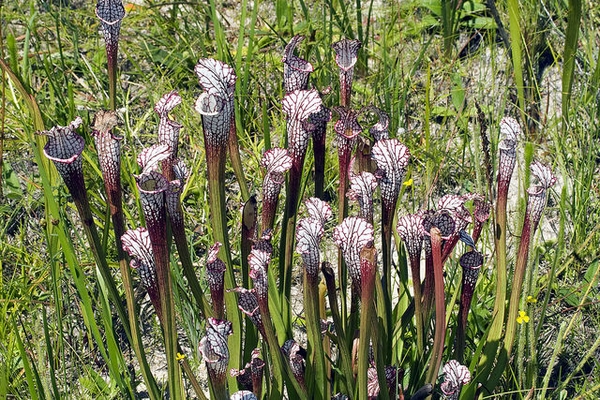
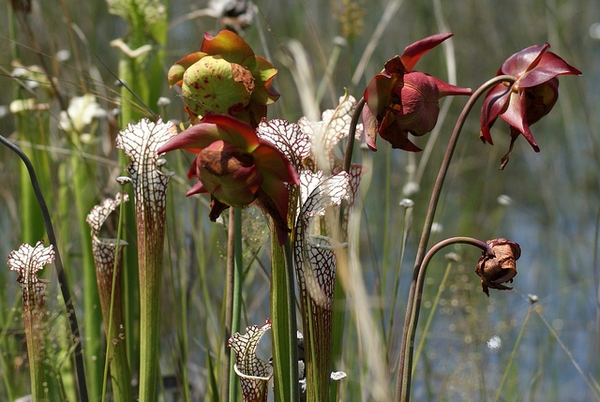
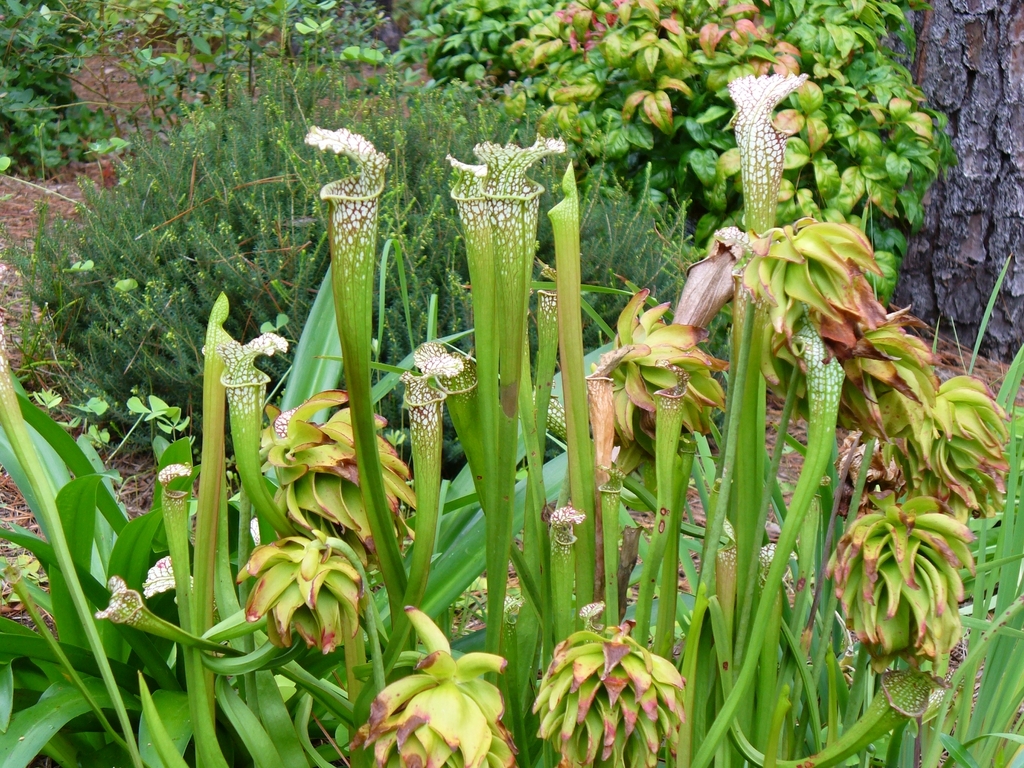
Whitetop pitcher plant grows in clumps in pine savannas. Showy flowers bloom in the spring, appearing as an upside-down umbrella on the top of a tall stalk. Bees pollinate the flowers. A seed pod forms and matures in autumn. A dry capsule will split open and release tiny seeds. The seeds are scattered and will germinate after a period of cold stratification.
Never harvest these plants from the wild. They are best purchased from a reputable carnivorous plant nursery. Whitetop pitcher plant is well suited to bog gardens, rain gardens, and children’s gardens. In a container, it can be the talking point for any garden. Florists have used cut leaves (pitchers) of the whitetop pitcher plant as accents in floral arrangements.
Quick ID Hints:
- clump-forming carnivorous plant found in swamps or bogs
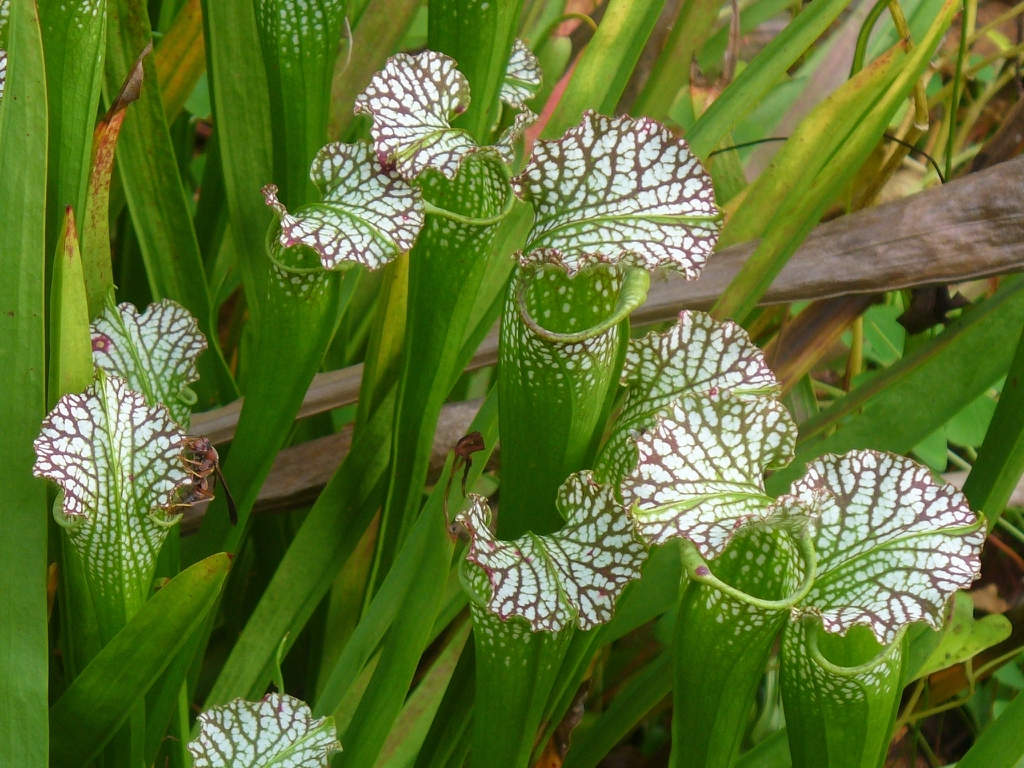
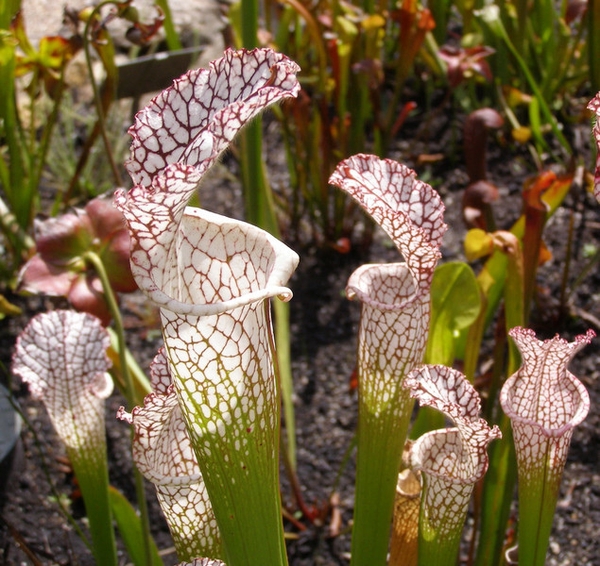
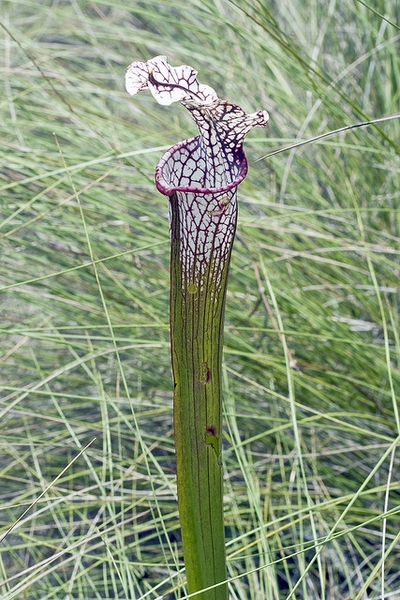
- tall, narrow, lidded pitchers the tops of which are white with green and/or red veins
Insects, Diseases, and Other Plant Problems: Monitor for aphids, scale, mealybugs, moth larvae, leaf spots, and root rot.
VIDEO created by Andy Pulte for “Landscape Plant Identification, Taxonomy and Morphology” a plant identification course offered by the Department of Plant Sciences, University of Tennessee.
- Profile Video:
- See this plant in the following landscape :
- Stanley Rehder Carnivorous Plant Garden in Wilmington
- Cultivars / Varieties:
-
- 'Hurricane Creek White'
Green veins turn red as the pitcher age. - 'Sumter'
Red-and-green venation; bright red flowers. - 'Tarnock'
Whorls of petals are multiplied. - 'Unstained Glass'
No trace of red venation in the pitcher. Just white and green.
- 'Hurricane Creek White'
- 'Hurricane Creek White', 'Sumter', 'Tarnock', 'Unstained Glass'
- Tags:


- Cultivars / Varieties:
-
- 'Hurricane Creek White'
Green veins turn red as the pitcher age. - 'Sumter'
Red-and-green venation; bright red flowers. - 'Tarnock'
Whorls of petals are multiplied. - 'Unstained Glass'
No trace of red venation in the pitcher. Just white and green.
- 'Hurricane Creek White'
- 'Hurricane Creek White', 'Sumter', 'Tarnock', 'Unstained Glass'
- Tags:
-
-
Attributes:
- Genus:
- Sarracenia
- Species:
- leucophylla
- Family:
- Sarraceniaceae
- Life Cycle:
- Perennial
- Recommended Propagation Strategy:
- Division
- Seed
- Country Or Region Of Origin:
- Georgia south to Florida and west to Mississippi.
- Distribution:
- North Carolina, Washington state
- Wildlife Value:
- Bees and other winged insects pollinate the flowers.
- Play Value:
- Attracts Pollinators
- Dimensions:
- Height: 1 ft. 0 in. - 3 ft. 0 in.
- Width: 1 ft. 0 in. - 3 ft. 0 in.
-
-
Whole Plant Traits:
- Plant Type:
- Carnivorous
- Herbaceous Perennial
- Habit/Form:
- Clumping
- Erect
- Maintenance:
- High
-
-
Cultural Conditions:
- Light:
- Full sun (6 or more hours of direct sunlight a day)
- Soil Texture:
- Loam (Silt)
- Sand
- Soil pH:
- Acid (<6.0)
- Soil Drainage:
- Moist
- Occasional Flooding
- Occasionally Wet
- Available Space To Plant:
- 12 inches-3 feet
- NC Region:
- Coastal
- USDA Plant Hardiness Zone:
- 6a, 6b, 7a, 7b, 8a, 8b, 9a, 9b
-
-
Fruit:
- Fruit Color:
- Brown/Copper
- Display/Harvest Time:
- Fall
- Fruit Type:
- Capsule
- Fruit Description:
- After the petals drop and if the ovary has been pollinated, it will begin to swell. The seed pod develops at the top of the flower. It takes 5 months for the seed pod to mature. It turns brown and then splits open to scatter the seeds. The dry 5-parted capsule contains pear-shaped seeds that are scattered and germinate after a period of cold weather.
-
-
Flowers:
- Flower Color:
- Red/Burgundy
- Flower Inflorescence:
- Solitary
- Flower Value To Gardener:
- Fragrant
- Showy
- Flower Bloom Time:
- Spring
- Flower Shape:
- Star
- Flower Size:
- 1-3 inches
- Flower Description:
- Nodding, red flower in April and May. The flowers are showy, solitary, and measure 2 to 3 inches in diameter. They look like upside-down umbrellas and grow on long stalks. They bloom before the first pitcher is formed. The stalks are taller than the pitchers so the pollinators can reach their blooms without getting trapped.
-
-
Leaves:
- Leaf Color:
- Green
- Purple/Lavender
- Red/Burgundy
- White
- Leaf Value To Gardener:
- Showy
- Deciduous Leaf Fall Color:
- Brown/Copper
- Leaf Type:
- Simple
- Leaf Arrangement:
- Alternate
- Hairs Present:
- No
- Leaf Length:
- > 6 inches
- Leaf Description:
- The 20 to 36 inch pitchers are erect, with white or translucent patches near the top. The flat hood is erect or ascending with a wavy edge. The lateral wing is not prominent. Each leaf is colored at top with reddish-purple veins on a white background. There are two crops of pitchers; one in the spring and a more robust crop in late summer.
-
-
Stem:
- Stem Is Aromatic:
- No
-
-
Landscape:
- Landscape Location:
- Container
- Pond
- Landscape Theme:
- Cutting Garden
- Rain Garden
- Water Garden
- Design Feature:
- Specimen
- Attracts:
- Bees
- Moths
- Pollinators