


Musa x paradisiaca
Common Name(s):
Previously known as:
- Musa paradisiaca
- Musa sapientum
- Phonetic Spelling
- MOO-sah par-ah-dee-see-AH-ka
- Description
-
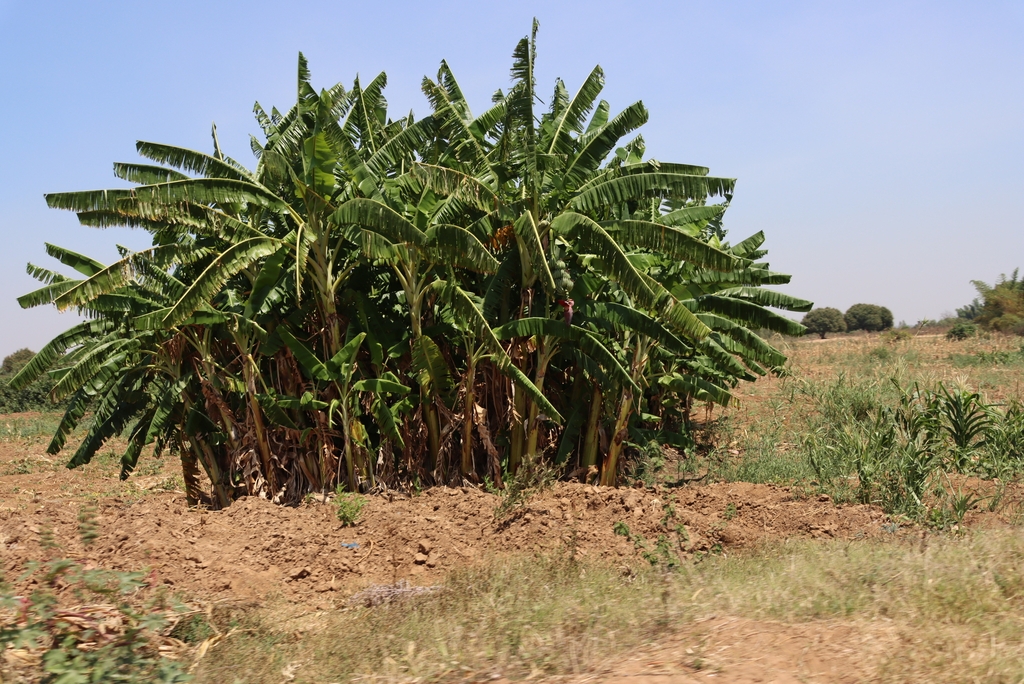
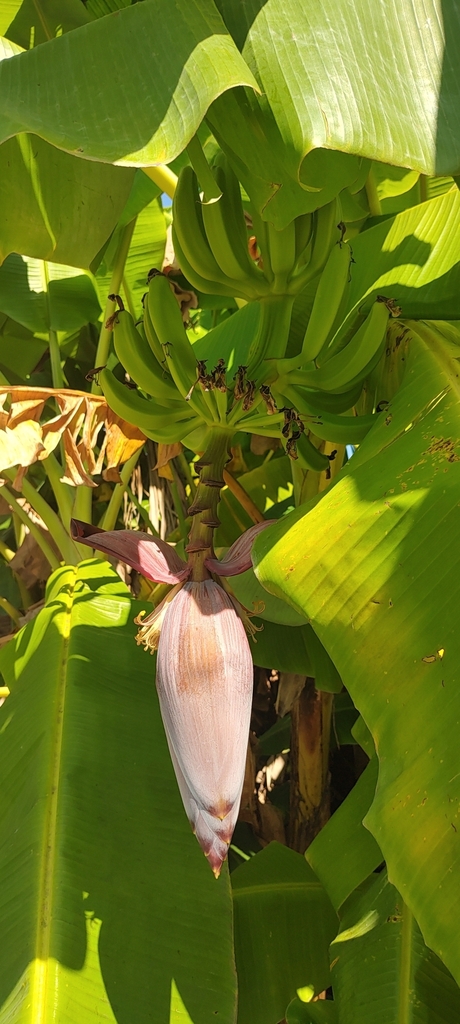
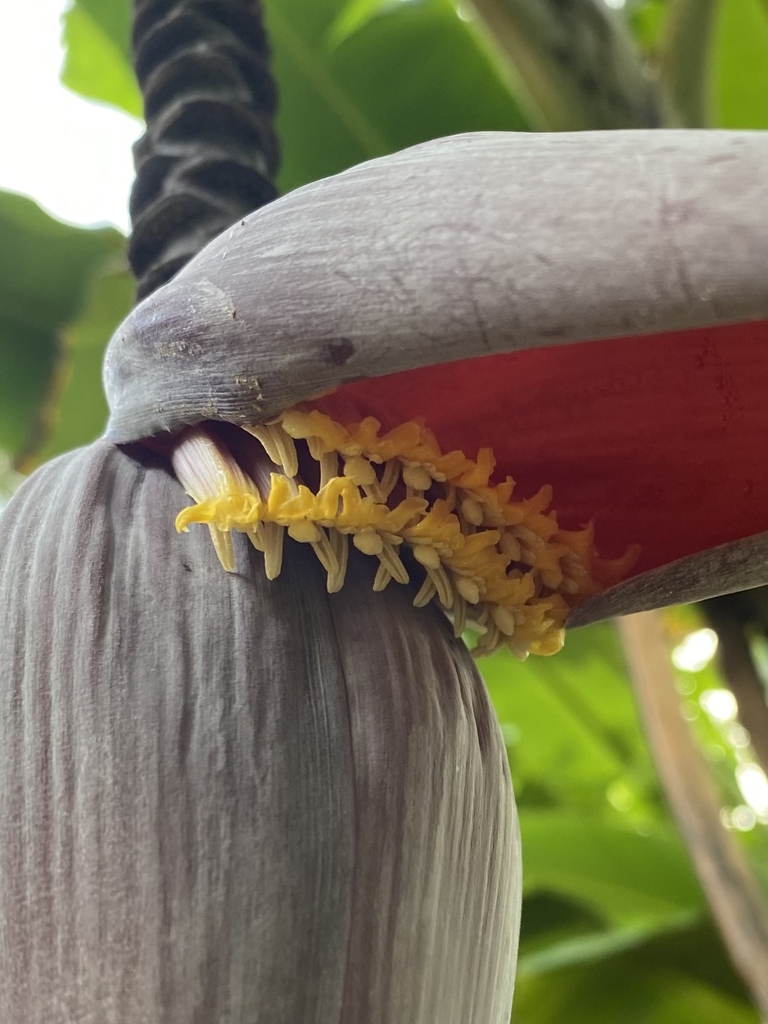
Edible Banana is a fast growing,suckering, herbaceous perennial tree, a member of the banana family (Musaceae), and a sterile hybrid of M. acuminata and M. balbisiana. It is a tropical plant cultivated in warm climates for its tasty yellow-skinned fruit, commonly called French plantains. In addition to the fruit, the plant produces large (8 foot) leaves and yellow flowers with attractive lavender bracts.The genus name honors Antonia Musa, Roman physician of the 1st century B.C. The species epithet means "of the paradise or of the pleasure garden."
Edible Banana is not winter hardy, but it can be grown outdoors with the condition that it be dug up and brought indoors at first frost. More typically, it is grown in greenhouses or containers that are brought indoors. Its relatively small size makes it useful as a houseplant. If grown outdoors, plant Edible Banana in organically rich, medium moisture, well-drained soil in full sun. Use a site with part shade or light filtered sun in the heat of the day and protected from winds that can damage the leaves. Keep the soil moist and fertilize plants regularly during the growing season. If grown in containers, use a well-drained potting soil mix kept consistently moist. When brought indoors, place containers in a large sunny room with reduced water and fertilization. Alternatively, you can cut foliage back to 6 or 8 inches and store the container in a cool, dark, frost-free locaton.
Young plants often will not flower and fruit until well established and container plants cut close to the ground in fall each year may never flower. Also, after flowering and fruiting, the pseudostem formed by the leaves dies, but suckers will form new pseudostems.
While this species does include some dessert bananas, it mostly contains cultivars of starchy cooking bananas and plantains. Many of these cultivars are available in commerce, ranging in height from 7 to 25 feet tall.
Diseases, Insect Pests, and Other Plant Problems:
No serious insect or disease problems. If grown in a greenhouse, watch for aphids, mealybugs, moths, scale, thrips, fruit flies and spider mites. Susceptible to anthracnose, wilt and mosaic virus.
- See this plant in the following landscape :
- Cultivars / Varieties:
-
- Tags:


- Cultivars / Varieties:
-
- Tags:
-
-
Attributes:
- Genus:
- Musa
- Species:
- x paradisiaca
- Family:
- Musaceae
- Life Cycle:
- Perennial
- Recommended Propagation Strategy:
- Division
- Country Or Region Of Origin:
- Malesia
- Distribution:
- Southeast Asia, India, Central America, Peru, Florida
- Wildlife Value:
- Attracts wildlife.
- Edibility:
- The fruits can be eaten raw or cooked. Flowers are used as ingredient in curries.
- Dimensions:
- Height: 7 ft. 0 in. - 25 ft. 0 in.
- Width: 6 ft. 0 in. - 10 ft. 0 in.
-
-
Whole Plant Traits:
- Plant Type:
- Edible
- Herbaceous Perennial
- Houseplant
- Tree
- Woody Plant Leaf Characteristics:
- Broadleaf Evergreen
- Habit/Form:
- Spreading
- Growth Rate:
- Slow
- Maintenance:
- High
-
-
Cultural Conditions:
- Light:
- Full sun (6 or more hours of direct sunlight a day)
- Soil Texture:
- High Organic Matter
- Loam (Silt)
- Sand
- Soil pH:
- Acid (<6.0)
- Alkaline (>8.0)
- Neutral (6.0-8.0)
- Soil Drainage:
- Good Drainage
- Moist
- Available Space To Plant:
- 12-24 feet
- USDA Plant Hardiness Zone:
- 9a, 9b, 10a, 10b, 11a, 11b
-
-
Fruit:
- Fruit Color:
- Black
- Brown/Copper
- Gold/Yellow
- Green
- Fruit Value To Gardener:
- Edible
- Showy
- Display/Harvest Time:
- Fall
- Fruit Type:
- Berry
- Fruit Length:
- > 3 inches
- Fruit Width:
- 1-3 inches
- Fruit Description:
- An elongated fruit with a thick peel. Tends to be starchier than more commonly known bananas.
-
-
Flowers:
- Flower Color:
- Gold/Yellow
- Purple/Lavender
- Flower Inflorescence:
- Spike
- Flower Value To Gardener:
- Showy
- Flower Bloom Time:
- Summer
- Flower Shape:
- Tubular
- Flower Petals:
- Bracts
- Flower Size:
- > 6 inches
- Flower Description:
- Large hanging cluster of yellow flowers with purple-red bracts appear in summer on mature plants.
-
-
Leaves:
- Woody Plant Leaf Characteristics:
- Broadleaf Evergreen
- Leaf Color:
- Green
- Purple/Lavender
- Leaf Feel:
- Smooth
- Leaf Value To Gardener:
- Showy
- Leaf Type:
- Sheath
- Leaf Shape:
- Oblong
- Spatulate
- Hairs Present:
- No
- Leaf Length:
- > 6 inches
- Leaf Width:
- > 6 inches
- Leaf Description:
- Oblong to paddle-shaped leaves up to 8 feet long with leaf sheaths that overlap to form a trunk-like pseudostem (false stem).
-
-
Stem:
- Stem Is Aromatic:
- No
-
-
Landscape:
- Landscape Location:
- Container
- Houseplants
- Lawn
- Landscape Theme:
- Edible Garden
- Design Feature:
- Accent
- Flowering Tree
- Specimen
- Attracts:
- Pollinators
- Songbirds