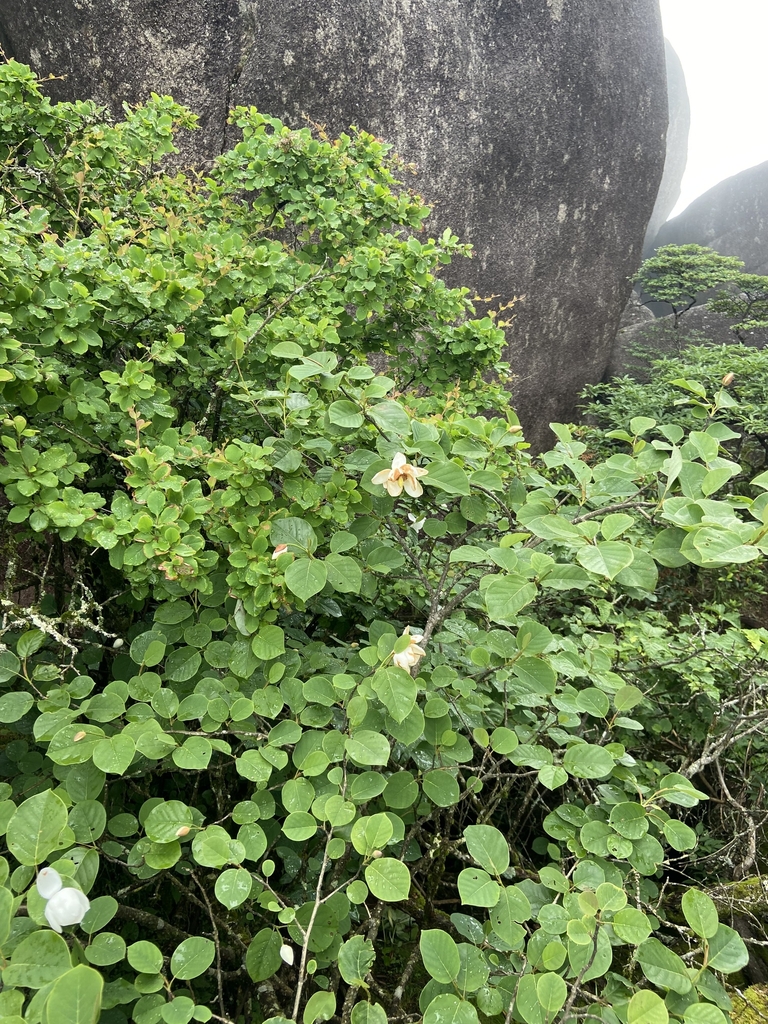
Magnolia sieboldii
Previously known as:
- Magnolia parviflora
- Phonetic Spelling
- mag-NO-lee-ah see-BOLD-ee-eye
- Description
-
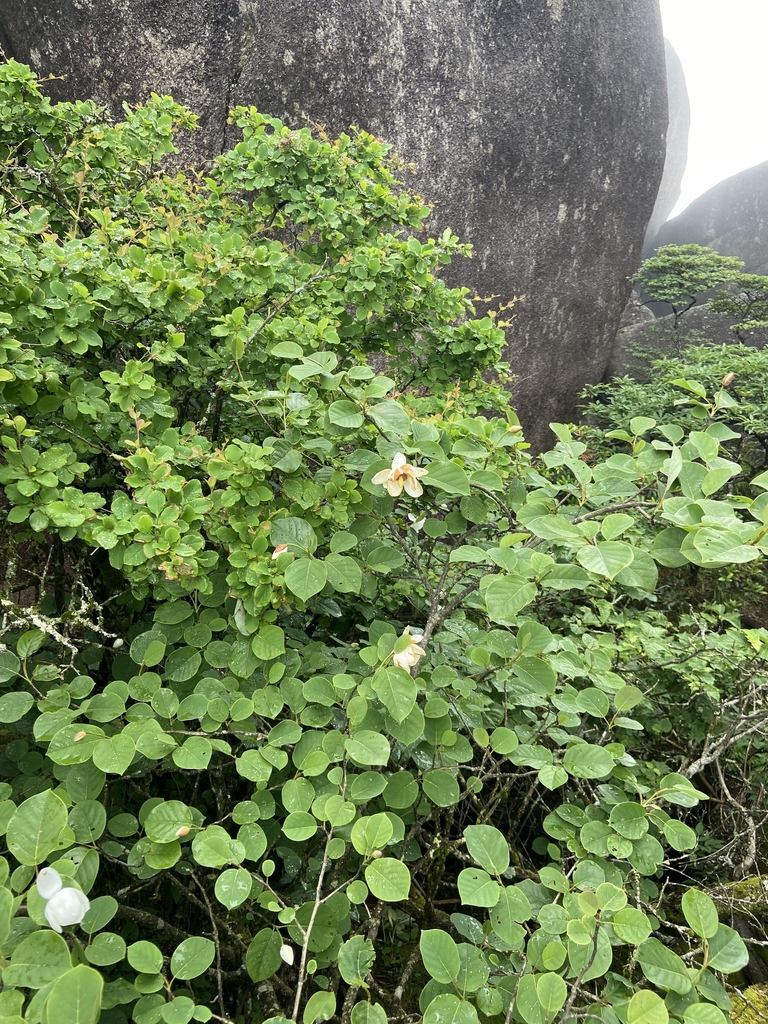
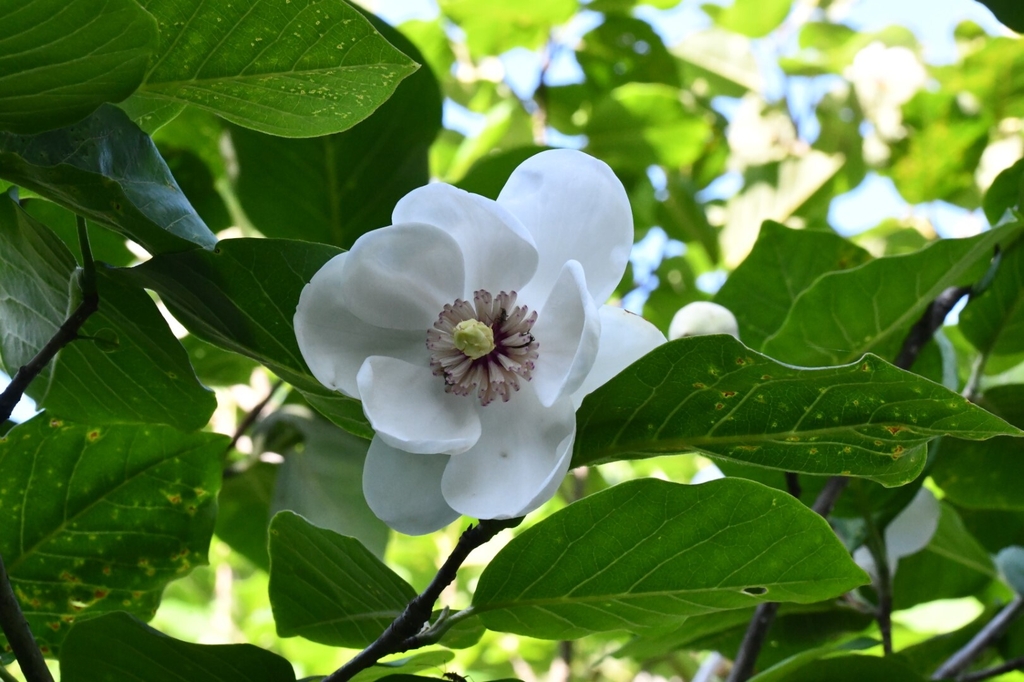
The Oyama Magnolia is a large deciduous shrub or small tree with a spreading form reaching a mature height of about 26 feet and an equal spread and needs plenty of room to fulfill its potential. The fragrant white flowers are said to be the purest white of all the magnolia flowers with red stamens, blooming in spring and continuing to bloom intermittently through the summer. The flowers are followed by prominent pink oval fruits (to 3 inches long) that split open in fall to reveal orange to red seeds. Dark green leaves (3 to 6 inches long) turn golden yellow in fall.
The Oyama Magnolia is best grown in moist, fertile, slightly acidic, organically rich, well-drained loams in partial shade. It will not tolerate poor soils or full sun in hot, summer climates. The branches can be brittle, so protect the plant from strong winds and cold winter temperatures.Site the tree in protected areas with morning sun with consistent moisture.
Diseases, Insect Pests, and Other Plant Problems:
No known diseases or insect pests. Spring flowers can be affected by a last frost.
- See this plant in the following landscape :
- Cultivars / Varieties:
-
- Tags:


- Cultivars / Varieties:
-
- Tags:
-
-
Attributes:
- Genus:
- Magnolia
- Species:
- sieboldii
- Family:
- Magnoliaceae
- Life Cycle:
- Woody
- Recommended Propagation Strategy:
- Seed
- Stem Cutting
- Country Or Region Of Origin:
- Central China to Japan and Korea
- Dimensions:
- Height: 13 ft. 0 in. - 26 ft. 0 in.
- Width: 13 ft. 0 in. - 26 ft. 0 in.
-
-
Whole Plant Traits:
- Plant Type:
- Perennial
- Shrub
- Tree
- Woody Plant Leaf Characteristics:
- Deciduous
- Habit/Form:
- Multi-stemmed
- Rounded
- Spreading
- Vase
- Growth Rate:
- Slow
- Maintenance:
- Medium
- Texture:
- Medium
-
-
Cultural Conditions:
- Light:
- Partial Shade (Direct sunlight only part of the day, 2-6 hours)
- Soil Texture:
- Clay
- Loam (Silt)
- Sand
- Soil pH:
- Acid (<6.0)
- Alkaline (>8.0)
- Neutral (6.0-8.0)
- Soil Drainage:
- Good Drainage
- Moist
- NC Region:
- Mountains
- Piedmont
- USDA Plant Hardiness Zone:
- 5a, 5b, 6a, 6b, 7a, 7b, 8a, 8b, 9a, 9b
-
-
Fruit:
- Fruit Color:
- Red/Burgundy
- Fruit Value To Gardener:
- Showy
- Display/Harvest Time:
- Fall
- Fruit Length:
- 1-3 inches
- Fruit Description:
- Fruit is red when mature, 2 1/2 inches long.
-
-
Flowers:
- Flower Color:
- Gold/Yellow
- Pink
- White
- Flower Inflorescence:
- Solitary
- Flower Value To Gardener:
- Fragrant
- Flower Bloom Time:
- Summer
- Flower Shape:
- Cup
- Saucer
- Flower Petals:
- Tepals
- Flower Size:
- 3-6 inches
- Flower Description:
- Flowers bloom in late spring, cup-shaped at first but saucer-shaped later, 3 inches across, erect to slightly nodding, and fragrant.
-
-
Leaves:
- Woody Plant Leaf Characteristics:
- Deciduous
- Leaf Color:
- Green
- Leaf Feel:
- Leathery
- Deciduous Leaf Fall Color:
- Gold/Yellow
- Leaf Shape:
- Elliptical
- Oblong
- Obovate
- Leaf Margin:
- Entire
- Hairs Present:
- Yes
- Leaf Length:
- 3-6 inches
- Leaf Width:
- 1-3 inches
- Leaf Description:
- Leaf blade obovate, 3.5 to 6 inches long and 1.5 to 3.5 inches wide. Lower surface glaucous, usually with long, silky white hairs along major veins. The upper surface has curved hairs on major veins.
-
-
Stem:
- Stem Color:
- Brown/Copper
- Gray/Silver
- Stem Is Aromatic:
- No
- Stem Surface:
- Hairy (pubescent)
- Stem Description:
- Twigs are pale greyish brown, slender, with appressed grey hairs when young.
-
-
Landscape:
- Landscape Location:
- Lawn
- Woodland
- Landscape Theme:
- Asian Garden
- Design Feature:
- Flowering Tree
- Specimen
- Understory Tree