


Lagerstroemia 'Natchez'
Common Name(s):
- Phonetic Spelling
- la-ger-STROH-mee-ah
- Description
-
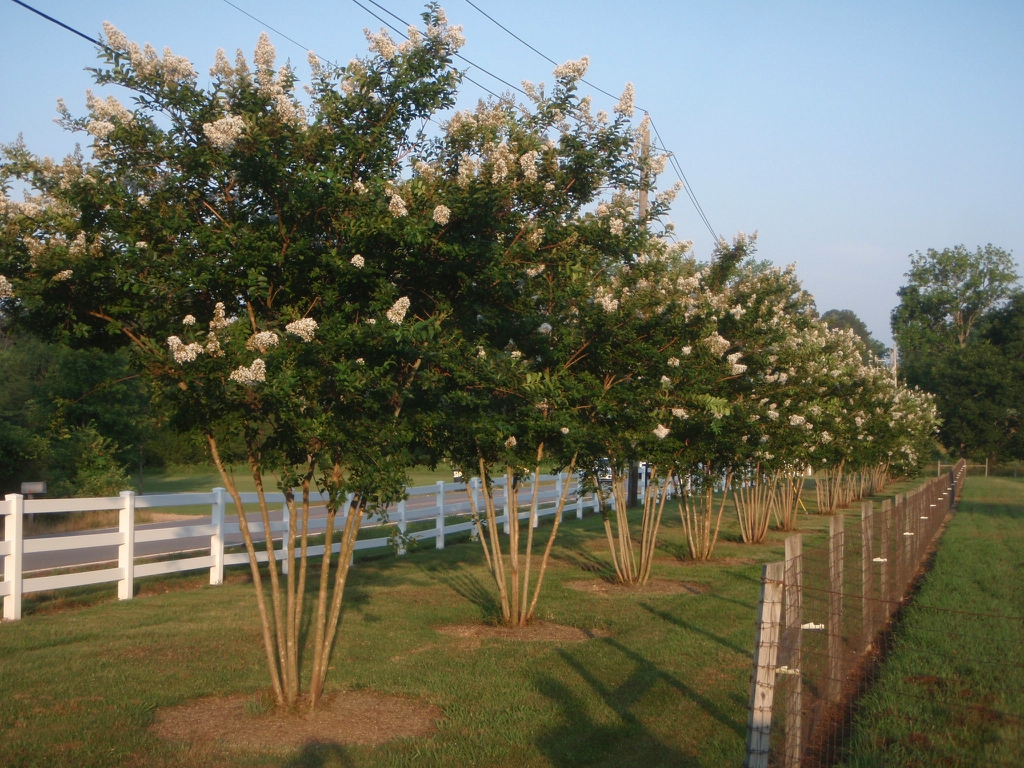
Natchez crape myrtle is an upright, ornamental, spreading, deciduous, multi-stemmed, flowering, large shrub or small-sized tree cultivar, a cross between L. indica 'Pink Lace' x L. subcostata var. faurei. It grows 4 to 30 feet tall and 4 to 35 feet wide. From mid-summer to fall, 6- to 12-inch-long panicles of showy, pure white, ruffled, crepe-paper-like flowers appear. In summer, its glossy leaves are dark green, but by fall they are orange-to-red. The bark is mottled and dark cinnamon brown, exfoliating as the tree ages. It is a member of the loosestrife family (Lythraceae). This plant was developed at the United States Arboretum in Washington, D.C, and was officially named for a Native American tribe in 1978.
Prefers full sun and moist, well-drained, acidic, loamy or clay soils. Tolerates partial shade; however, flower production will be reduced. It is hardy in zones 6 to 9. It should be planted in a protected location. 'Natchez' was bred to be mildew-resistant and is drought-, heat-, clay-soil, and urban-tolerant. Pruning should be completed in winter or early spring, as this plant blooms on new wood.
'Natchez' is often found in Southern home or commercial landscapes and is one of the more commonly planted flowering shrubs. It may be used as a specimen, foundation, or mass planting. The attractive, exfoliating bark and the large, showy white clusters of flowers will be a striking addition.
Insects, Diseases, and Other Plant Problems: Monitor for aphids, Japanese beetles, and scale. May be susceptible to sooty mold, leaf spot, and iron chlorosis. Protect from winter injury.
The Clemson Cooperative Extension Home & Garden Information Center has a factsheet on common crape myrtle pests and diseases.
- See this plant in the following landscape :
- Border Landscape Pinewild County Club, Moore County
- Cultivars / Varieties:
-
- Tags:


- Cultivars / Varieties:
-
- Tags:
-
-
Attributes:
- Genus:
- Lagerstroemia
- Family:
- Lythraceae
- Life Cycle:
- Woody
- Wildlife Value:
- Attracts pollinators.
- Play Value:
- Attractive Flowers
- Attracts Pollinators
- Colorful
- Easy to Grow
- Particularly Resistant To (Insects/Diseases/Other Problems):
- Mildew
- Dimensions:
- Height: 4 ft. 0 in. - 30 ft. 0 in.
- Width: 4 ft. 0 in. - 35 ft. 0 in.
-
-
Whole Plant Traits:
- Plant Type:
- Shrub
- Tree
- Habit/Form:
- Erect
- Multi-stemmed
- Rounded
- Spreading
- Growth Rate:
- Medium
- Maintenance:
- Medium
-
-
Cultural Conditions:
- Light:
- Full sun (6 or more hours of direct sunlight a day)
- Soil Texture:
- Clay
- Loam (Silt)
- Sand
- Soil pH:
- Acid (<6.0)
- Neutral (6.0-8.0)
- Soil Drainage:
- Good Drainage
- Moist
- Available Space To Plant:
- 6-feet-12 feet
- 12-24 feet
- NC Region:
- Coastal
- Mountains
- Piedmont
- USDA Plant Hardiness Zone:
- 6a, 6b, 7a, 7b, 8a, 8b, 9a, 9b
-
-
Fruit:
- Fruit Color:
- Brown/Copper
- Display/Harvest Time:
- Fall
- Winter
- Fruit Type:
- Capsule
- Fruit Length:
- < 1 inch
- Fruit Width:
- < 1 inch
- Fruit Description:
- The fruits appear as a panicle of round, woody, dark brown capsules that persist until late winter.
-
-
Flowers:
- Flower Color:
- White
- Flower Inflorescence:
- Panicle
- Flower Value To Gardener:
- Showy
- Flower Bloom Time:
- Fall
- Summer
- Flower Size:
- < 1 inch
- Flower Description:
- Panicles of pure white flowers bloom from late June to September. The panicles measure 6- to 12- inches long. There are 100-800 flowers per panicle.
-
-
Leaves:
- Leaf Color:
- Green
- Deciduous Leaf Fall Color:
- Orange
- Red/Burgundy
- Leaf Type:
- Simple
- Hairs Present:
- No
- Leaf Length:
- 1-3 inches
- Leaf Width:
- 1-3 inches
- Leaf Description:
- The leaves are glossy, dark green, measuring 1.5 to 3 inches long and 0.75 to 1.5 inches wide. The fall color is a brilliant orange-red.
-
-
Bark:
- Bark Color:
- Dark Brown
- Surface/Attachment:
- Exfoliating
- Bark Description:
- The bark is dark cinnamon brown. As the shrub or small tree ages, the bark will exfoliate.
-
-
Stem:
- Stem Is Aromatic:
- No
-
-
Landscape:
- Design Feature:
- Border
- Flowering Tree
- Hedge
- Screen/Privacy
- Small groups
- Small Tree
- Specimen
- Street Tree
- Attracts:
- Bees
- Pollinators
- Resistance To Challenges:
- Deer
- Diseases
- Drought
- Heat
- Pollution
- Urban Conditions