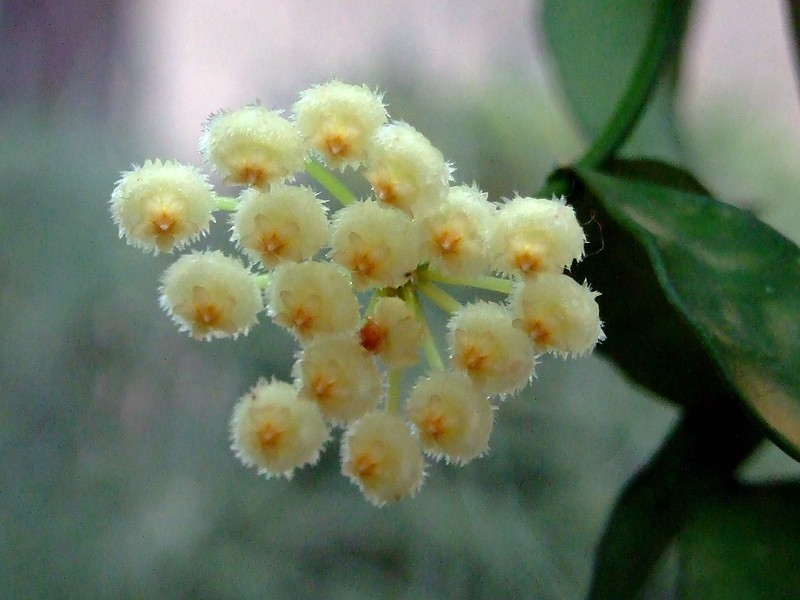
Hoya lacunosa
Common Name(s):
Previously known as:
- Hoya lacunosa var. pallidiflora
- Hoya suaveolens
- Otostemma lacunosum
- Phonetic Spelling
- HOY-ah lak-uh-NO-suh
- Description
-
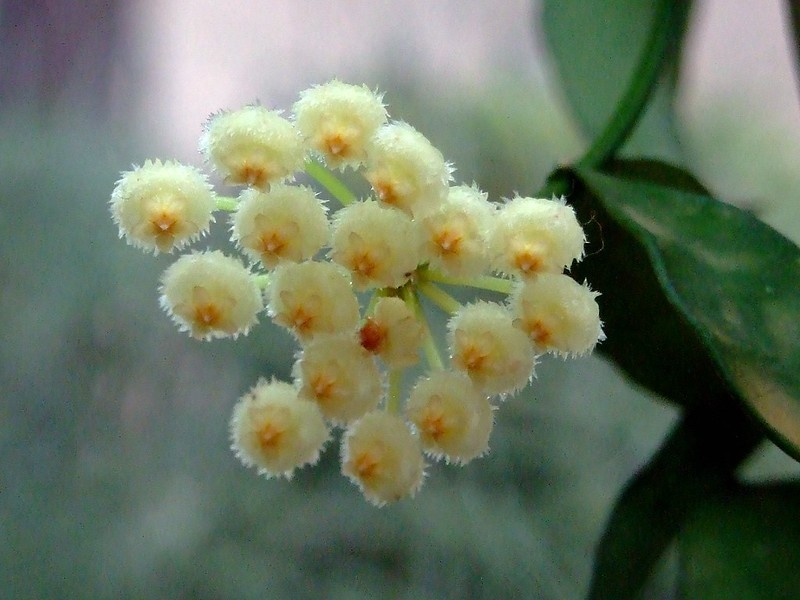
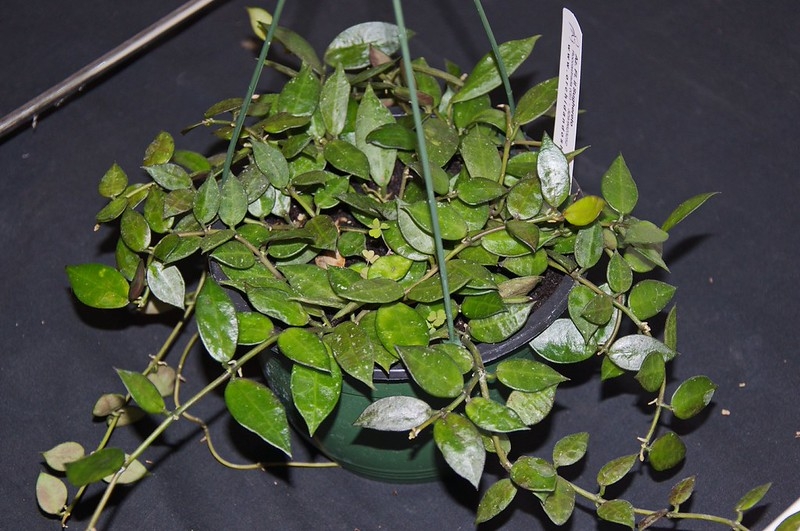
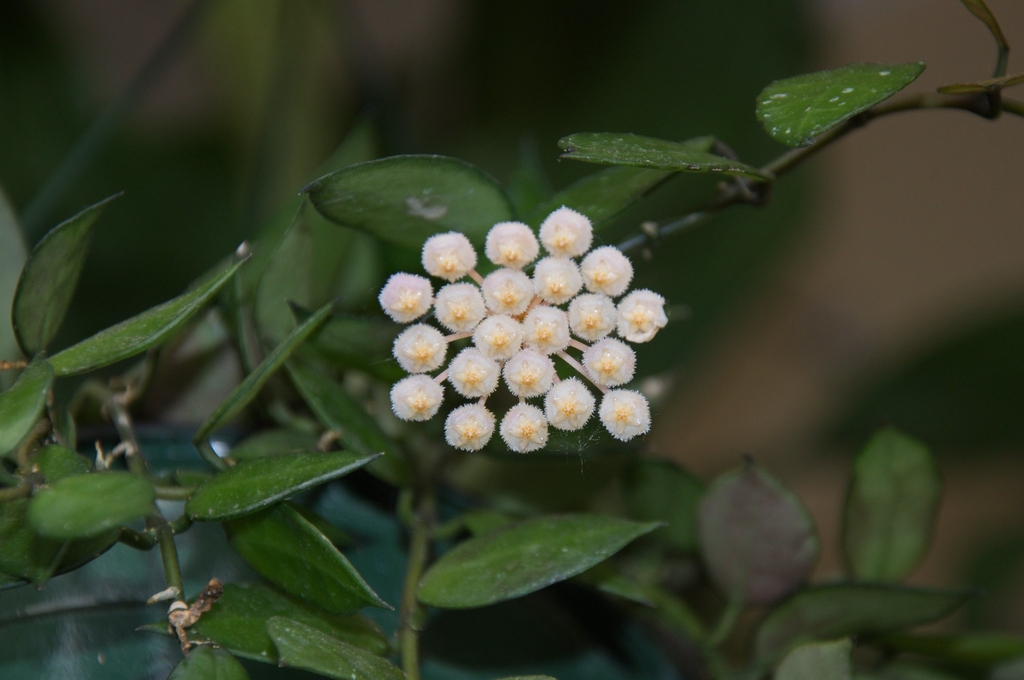
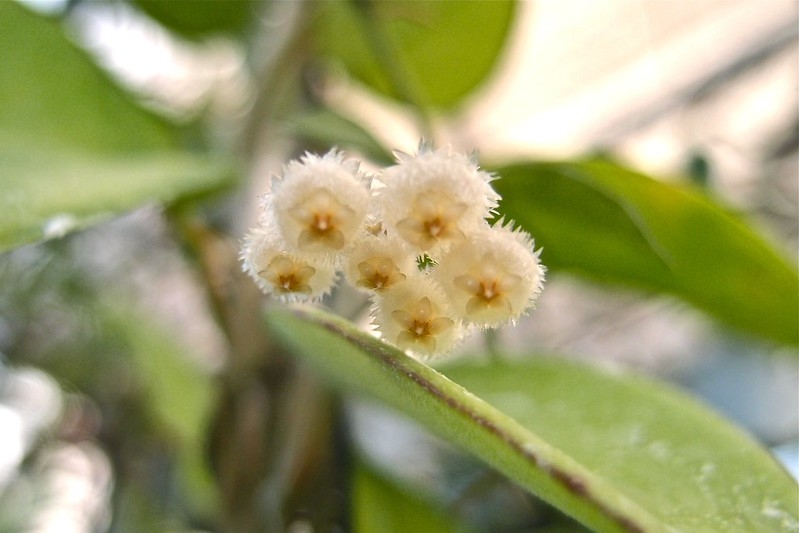
Cinnamon hoya is a delicate, compact, creeping, climbing epiphyte and lithophyte vine native to the tropical forests of Southern Myanmar and West and Central Malaysia. Typically, it is found along forest edges in its native habitat, climbing on tree trunks and limbs. The plant has slender, smooth stems and dense, deep green, waxy leaves. Its flowers are arranged in hanging umbels on a sturdy stalk. There are up to 30 flowers per umbel, and each bloom is white, star-shaped, fuzzy, and tightly curled with a yellow corona in the center. The blooms have a cinnamon fragrance, especially at night. This plant has a similar habit and growth pattern to Hoya bella. Cinnamon hoya is a member of the dogbane family (Apocynaceae). The specific epithet, lacunosa, means "full of little cavities' and describes the pitted texture or the depressed areas between the veins on the outer surface of the plant's leaves.
Prefers bright, indirect light or partial shade and grows well in a moist, well-drained orchid potting medium. A mixture of perlite, pine bark, sand, and peat moss may also be used. Hanging baskets made with coconut fibers provide good airflow to the plants' roots. The plant should be kept moist, but allow it to dry out somewhat between each watering. This plant also prefers warm temperatures between 68 and 77 degrees Fahrenheit and humidity levels between 50 and 70%. It is winter hardy in zones 10b to 12b. Propagated by stem cuttings.
Avoid removing spent flower stalks or peduncles. The new flowers will form on the old spurs. If needed, prune only to maintain the plant's shape or to remove dead leaves or stems.
Cinnamon hoya is a highly prized ornamental houseplant with its cinnamon fragrance, white fuzzy flowers, pitted foliage, and compact habit.
Insects, Diseases, and Other Plant Problems: No significant insect pests or diseases. Monitor for mealybugs and spider mites. Overwatering can cause root rot, and fungal diseases such as powdery mildew and leaf spot can occur. Direct sun can cause leaf scorch, while inadequate sunlight will make the plant weak and leggy. The sap of the plant is white and milky, and may cause skin irritation. Wear protective gloves when handling the plant.
- See this plant in the following landscape :
- Cultivars / Varieties:
-
- 'Black Queen'
dark green leaves with black margins, and white flowers - 'Eskimo'
green, heart-shaped leaves with white, fluffy flowers - 'Mint'
new leaves are light mint green, and they mature to silver mint - 'Royal Flush'
dark green leaves with red margins and pink blooms - 'Silver'
silver and green variegated leaves and pink flowers - 'Snowcaps'
dark green leaves speckled with white, white flowers - 'Splash'
compact, trailing habit, deep green leaves with silver speckles, and fuzzy, creamy-white flowers
- 'Black Queen'
- 'Black Queen', 'Eskimo', 'Mint', 'Royal Flush', 'Silver', 'Snowcaps', 'Splash'
- Tags:


- Cultivars / Varieties:
-
- 'Black Queen'
dark green leaves with black margins, and white flowers - 'Eskimo'
green, heart-shaped leaves with white, fluffy flowers - 'Mint'
new leaves are light mint green, and they mature to silver mint - 'Royal Flush'
dark green leaves with red margins and pink blooms - 'Silver'
silver and green variegated leaves and pink flowers - 'Snowcaps'
dark green leaves speckled with white, white flowers - 'Splash'
compact, trailing habit, deep green leaves with silver speckles, and fuzzy, creamy-white flowers
- 'Black Queen'
- 'Black Queen', 'Eskimo', 'Mint', 'Royal Flush', 'Silver', 'Snowcaps', 'Splash'
- Tags:
-
-
Attributes:
- Genus:
- Hoya
- Species:
- lacunosa
- Family:
- Apocynaceae
- Uses (Ethnobotany):
- In China, all parts of the plant are used to treat insect bites and wounds.
- Life Cycle:
- Perennial
- Recommended Propagation Strategy:
- Stem Cutting
- Country Or Region Of Origin:
- Southern Myanmar, West and Central Malaysia.
- Distribution:
- Native: Borneo, Java, Malaysia, Myanmar, the Philippines, Sumatra, and Thailand. Introduced: Southeast China
- Wildlife Value:
- Attracts butterflies and other pollinators.
- Play Value:
- Attractive Flowers
- Easy to Grow
- Fragrance
-
-
Whole Plant Traits:
- Plant Type:
- Epiphyte
- Houseplant
- Perennial
- Vine
- Woody Plant Leaf Characteristics:
- Broadleaf Evergreen
- Habit/Form:
- Climbing
- Creeping
- Growth Rate:
- Rapid
- Maintenance:
- Low
- Texture:
- Medium
-
-
Cultural Conditions:
- Light:
- Partial Shade (Direct sunlight only part of the day, 2-6 hours)
- Soil Texture:
- Loam (Silt)
- Sand
- Soil pH:
- Acid (<6.0)
- Soil Drainage:
- Good Drainage
- Moist
- USDA Plant Hardiness Zone:
- 10b, 11a, 11b, 12a, 12b
-
-
Fruit:
- Fruit Type:
- Follicle
- Fruit Length:
- 1-3 inches
- Fruit Width:
- < 1 inch
- Fruit Description:
- The fruit is a dry, smooth, thick, long, lance-shaped follicle up to 2 to 2.5 inches long and 0.25 inches wide.
-
-
Flowers:
- Flower Color:
- Gold/Yellow
- Green
- White
- Flower Inflorescence:
- Umbel
- Flower Value To Gardener:
- Fragrant
- Showy
- Flower Bloom Time:
- Summer
- Flower Shape:
- Star
- Flower Petals:
- 4-5 petals/rays
- Flower Size:
- < 1 inch
- Flower Description:
- The flower stalks arise from the leaf axils and bear a cluster or umbel of up to 30 flowers. Each bloom is white to pale yellow and has 5 ovate or elliptical lobes. The corolla is white to greenish-yellow and reflexed. The interior of the corolla has a circle of velvet-like hair. The corona has yellow, ovate-shaped lobes. The bloom is up to 0.3 inches in diameter. Each umbel measures up to 2.8 inches long. The blooms have a cinnamon fragrance. The blooms last up to 5 days.
-
-
Leaves:
- Woody Plant Leaf Characteristics:
- Broadleaf Evergreen
- Leaf Color:
- Green
- Leaf Feel:
- Fleshy
- Glossy
- Leathery
- Leaf Type:
- Simple
- Leaf Arrangement:
- Opposite
- Leaf Shape:
- Lanceolate
- Ovate
- Leaf Margin:
- Entire
- Hairs Present:
- No
- Leaf Length:
- 1-3 inches
- Leaf Width:
- < 1 inch
- Leaf Description:
- The leaves are deep green, ovate to lanceolate, opposite, smooth, fleshy, leathery, and shiny. They measure 0.75 to 2.75 inches long and 0.5 to 1.25 inches wide. The tip of the leaf is acute. and the base is rounded or wedge-shaped. The upper surface has a depressed midrib and 2 to 4 pairs of lateral veins. The area between the veins is slightly sunken or lacunose. The petiole is 0.25 inches long, thick, and mostly smooth.
-
-
Stem:
- Stem Color:
- Green
- Stem Is Aromatic:
- No
- Stem Cross Section:
- Round
- Stem Surface:
- Smooth (glabrous)
- Stem Description:
- The stems are green, thin, cylinder-like, and are smooth or sparsely hairy. The stems are up to 5 feet long with rooting nodes along the stem.
-
-
Landscape:
- Landscape Location:
- Container
- Hanging Baskets
- Houseplants
- Patio
- Design Feature:
- Specimen
- Attracts:
- Butterflies
- Pollinators
- Resistance To Challenges:
- Humidity
- Problems:
- Contact Dermatitis