



Hesperocyparis glabra
Common Name(s):
Previously known as:
- Callitropsis glabra
- Cupressus arizonica subsp. glabra
- Cupressus arizonica var. glabra
- Cupressus glabra
- Neocupressus arizonica var. glabra
- Phonetic Spelling
- hes-per-oh-SY-pair-iss GLAY-bruh
- Description
-
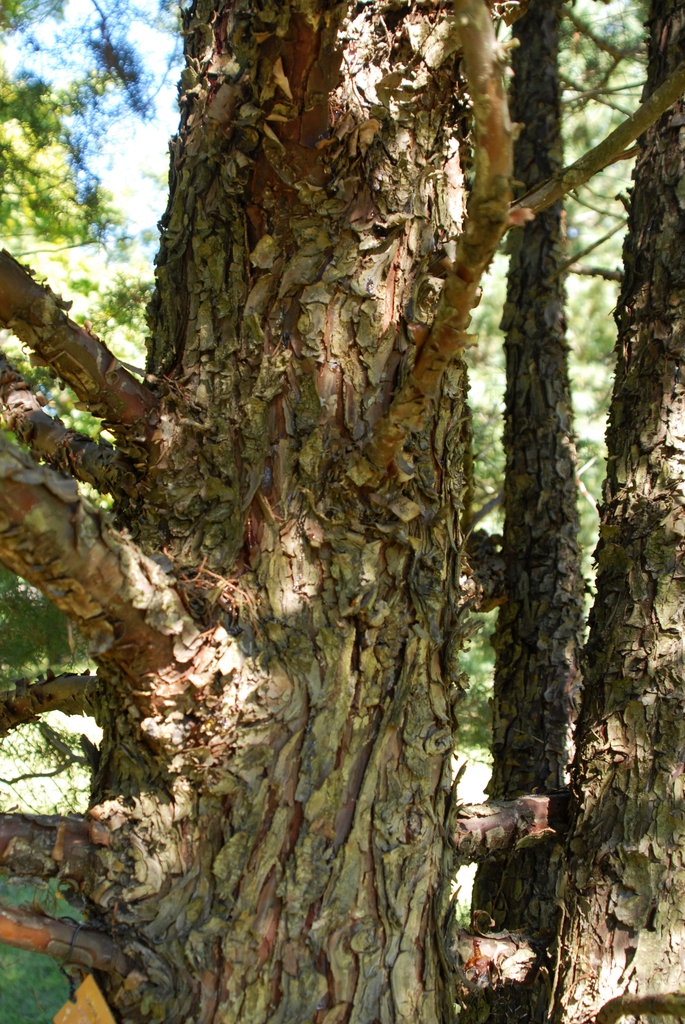
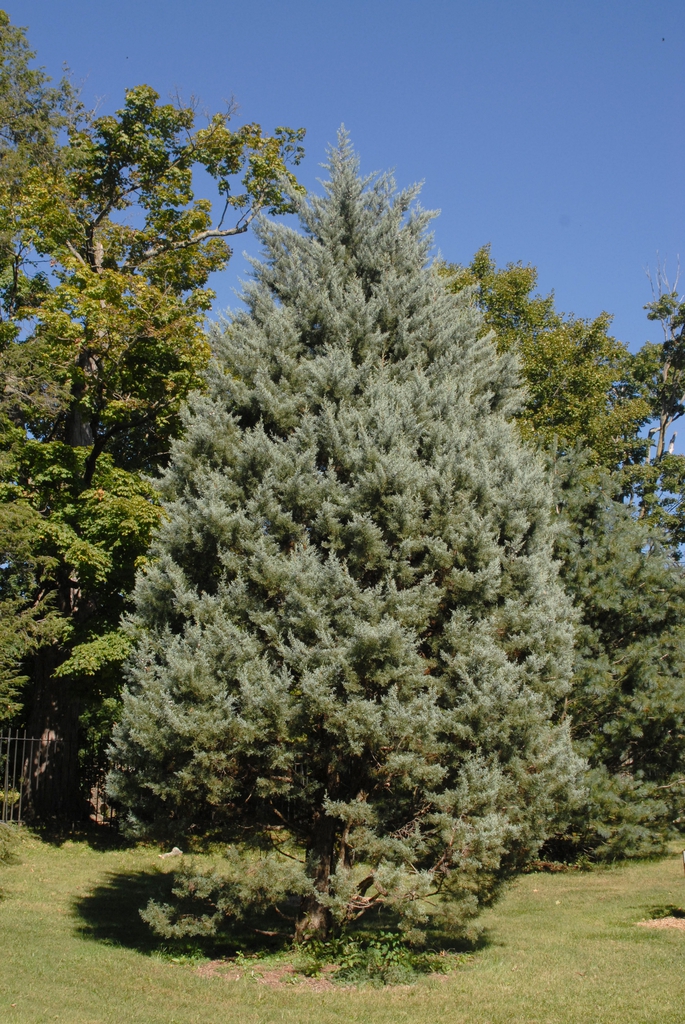
The smooth Arizona cypress is a conical to columnar, needle-bearing evergreen tree native to Arizona in the southwestern United States, and often found in rocky or gravelly soils of canyons and ravines. The tree can mature up to 70 feet tall, but typically grows 25 to 40 feet tall and 25 to 30 feet wide. This conifer has distinctive peeling gray outer bark that sheds, revealing a smooth dark red inner bark. The dense foliage is scale-like and bluish-green, and the fruit is small, gray or brown round cones. It is a member of the cypress family (Cupressaceae). The specific epithet, glabra, means "smooth" and refers to the tree's bark.
It thrives in full sun and in a variety of moist, well-drained soils. It is drought-tolerant once established, deer-resistant, salt- and poor-soil-tolerant, and resistant to cypress canker. This conifer is winter hardy in zones 6 through 9.
The smooth Arizona cypress is frequently used for screening or windbreaks or planted in gardens and parks.
Diseases, Insect Pests, and Other Plant Problems: Monitor for cypress aphids, and it may be susceptible to honey fungus. Overwatering can cause root rot.
- See this plant in the following landscape :
- Cultivars / Varieties:
-
- 'Blue Ice'
Grows 40 to 50 feet tall, 15 to 20 feet wide, columnar with silvery-blue leaves - 'Blue Spire'
Narrow and weeping - 'Chaparral'
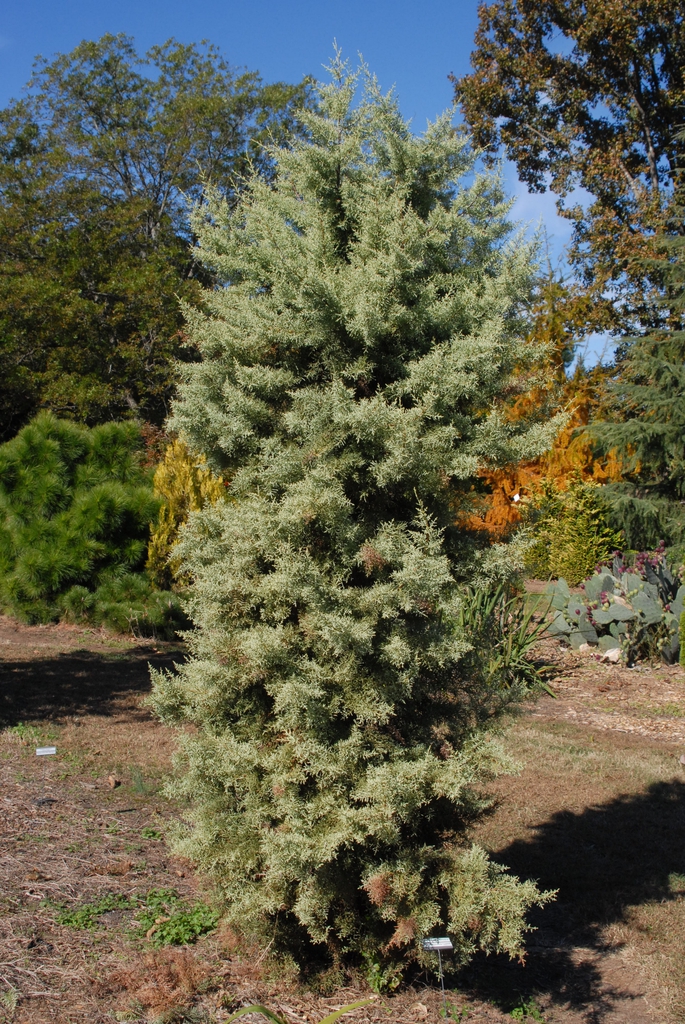
Columnar, broad, dense, creamy-white to blue-green leaves - 'Limelight'
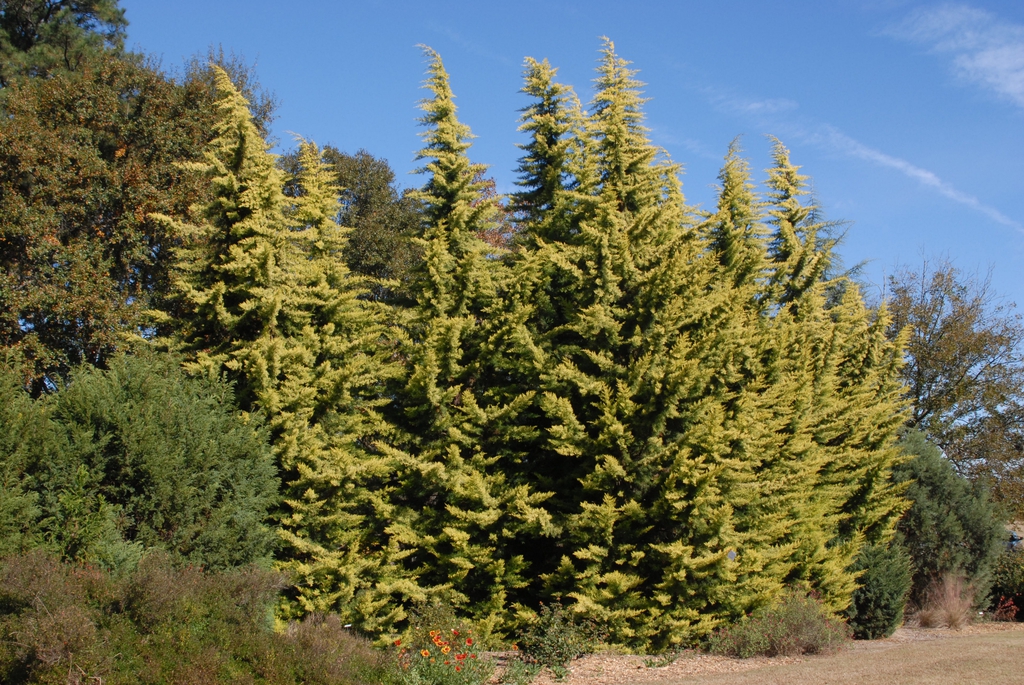
Grows up to 20 feet tall, 5 feet wide, conical, foliage yellow lime green, fast-growing - 'Raywoods Weeping'
Erect, narrow, but secondary branches are drooping - 'Sulphurea'
Erect, compact, columnar, with yellow leaves
- 'Blue Ice'
- 'Blue Ice', 'Blue Spire', 'Chaparral', 'Limelight', 'Raywoods Weeping', 'Sulphurea'
- Tags:


- Cultivars / Varieties:
-
- 'Blue Ice'
Grows 40 to 50 feet tall, 15 to 20 feet wide, columnar with silvery-blue leaves - 'Blue Spire'
Narrow and weeping - 'Chaparral'
Columnar, broad, dense, creamy-white to blue-green leaves - 'Limelight'
Grows up to 20 feet tall, 5 feet wide, conical, foliage yellow lime green, fast-growing - 'Raywoods Weeping'
Erect, narrow, but secondary branches are drooping - 'Sulphurea'
Erect, compact, columnar, with yellow leaves
- 'Blue Ice'
- 'Blue Ice', 'Blue Spire', 'Chaparral', 'Limelight', 'Raywoods Weeping', 'Sulphurea'
- Tags:
-
-
Attributes:
- Genus:
- Hesperocyparis
- Species:
- glabra
- Family:
- Cupressaceae
- Life Cycle:
- Woody
- Recommended Propagation Strategy:
- Seed
- Stem Cutting
- Country Or Region Of Origin:
- Central Arizona
- Distribution:
- Native to Central Arizona. Introduced in Italy and Tunisia.
- Play Value:
- Screening
- Wind Break
- Particularly Resistant To (Insects/Diseases/Other Problems):
- cypress canker
- Dimensions:
- Height: 25 ft. 0 in. - 45 ft. 0 in.
- Width: 25 ft. 0 in. - 30 ft. 0 in.
-
-
Whole Plant Traits:
- Plant Type:
- Tree
- Woody Plant Leaf Characteristics:
- Needled Evergreen
- Habit/Form:
- Columnar
- Conical
- Dense
- Erect
- Growth Rate:
- Rapid
- Maintenance:
- Low
- Texture:
- Fine
-
-
Cultural Conditions:
- Light:
- Full sun (6 or more hours of direct sunlight a day)
- Soil Texture:
- Clay
- Loam (Silt)
- Sand
- Shallow Rocky
- Soil pH:
- Acid (<6.0)
- Alkaline (>8.0)
- Neutral (6.0-8.0)
- Soil Drainage:
- Good Drainage
- Moist
- Occasionally Dry
- Available Space To Plant:
- 24-60 feet
- NC Region:
- Coastal
- Mountains
- Piedmont
- USDA Plant Hardiness Zone:
- 6a, 6b, 7a, 7b, 8a, 8b, 9a, 9b
-
-
Fruit:
- Fruit Color:
- Brown/Copper
- Display/Harvest Time:
- Fall
- Fruit Description:
- The cones are woody and become gray or brown upon maturity. The male cones measure about 0.1 inches long and appear in September. The female cones measure 0.6 to 1.2 inches wide. They have 5 to 10 scales. They do not open for several seasons and often seen clinging to the branches. The seeds are smooth or warty, and winged, dispersed by the wind.
-
-
Flowers:
- Flower Description:
- Non-flowering.
-
-
Leaves:
- Woody Plant Leaf Characteristics:
- Needled Evergreen
- Leaf Color:
- Blue
- Green
- Leaf Value To Gardener:
- Fragrant
- Leaf Type:
- Needles
- Leaf Arrangement:
- Opposite
- Leaf Margin:
- Entire
- Hairs Present:
- No
- Leaf Length:
- < 1 inch
- Leaf Description:
- The foliage is scale-like, blue-green to waxy blue, each scale measuring 0.04 inches long. The leaves are short, closely pressed to the twigs, acutely pointed, thickened and keel-shaped on the back, and resinous. Tiny white dots seen on the foliage are actually resin glands. The leaves die during the second year, turn a bright red-brown, and remain on the twigs for about four years. The foliage is fragrant when crushed.
-
-
Bark:
- Bark Color:
- Light Gray
- Red/Burgundy
- Surface/Attachment:
- Furrowed
- Peeling
- Scaly
- Smooth
- Bark Description:
- The blistering and peeling gray outer bark sheds in thin, flat reddish strips or plates; beneath the bark is a smooth, red inner bark.
-
-
Stem:
- Stem Is Aromatic:
- No
-
-
Landscape:
- Landscape Location:
- Slope/Bank
- Landscape Theme:
- Drought Tolerant Garden
- Design Feature:
- Hedge
- Street Tree
- Resistance To Challenges:
- Deer
- Drought
- Erosion
- Poor Soil
- Salt



