



Helleborus argutifolius
Common Name(s):
Previously known as:
- Helleborus corsicus f. angustifolius
- Helleborus lividus subsp. corsicus
- Phonetic Spelling
- hel-eh-BORE-us ar-goo-tee-FOH-lee-us
- This plant has medium severity poison characteristics.
- See below
- Description
-
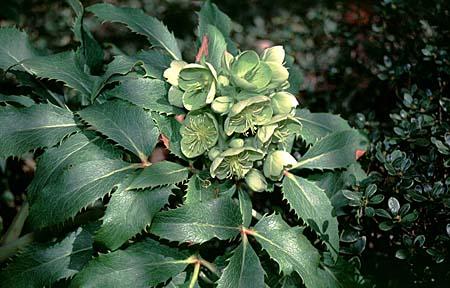
Corsican hellebore is a shade-loving, rhizomatous, clumping, evergreen, herbaceous perennial native to Corsica and Sardinia, found on hillsides, woodlands, and ravines. It is one of the larger species, growing 1.5 to 2 feet tall and sometimes reaching up to 3 to 4 feet. In late winter or early spring, the flowers appear in clusters; each bloom is cup-shaped, nodding, pale green, measuring 2 inches wide. The leaves are large, bluish-green to grayish-green, thick, with 3 individual elliptical-shaped leaflets and toothed margins. The specific epithet argutifolius is derived from two Latin words: argutus, meaning sharp, and folius, meaning leaf. This refers to the plant's sharp, toothed margins. It is a member of the buttercup family (Ranunculaceae).
Prefers partial to full shade but can tolerate full sun. It thrives in moist, well-drained, organic-rich soil with a neutral or alkaline pH. It is intolerant of bright winter sun and high temperatures. Plants in colder regions should be well mulched and protected from winter winds, or the foliage may be damaged. It is drought-tolerant once established. This plant can spread through self-seeding.
Corsican hellebore has leafy stems up to 2 feet tall, and its leaves are trifoliate, leather-like, and smooth. Each leaflet measures 5 to 7 inches long. Each cluster of flowers has 15 to 30 blooms.
Coriscan hellebore is attractive year-round, especially when planted in groups. It is easy to grow, and a perfect addition for borders or patios in protected, shady spots.
Quick ID Hints:
- Flowers nodding, petaloid sepals
- Short plant with stiff, large, evergreen leaves
- Leaves are palmately divided into many leaflets
- Flower center of numerous stamens outlined by tubular nectaries, or fleshy, beaked capsules
Insects, Diseases, and Other Plant Problems: Has no significant insect pests or diseases. Monitor for aphids, snails, and slugs. It may have occasional problems with crown rot and leaf spot. This plant is also susceptible to a serious viral disease known as hellebore black death that causes stunted and deformed growth. Leaves may be scorched or tattered over very cold winters. The normal life expectancy of this plant is 4 to 5 years. The NC Invasive Plant Council regards all hellebores as potentially invasive, although the threat is low.
If ingested, this plant is toxic to humans, dogs, cats, and horses. Wear gloves and protective clothing when handling this plant due to the risk of skin irritation.
- See this plant in the following landscape :
- Cultivars / Varieties:
-
- 'Janet Starnes' (Janet Starnes Speckled Corsican Hellebore)
Grows up to 20 inches tall, trifoliate green leaves speckled with white and has a pinkish overlay, light green flowers - 'Laurelhurst'
Grows up to 24 inches tall, with grayish-green leaves and light green flowers - 'Pacific Frost'
Grows 18 to 24 inches tall, with blue-green leaves speckled with creamy white and apple green flowers - 'Silver Lace'
Grows up to 20 inches tall, with silvery-pewter leaves, and green flowers - 'Snow Fever' PP23880 (Snow Fever Corsican Lenten Rose)
Grow 12 inches tall, with dark green leaves speckled with white and creamy colored flowers
- 'Janet Starnes' (Janet Starnes Speckled Corsican Hellebore)
- 'Janet Starnes' (Janet Starnes Speckled Corsican Hellebore), 'Laurelhurst', 'Pacific Frost', 'Silver Lace', 'Snow Fever' PP23880 (Snow Fever Corsican Lenten Rose)
- Tags:

- Cultivars / Varieties:
-
- 'Janet Starnes' (Janet Starnes Speckled Corsican Hellebore)
Grows up to 20 inches tall, trifoliate green leaves speckled with white and has a pinkish overlay, light green flowers - 'Laurelhurst'
Grows up to 24 inches tall, with grayish-green leaves and light green flowers - 'Pacific Frost'
Grows 18 to 24 inches tall, with blue-green leaves speckled with creamy white and apple green flowers - 'Silver Lace'
Grows up to 20 inches tall, with silvery-pewter leaves, and green flowers - 'Snow Fever' PP23880 (Snow Fever Corsican Lenten Rose)
Grow 12 inches tall, with dark green leaves speckled with white and creamy colored flowers
- 'Janet Starnes' (Janet Starnes Speckled Corsican Hellebore)
- 'Janet Starnes' (Janet Starnes Speckled Corsican Hellebore), 'Laurelhurst', 'Pacific Frost', 'Silver Lace', 'Snow Fever' PP23880 (Snow Fever Corsican Lenten Rose)
- Tags:
-
-
Attributes:
- Genus:
- Helleborus
- Species:
- argutifolius
- Family:
- Ranunculaceae
- Life Cycle:
- Perennial
- Recommended Propagation Strategy:
- Division
- Seed
- Country Or Region Of Origin:
- Corsica and Sardinia
- Distribution:
- Native: Corsica and Sardinia; Introduced: Austria, France, and Great Britain.
- Play Value:
- Attractive Flowers
- Colorful
- Easy to Grow
- Particularly Resistant To (Insects/Diseases/Other Problems):
- Deer and rabbit resistant
- Edibility:
- Toxic if ingested
- Dimensions:
- Height: 1 ft. 6 in. - 2 ft. 0 in.
- Width: 1 ft. 6 in. - 2 ft. 0 in.
-
-
Whole Plant Traits:
- Plant Type:
- Herbaceous Perennial
- Perennial
- Poisonous
- Woody Plant Leaf Characteristics:
- Broadleaf Evergreen
- Habit/Form:
- Clumping
- Erect
- Spreading
- Growth Rate:
- Medium
- Maintenance:
- Low
- Texture:
- Medium
-
-
Cultural Conditions:
- Light:
- Dappled Sunlight (Shade through upper canopy all day)
- Deep shade (Less than 2 hours to no direct sunlight)
- Partial Shade (Direct sunlight only part of the day, 2-6 hours)
- Soil Texture:
- High Organic Matter
- Sand
- Soil pH:
- Alkaline (>8.0)
- Neutral (6.0-8.0)
- Soil Drainage:
- Good Drainage
- Moist
- Available Space To Plant:
- 12 inches-3 feet
- NC Region:
- Coastal
- Mountains
- Piedmont
- USDA Plant Hardiness Zone:
- 6a, 6b, 7a, 7b, 8a, 8b
-
-
Fruit:
- Fruit Color:
- Brown/Copper
- Green
- Display/Harvest Time:
- Spring
- Summer
- Fruit Type:
- Capsule
- Fruit Description:
- The fruits are clustered, green, fleshy capsules, long-beaked, and surrounded by persistent sepals. They are initially green and then turn brown as they mature. Each capsule contains 7 to 9 seeds, which are black and shiny. Harvest seeds from late spring to early summer.
-
-
Flowers:
- Flower Color:
- Cream/Tan
- Green
- Flower Inflorescence:
- Panicle
- Flower Value To Gardener:
- Long-lasting
- Showy
- Flower Bloom Time:
- Spring
- Winter
- Flower Shape:
- Cup
- Flower Petals:
- 4-5 petals/rays
- Flower Size:
- 1-3 inches
- Flower Description:
- There are 15 to 30 blooms in each terminal panicle or cluster. Each flower is 5-parted, cup- or bowl-shaped, nodding, pale green, and about 2 inches in diameter. It has numerous stamens and yellow anthers. Blooms February to April.
-
-
Leaves:
- Woody Plant Leaf Characteristics:
- Broadleaf Evergreen
- Leaf Color:
- Blue
- Gray/Silver
- Green
- Leaf Feel:
- Leathery
- Leaf Type:
- Compound (Pinnately , Bipinnately, Palmately)
- Leaf Arrangement:
- Alternate
- Leaf Shape:
- Elliptical
- Leaf Margin:
- Serrate
- Hairs Present:
- No
- Leaf Length:
- > 6 inches
- Leaf Description:
- The basal and cauline leaves are bluish-green or grayish-green, alternate, coarse, leathery, smooth, and palmately compound with 3 leaflets, with irregularly toothed or serrate margins. Each leaflet is elliptical and measures 5 to 7 inches long.
-
-
Stem:
- Stem Is Aromatic:
- No
- Stem Description:
- Stout, rhizomatous or exposed.
-
-
Landscape:
- Landscape Location:
- Woodland
- Landscape Theme:
- Shade Garden
- Design Feature:
- Border
- Small groups
- Specimen
- Resistance To Challenges:
- Deer
- Drought
- Heavy Shade
- Rabbits
- Problems:
- Contact Dermatitis
- Poisonous to Humans
- Problem for Cats
- Problem for Children
- Problem for Dogs
- Problem for Horses
-
-
Poisonous to Humans:
- Poison Severity:
- Medium
- Poison Symptoms:
- TOXIC ONLY IF LARGE QUANTITIES EATEN. SKIN IRRITATION MINOR OR LASTING ONLY FOR A FEW MINUTES. Possibly causing burning of mouth and throat, salivation, vomiting, abdominal cramping, diarrhea, nervous symptoms, depression.
- Poison Toxic Principle:
- Protoanemonin
- Causes Contact Dermatitis:
- Yes
- Poison Part:
- Bark
- Flowers
- Fruits
- Leaves
- Roots
- Sap/Juice
- Seeds
- Stems

