



Silver Fleece Vine Fallopia aubertii
Other Common Name(s):
Previously known as:
- Polygonum aubertii
- Tiniaria aubertii
- Phonetic Spelling
- fal-OH-pee-uh aw-BERT-ee-eye
- Description
-
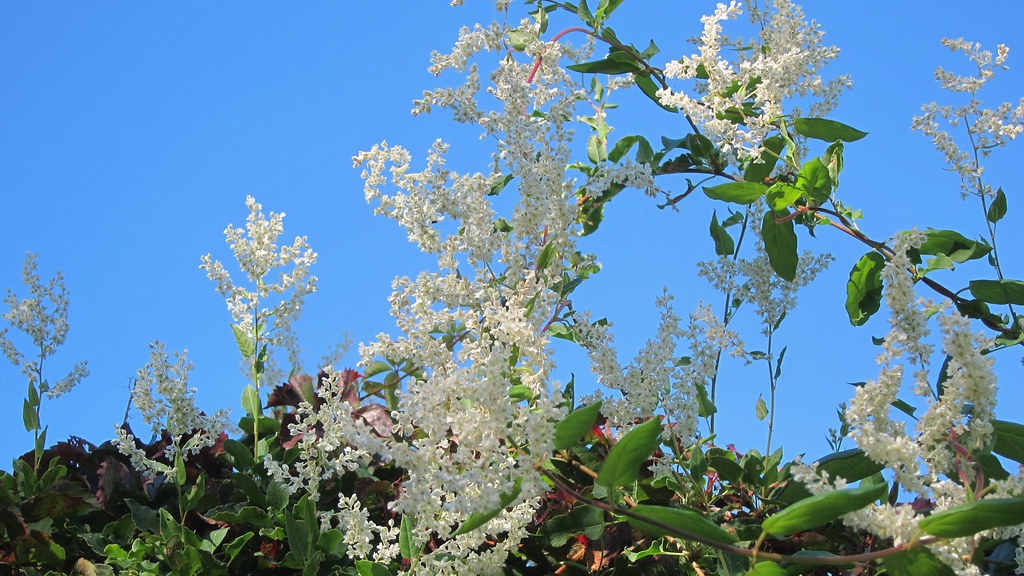
The silver lace vine is a multi-stemmed, deciduous, perennial, twining, woody vine that can grow up to 35 feet long and spreads 2 feet wide. This fast-growing vine climbs by twisting its stems for support and does well on surfaces such as a trellis, chain-link fence, wire, or other objects where it can twist to hold on. It has bright green leaves and fragrant, white flowers from June to October. It is native to the temperate regions of Tibet and Central China, and is a member of the buckwheat family (Polygonaceae). The genus name, Fallopia, honors Gabriele Fallopi, an Italian professor of anatomy.
Thrives in full sun to partial shade, moderate humidity, and moist, well-drained, fertile soil. Prefers temperatures between 65 and 75 degrees Fahrenheit. Easy to propagate by division, stem or root cuttings, seeds, or layering. This vine needs the sturdy support of a fence or trellis.
Pruning is important for managing its vigorous growth. Flowering occurs on new wood, and it is best done in late winter and early spring before the new growth. It is tolerant of urban and coastal conditions as well as drought. It spreads by rhizomes and is easily transplanted. However, the spreading rhizomes can easily take over an area and make it appear weedy.
Due to its rapid growth, the silver lace vine is invasive in some areas. It is essential to monitor and prune this vine regularly. It is a good vine for quickly covering a fence, arbor, or trellis. Container planting will help to restrain its growth. It is excellent for screening and creates the desired effect in several weeks.
Insects, Diseases, and Other Plant Problems: No significant insect pests or diseases. Susceptible to Japanese beetles. The vines' vigorous growth can easily overtake other plants. Requires frequent pruning and can become weedy. It is considered invasive in the midwestern and northeastern United States.
- See this plant in the following landscape :
- Cultivars / Varieties:
-
- 'Lemon Lace"
vigorous vine 20 to 30 ft. tall, 15 ft to 20 ft. wide with red stems, golden leaves, and white flowers, deer resistant
- 'Lemon Lace"
- 'Lemon Lace"
- Tags:


- Cultivars / Varieties:
-
- 'Lemon Lace"
vigorous vine 20 to 30 ft. tall, 15 ft to 20 ft. wide with red stems, golden leaves, and white flowers, deer resistant
- 'Lemon Lace"
- 'Lemon Lace"
- Tags:
-
-
Attributes:
- Genus:
- Fallopia
- Species:
- aubertii
- Family:
- Polygonacaea
- Life Cycle:
- Woody
- Recommended Propagation Strategy:
- Division
- Layering
- Leaf Cutting
- Root Cutting
- Seed
- Stem Cutting
- Country Or Region Of Origin:
- Tibet to Northern and Central China
- Distribution:
- Native: China North-Central, China South-Central, Inner Mongolia, Qinghai, and Tibet. Introduced: Albania, Bulgaria, Greece, Hungary, Mexico Gulf, Mexico Northeast, New Zealand North, New Zealand South, and Romania
- Wildlife Value:
- Birds and Butterflies
- Play Value:
- Buffer
- Easy to Grow
- Screening
- Wildlife Cover/Habitat
- Climbing Method:
- Twining
- Dimensions:
- Height: 20 ft. 0 in. - 35 ft. 0 in.
- Width: 2 ft. 0 in. - 3 ft. 0 in.
-
-
Whole Plant Traits:
- Plant Type:
- Vine
- Woody Plant Leaf Characteristics:
- Deciduous
- Habit/Form:
- Cascading
- Climbing
- Multi-stemmed
- Growth Rate:
- Rapid
- Maintenance:
- High
- Texture:
- Medium
-
-
Cultural Conditions:
- Light:
- Full sun (6 or more hours of direct sunlight a day)
- Partial Shade (Direct sunlight only part of the day, 2-6 hours)
- Soil Texture:
- Loam (Silt)
- Sand
- Soil pH:
- Acid (<6.0)
- Alkaline (>8.0)
- Neutral (6.0-8.0)
- Soil Drainage:
- Good Drainage
- Moist
- Available Space To Plant:
- 12 inches-3 feet
- NC Region:
- Coastal
- Mountains
- Piedmont
- USDA Plant Hardiness Zone:
- 4b, 5a, 5b, 6a, 6b, 7a, 7b, 8a, 8b
-
-
Fruit:
- Fruit Color:
- Black
- Fruit Type:
- Achene
- Fruit Length:
- < 1 inch
- Fruit Width:
- < 1 inch
- Fruit Description:
- The fruit is an achene, shiny, black, and 2mm long.
-
-
Flowers:
- Flower Color:
- Green
- Pink
- White
- Flower Inflorescence:
- Panicle
- Flower Value To Gardener:
- Fragrant
- Showy
- Flower Bloom Time:
- Fall
- Summer
- Flower Size:
- < 1 inch
- Flower Description:
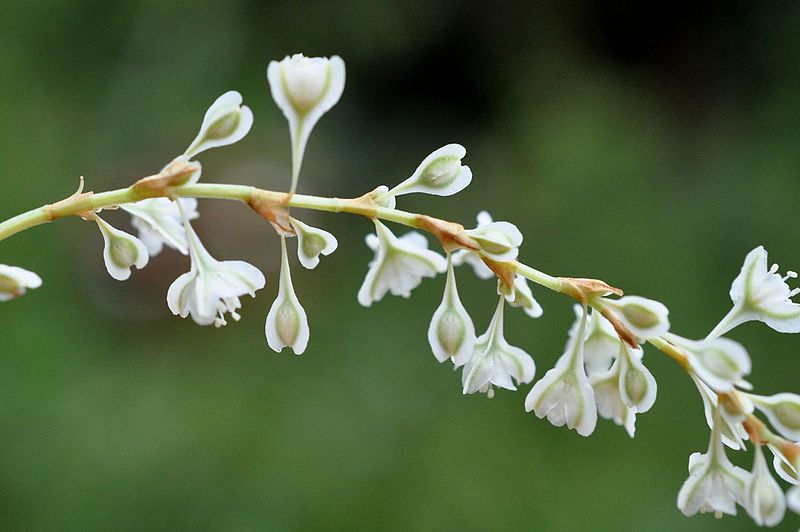
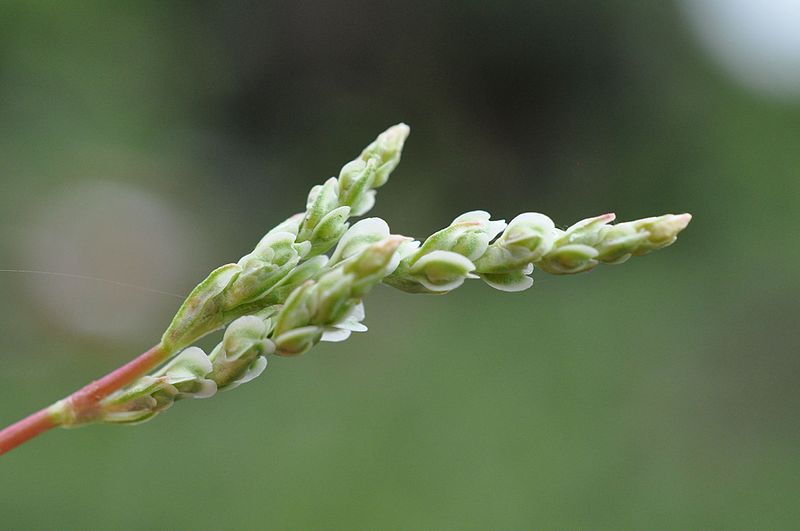
- The flowers are fragrant, white to greenish-white, and sometimes pale pink. Each flower is less than 0.2inches in diameter. The flowers are arranged in clusters or panicles, and each cluster measures about 6 inches long. The panicles are narrow, erect, spike-like, and borne laterally on the stems.
-
-
Leaves:
- Woody Plant Leaf Characteristics:
- Deciduous
- Leaf Color:
- Green
- Red/Burgundy
- Leaf Type:
- Simple
- Leaf Arrangement:
- Alternate
- Leaf Shape:
- Cordate
- Elliptical
- Ovate
- Hairs Present:
- No
- Leaf Length:
- 3-6 inches
- Leaf Description:
- The leaves are bright green, elliptical to cordate, petiolate, and measure 1.5 to 4 inches long. New growth has a reddish color. Has no significant fall color.
-
-
Stem:
- Stem Color:
- Green
- Red/Burgundy
- Stem Is Aromatic:
- No
- Stem Description:
- The stems are thin, twisting, reddish to green, and can grow up to 35 feet long.
-
-
Landscape:
- Landscape Location:
- Container
- Patio
- Vertical Spaces
- Design Feature:
- Mass Planting
- Screen/Privacy
- Specimen
- Resistance To Challenges:
- Deer
- Drought
- Salt
- Urban Conditions
- Problems:
- Weedy

