


Small Globe Thistle Echinops ritro
Other Common Name(s):
Previously known as:
- Echinopus ritro
- Phonetic Spelling
- EK-in-ops REE-troh
- Description
-
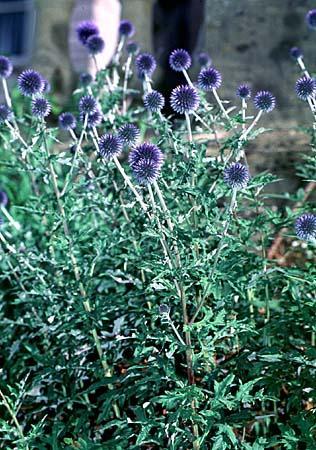
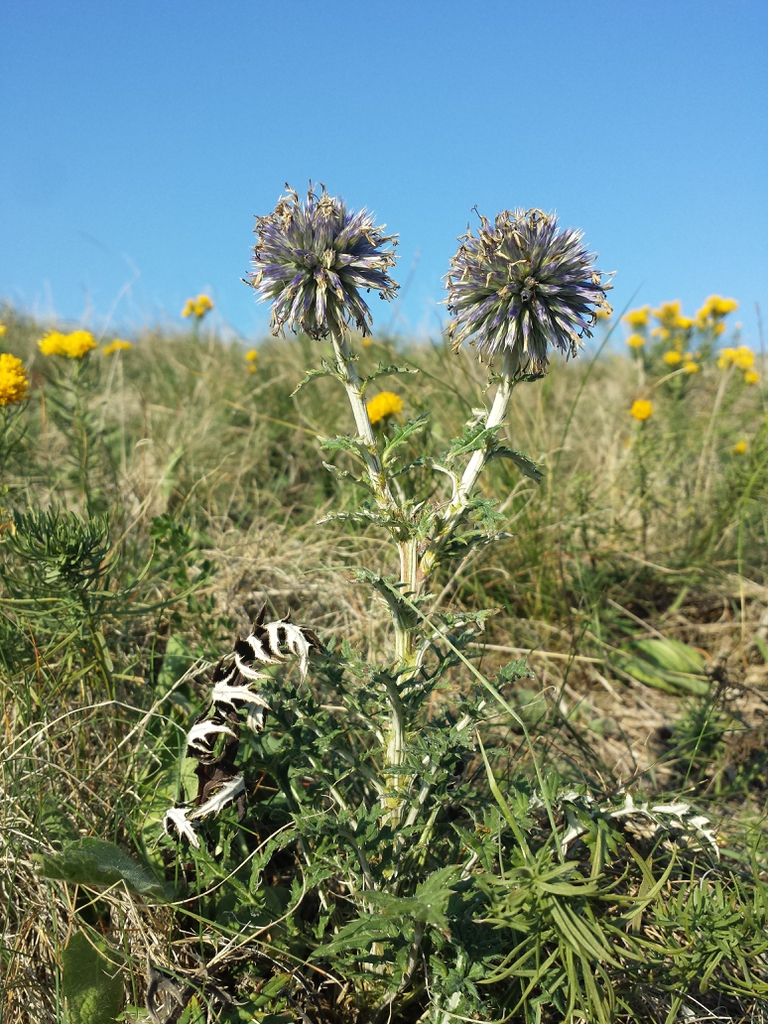
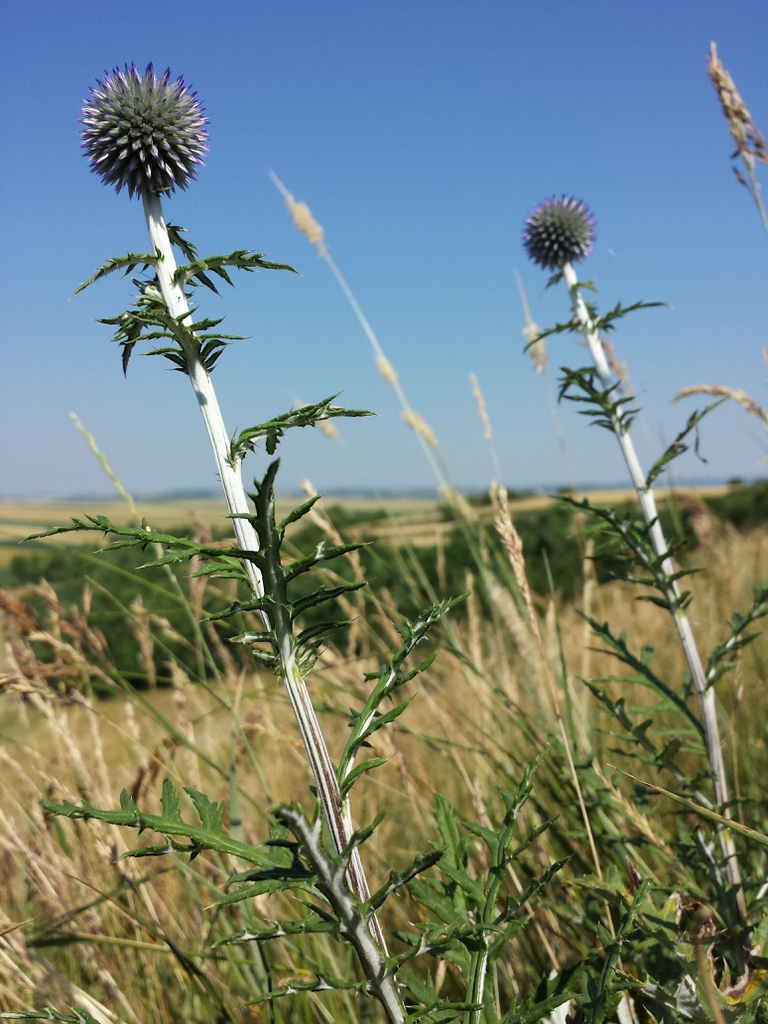
Globe thistle is a clump-forming, herbaceous perennial native to central and southeastern Europe and central Asia, and found on stony slopes or grasslands. It has a compact habit, grows 3 to 4 feet tall, and 2 to 2.5 feet wide. It has erect grayish-white stems, grayish-green, stiff, spiny leaves, and bright blue spherical flowerheads. It is a member of the daisy family (Asteraceae). The genus name, Echinops, is derived from two Greek words: echinos, meaning "hedgehog," and ops, meaning "appearance." This refers to the plant's unique flower heads.
Performs best in full sun, but will tolerate partial shade. This plant is easily grown in a variety of soils: chalk, loam, and sand. It thrives in poor to average, medium-moist to dry, well-drained conditions. Once established, these plants are drought-tolerant. Avoid wet, soggy, or rich organic, amended soils. Deadheading spent blooms will encourage reblooming. Best propagated by seeds in the spring and will self-seed. Deadhead before the seed sets, if seedlings are not wanted. It is tolerant of drought, deer, and rabbits. The blooms are very attractive to bees and butterflies.
The blooms appear mid-summer through September, and the gray-green hairy leaves are also attractive.
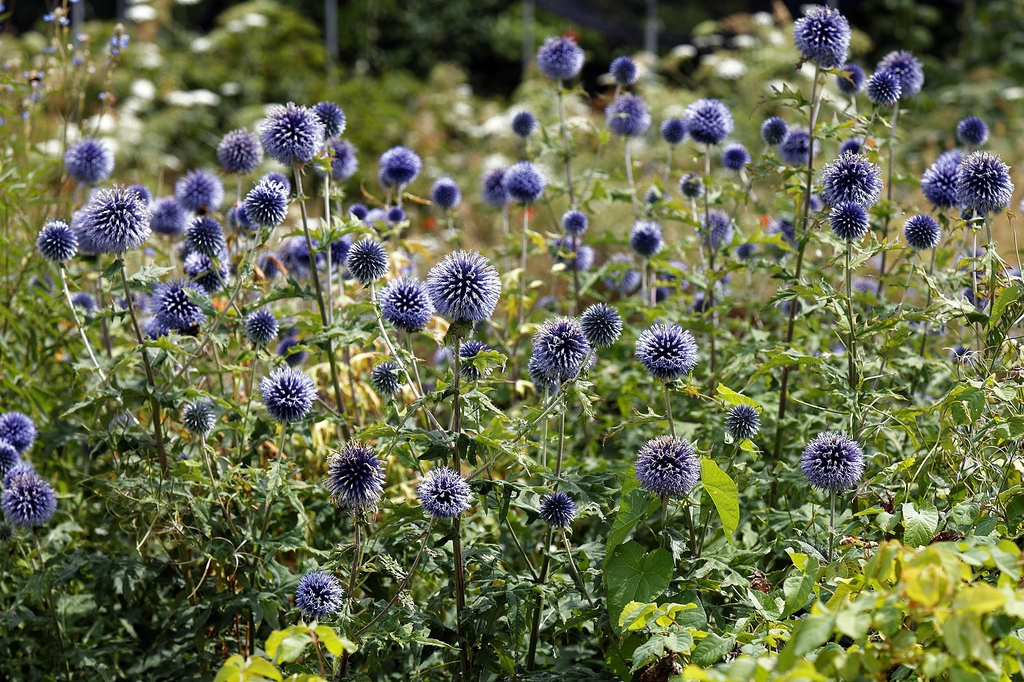
For peak color and sturdy plants, plant in full sun at the back of the perennial border, cutting garden, or cottage garden. The blue globe flowers will add interest and contrast to your garden. When used in dried floral arrangements, cut the flowers when young and place them in a warm, dry room to keep the deep blue color.
Insects, Diseases, and Other Plant Problems: No significant insect pests or diseases. Monitor for aphids, leaf miners, thrips, slugs, and snails. Overwatering or poor air circulation can cause root rot and powdery mildew. Stems may be lanky or floppy if grown in partial shade or in rich soils. Staking is sometimes required. Due to its tap root, division and transplanting can be difficult.
- See this plant in the following landscape :
- Cultivars / Varieties:
-
- 'Platinum Blue'
silvery white stems, lavender-blue flowers - ‘Veitch’s Blue’
3 to 3.5 feet tall, darker blue flowers, and produces more flowers than the species
- 'Platinum Blue'
- 'Platinum Blue', ‘Veitch’s Blue’
- Tags:


- Cultivars / Varieties:
-
- 'Platinum Blue'
silvery white stems, lavender-blue flowers - ‘Veitch’s Blue’
3 to 3.5 feet tall, darker blue flowers, and produces more flowers than the species
- 'Platinum Blue'
- 'Platinum Blue', ‘Veitch’s Blue’
- Tags:
-
-
Attributes:
- Genus:
- Echinops
- Species:
- ritro
- Family:
- Asteraceae
- Life Cycle:
- Perennial
- Recommended Propagation Strategy:
- Division
- Root Cutting
- Country Or Region Of Origin:
- Europe to Mongolia and Turkey
- Distribution:
- Native: Albania, Austria, Baltic States, Bulgaria, Central European Russia, Czechoslovakia, East European Russia, France, Greece, Hungary, Iran, Italy, Kazakhstan, Mongolia, North Caucasus, Poland, Romania, Sicily, South European Russia, Spain, Transcaucasus, Turkmenistan, Turkey, Ukraine, Uzbekistan, West Siberia, and Xinjiang. Introduced: Germany, New York, and Washington.
- Wildlife Value:
- Attracts butterflies
- Particularly Resistant To (Insects/Diseases/Other Problems):
- Deer and rabbit resistant
- Dimensions:
- Height: 3 ft. 0 in. - 4 ft. 0 in.
- Width: 2 ft. 0 in. - 2 ft. 6 in.
-
-
Whole Plant Traits:
- Plant Type:
- Perennial
- Habit/Form:
- Clumping
- Erect
- Growth Rate:
- Medium
- Maintenance:
- Low
- Texture:
- Coarse
-
-
Cultural Conditions:
- Light:
- Full sun (6 or more hours of direct sunlight a day)
- Soil Texture:
- Clay
- Loam (Silt)
- Sand
- Shallow Rocky
- Soil pH:
- Acid (<6.0)
- Soil Drainage:
- Good Drainage
- Occasionally Dry
- Available Space To Plant:
- 3 feet-6 feet
- NC Region:
- Coastal
- Mountains
- Piedmont
- USDA Plant Hardiness Zone:
- 3a, 3b, 4a, 4b, 5a, 5b, 6a, 6b, 7a, 7b, 8a, 8b
-
-
Fruit:
- Fruit Value To Gardener:
- Showy
- Display/Harvest Time:
- Fall
- Fruit Type:
- Capsule
- Fruit Description:
- Spherical seedheads are attractive.
-
-
Flowers:
- Flower Color:
- Blue
- Flower Inflorescence:
- Head
- Flower Value To Gardener:
- Good Cut
- Good Dried
- Showy
- Flower Bloom Time:
- Summer
- Flower Shape:
- Crown
- Star
- Flower Petals:
- 4-5 petals/rays
- Flower Size:
- 1-3 inches
- Flower Description:
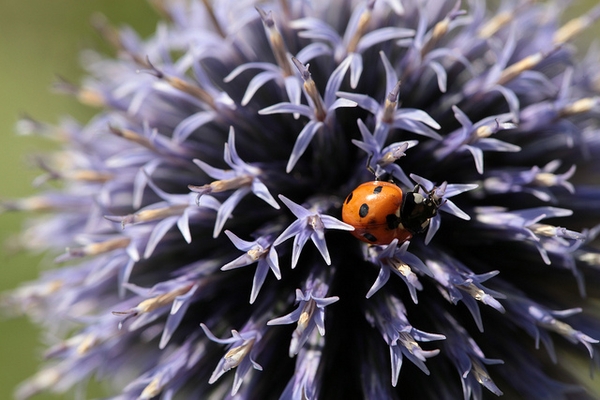
- The flowerheads are spherical, 1 to 2 inches in diameter, and steel-blue or dark blue. They appear on stiff stems in mid-summer through September. From 4 to 10 flower heads are produced on each branched stem. Small individual flowers are star-shaped.
-
-
Leaves:
- Leaf Color:
- Gray/Silver
- Green
- Leaf Feel:
- Leathery
- Leaf Value To Gardener:
- Showy
- Leaf Type:
- Simple
- Leaf Arrangement:
- Alternate
- Rosulate
- Leaf Shape:
- Elliptical
- Oblanceolate
- Leaf Margin:
- Lobed
- Hairs Present:
- Yes
- Leaf Length:
- > 6 inches
- Leaf Width:
- 1-3 inches
- Leaf Description:
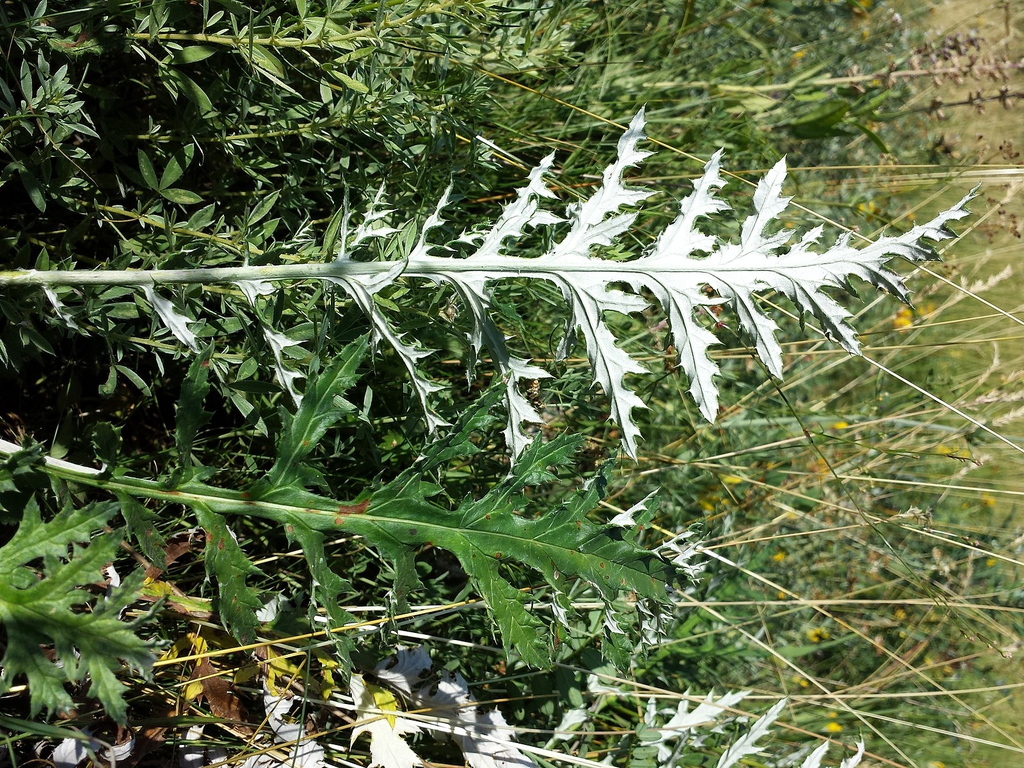
- The leaves are grayish-green on the upper surface and white tomentose on the undersides. Each leaf is coarse, spiny, and deeply dissected. The stem leaves are shorter than the basal leaves, which are usually 6 to 8 inches long and 1 to 3 inches wide.
-
-
Stem:
- Stem Color:
- Gray/Silver
- White
- Stem Is Aromatic:
- No
- Stem Form:
- Straight
- Stem Surface:
- Hairy (pubescent)
- Stem Description:
- The stems are stiff, hairy, and grayish-white.
-
-
Landscape:
- Landscape Theme:
- Cottage Garden
- Cutting Garden
- Pollinator Garden
- Design Feature:
- Border
- Small groups
- Attracts:
- Butterflies
- Pollinators
- Resistance To Challenges:
- Deer
- Drought
- Dry Soil
- Poor Soil
- Rabbits