


Daphne tangutica
Common Name(s):
- Phonetic Spelling
- DAF-nee tan-GUE-tick-uh
- This plant has high severity poison characteristics.
- See below
- Description
-
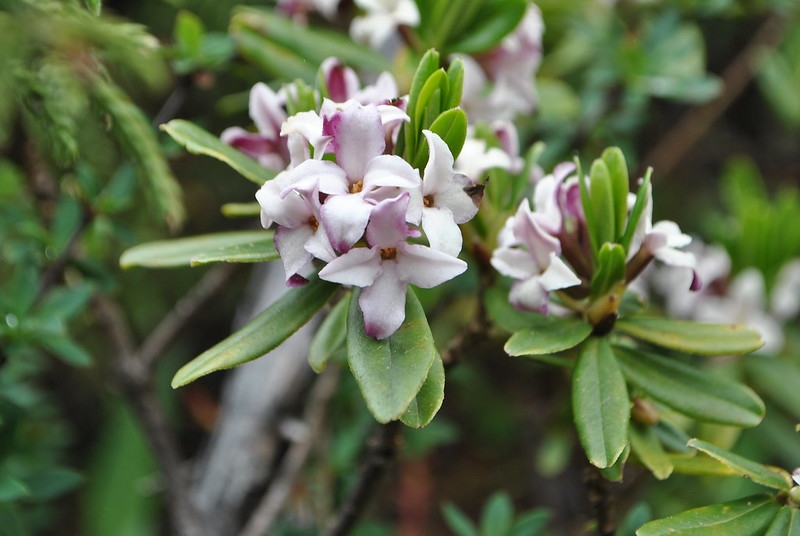
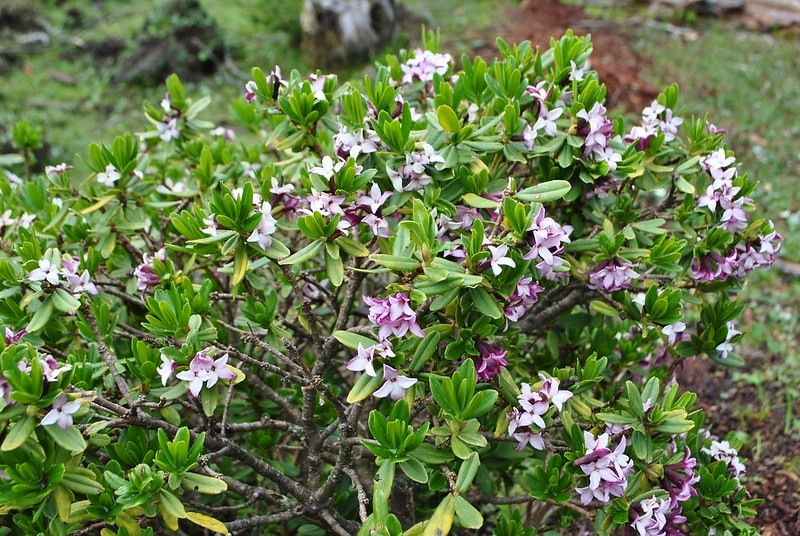
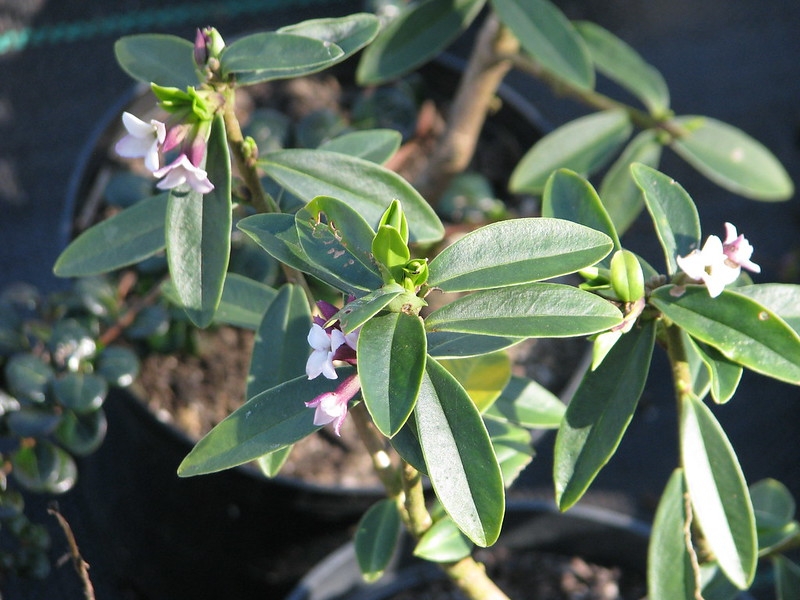
Tangut daphne is a compact, ornamental, evergreen or semi-deciduous shrub that grows 2 to 3 feet tall and equally as wide. It has shiny, dark, green, leathery, lanceolate leaves with fragrant clusters of small, white to purplish tubular blooms from April to June. It is native to Western and Central China and is found along forest margins, rocky areas, and shrublands. The genus name Daphne is derived from the Ancient Greek word meaning "laurel." The specific epithet, tangutica, is derived from the name of an ancient tribe known as Tanguts, which lived in the region of modern-day Qinghai and Gansu, China. This shrub is a member of the daphne family (Thymelaeaceae).
This shrub thrives in full sun to partial shade and well-drained, organic-rich soil with acidic to neutral pH. It is hardy in zones 6 to 9, and it benefits from a sheltered location for added protection from wind and cold. It is best to avoid planting in areas of hot afternoon sun.
Tangut daphne has attractive foliage, fragrant flowers that attract bees and butterflies in the spring, and clusters of red berries during the summer. It is resistant to rabbits and deer.
Consider this ornamental shrub for a border, foundation planting, or in a small garden. It may also be used in outdoor plant containers
Insects, Diseases, and Other Plant Problems: Overwatering or poorly drained soils can cause root rot. It is susceptible to aphids and viruses. All parts of this plant are poisonous. Keep out of the reach of children or pets.
- See this plant in the following landscape :
- Cultivars / Varieties:
-
- Tags:


- Cultivars / Varieties:
-
- Tags:
-
-
Attributes:
- Genus:
- Daphne
- Species:
- tangutica
- Family:
- Thymelaeaceae
- Recommended Propagation Strategy:
- Seed
- Stem Cutting
- Country Or Region Of Origin:
- West to Central China
- Distribution:
- Native: China North-Central, China South-Central, Qinghai, and Tibet
- Wildlife Value:
- Bright red drupe attracts birds. Flowers attract bees and butterflies.
- Dimensions:
- Height: 2 ft. 0 in. - 3 ft. 0 in.
- Width: 2 ft. 0 in. - 3 ft. 0 in.
-
-
Whole Plant Traits:
- Plant Type:
- Poisonous
- Shrub
- Habit/Form:
- Dense
- Mounding
- Growth Rate:
- Slow
- Maintenance:
- Low
- Texture:
- Medium
-
-
Cultural Conditions:
- Light:
- Full sun (6 or more hours of direct sunlight a day)
- Partial Shade (Direct sunlight only part of the day, 2-6 hours)
- Soil Texture:
- High Organic Matter
- Loam (Silt)
- Soil pH:
- Acid (<6.0)
- Neutral (6.0-8.0)
- Soil Drainage:
- Good Drainage
- Moist
- Available Space To Plant:
- 3 feet-6 feet
- NC Region:
- Coastal
- Mountains
- Piedmont
- USDA Plant Hardiness Zone:
- 6a, 6b, 7a, 7b, 8a, 8b, 9a, 9b
-
-
Fruit:
- Fruit Color:
- Red/Burgundy
- Display/Harvest Time:
- Summer
- Fruit Type:
- Drupe
- Fruit Length:
- < 1 inch
- Fruit Width:
- < 1 inch
- Fruit Description:
- The fruit is an oval, bright red drupe, and measures 1/3 inch wide. Fruits appear from May to July.
-
-
Flowers:
- Flower Color:
- Pink
- Purple/Lavender
- White
- Flower Value To Gardener:
- Fragrant
- Flower Bloom Time:
- Spring
- Flower Shape:
- Tubular
- Flower Petals:
- 4-5 petals/rays
- Flower Size:
- 1-3 inches
- Flower Description:
- Fragrant flowers are in dense, terminal 3-inch clusters. Each flower is about 0.5 inches wide, tubular with 4 ovate lobes. Each bloom is white, tinged with a purple interior. Two of the lobes are more deeply colored with a reddish-purple exterior. Flowers from April to June.
-
-
Leaves:
- Leaf Color:
- Green
- Leaf Feel:
- Glossy
- Leathery
- Leaf Type:
- Simple
- Leaf Arrangement:
- Alternate
- Leaf Shape:
- Lanceolate
- Oblanceolate
- Leaf Margin:
- Entire
- Hairs Present:
- No
- Leaf Length:
- 1-3 inches
- Leaf Width:
- < 1 inch
- Leaf Description:
- The leaves are simple, alternate, shiny, leathery, lanceolate to oblanceolate, notched at the apex, dark, bright green on the upper surface, and pale and dull on the underside. The margins of the leaf sometimes tend to roll downward toward the underside of the leaf. Each leaf measures about 1 to 3 inches long and 1/4 to 3/4 inches wide.
-
-
Stem:
- Stem Color:
- Brown/Copper
- Gray/Silver
- Stem Is Aromatic:
- No
- Stem Form:
- Straight
- Stem Description:
- The young stems are grayish-brown with pale gray bristles, but then become smooth.
-
-
Landscape:
- Landscape Location:
- Container
- Hanging Baskets
- Woodland
- Landscape Theme:
- Butterfly Garden
- Cottage Garden
- Pollinator Garden
- Rock Garden
- Design Feature:
- Specimen
- Attracts:
- Bees
- Butterflies
- Songbirds
- Resistance To Challenges:
- Deer
- Rabbits
-
-
Poisonous to Humans:
- Poison Severity:
- High
- Poison Symptoms:
- All parts of the plant are poisonous to humans if ingested. Symptoms include ulceration of the mouth, esophagus, and stomach, drooling, vomiting, bloody diarrhea, arrhythmias, delirium, seizures, coma, and death. Ingesting 10 to 12 berries can be fatal. Contact with this shrub can cause severe skin irritation.
- Poison Toxic Principle:
- daphnetoxin and mezerein
- Causes Contact Dermatitis:
- Yes
- Poison Part:
- Bark
- Flowers
- Fruits
- Leaves
- Roots
- Sap/Juice
- Seeds
- Stems