



Crataegus alabamensis
Common Name(s):
Previously known as:
- Crataegus adunca
- Crataegus dapsilis
- Crataegus fortis
- Crataegus ravenelii f. superba
- Phonetic Spelling
- krah-TEE-gus al-uh-bam-EN-sis
- Description
-
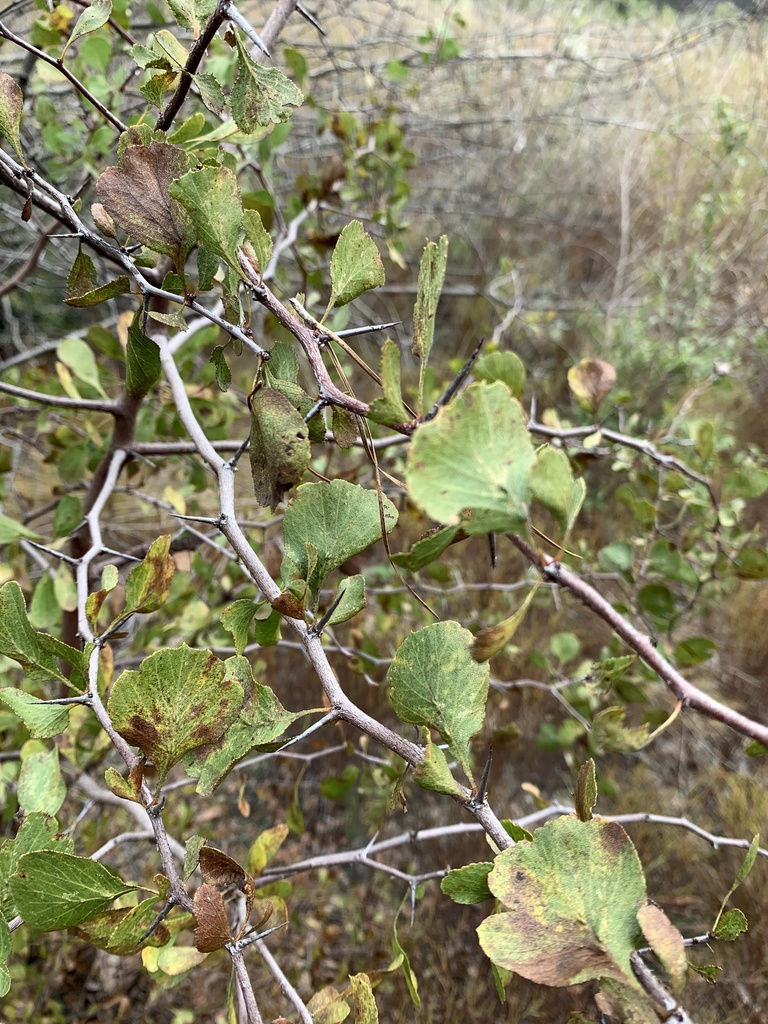
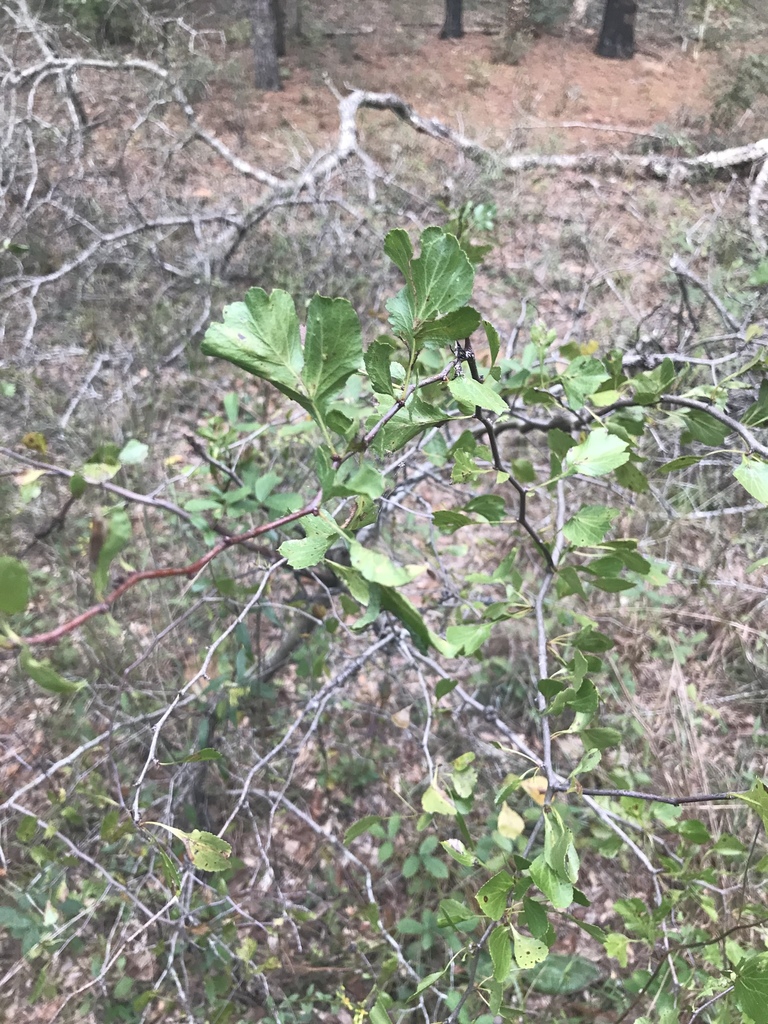
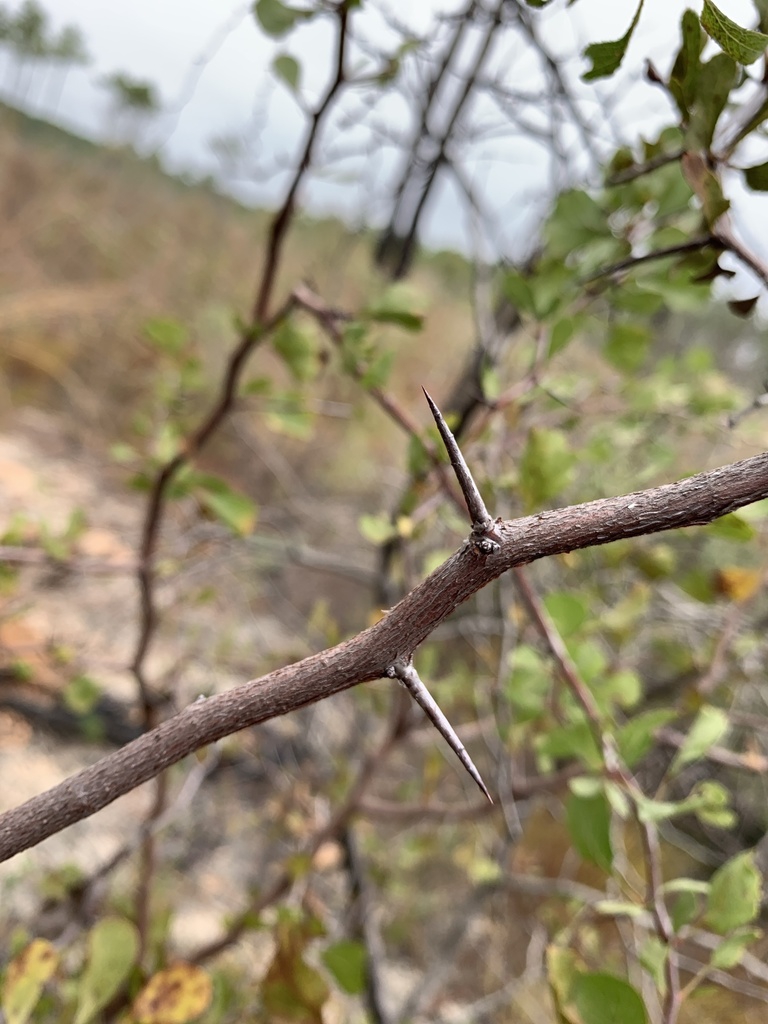
Alabama hawthorn is a native deciduous shrub or small tree in southern central Alabama and northern Florida, and found in pine and oak forests in clay soils. This plant grows 16 to 20 feet tall with weeping branches and long, straight thorns. Its dark green leaves are thick, rough, broadly oblong to cuneate with toothed margins. Small, fragrant, white flowers appear from March to April, and red pomes are produced from July to August. It is a member of the rose family (Rosaceae). The genus name Crataegus is derived from the Greek word kratos, meaning strength, and refers to the plant's hardwood. The specific epithet, alabamensis, is Latin, meaning "of Alabama."
Prefers full sun and moist, well-drained soils, but this specimen tends to thrive in clay soils in its native habitat.
This plant provides a nesting habitat for birds, and its thorny branches are an added protection. Alabama Hawthorn is a host plant for the larvae of the Gray hairstreak (Strymon melinus), Red-spotted purple (Limenitis arthemis astyanax), and the Viceroy (Limenitis archippus) butterflies.
Consider this shrub or small tree as a specimen, hedge, or group planting.
Insects, Diseases, and Other Plant Problems: Monitor for aphids, scale, borers, lace bugs, and caterpillars. May be susceptible to fire blight, rust, leaf spot, leaf blight, powdery mildew, and cankers.
- See this plant in the following landscape :
- Cultivars / Varieties:
-
- Tags:


- Cultivars / Varieties:
-
- Tags:
-
-
Attributes:
- Genus:
- Crataegus
- Species:
- alabamensis
- Family:
- Rosaceae
- Uses (Ethnobotany):
- The wood is strong, heavy, and hard, but rarely used in commercial applications. The leaves, berries, and flowers are used in medicines and herbals for cardiovascular health.
- Life Cycle:
- Woody
- Recommended Propagation Strategy:
- Seed
- Country Or Region Of Origin:
- South Central Alabama and Northern Florida
- Distribution:
- Native: Alabama and Florida
- Fire Risk Rating:
- low flammability
- Wildlife Value:
- Important nectar flower for insects; food plant of many moths including the eggar moth; haws provide winter fruit for songbirds. This plant provides nectar for other pollinators. It is a larval host plant for Gray Hairstreak (Strymon melinus), Red-spotted Purple (Limenitis arthemis astyanax), and Viceroy (Limenitis archippus). Red-spotted Purple and Viceroy rarely use this host plant in North Carolina. Good nesting habitat with thorns providing protection from predators.
- Play Value:
- Attracts Pollinators
- Edible fruit
- Wildlife Cover/Habitat
- Wildlife Food Source
- Wildlife Nesting
-
-
Whole Plant Traits:
- Plant Type:
- Shrub
- Tree
- Woody Plant Leaf Characteristics:
- Deciduous
- Habit/Form:
- Spreading
- Vase
- Growth Rate:
- Medium
- Maintenance:
- Low
- Texture:
- Coarse
- Appendage:
- Thorns
-
-
Cultural Conditions:
- Light:
- Full sun (6 or more hours of direct sunlight a day)
- Partial Shade (Direct sunlight only part of the day, 2-6 hours)
- Soil Texture:
- Clay
- Loam (Silt)
- Sand
- Soil pH:
- Acid (<6.0)
- Neutral (6.0-8.0)
- Soil Drainage:
- Moist
- Occasionally Wet
- USDA Plant Hardiness Zone:
- 8a, 8b, 9a, 9b, 10a, 10b
-
-
Fruit:
- Fruit Color:
- Red/Burgundy
- Fruit Value To Gardener:
- Edible
- Display/Harvest Time:
- Summer
- Fruit Type:
- Pome
- Fruit Length:
- < 1 inch
- Fruit Width:
- < 1 inch
- Fruit Description:
- The fruit is a small red pome with 1 to 5 pyrenes, resembling the “stones” in related plums and peaches. Sometimes they are called the ‘haw’. Fruits appear from July to August.
-
-
Flowers:
- Flower Color:
- White
- Flower Inflorescence:
- Corymb
- Flower Value To Gardener:
- Fragrant
- Showy
- Flower Bloom Time:
- Spring
- Flower Shape:
- Cup
- Flower Petals:
- 4-5 petals/rays
- Flower Size:
- < 1 inch
- Flower Description:
- Inflorescence with 3-6 flowers, hypanthium hairy and white. Flowers bloom from March to April. The fragrance of the flowers may be pleasant to some, and unpleasant to others.
-
-
Leaves:
- Woody Plant Leaf Characteristics:
- Deciduous
- Leaf Color:
- Green
- Leaf Feel:
- Glossy
- Rough
- Leaf Type:
- Simple
- Leaf Arrangement:
- Alternate
- Leaf Shape:
- Cuneate
- Oblong
- Leaf Margin:
- Crenate
- Serrate
- Hairs Present:
- Yes
- Leaf Length:
- 1-3 inches
- Leaf Description:
- The leaves are borne on hairy, slender petioles. Each leaf is 2 to 3 inches long, broadly oblong to cuneate, thick with crenate to serrate margins. There are 3 to 5 veins on each side of the leaf. The upper surface is shiny, and the lower surface is only hairy along the veins.
-
-
Bark:
- Bark Color:
- Black
- Dark Gray
- Light Gray
- Surface/Attachment:
- Smooth
- Bark Description:
- Thin, smooth, gray bark that becomes black with age. On old stems, it breaks up into narrow scales.
-
-
Stem:
- Stem Color:
- Gray/Silver
- Stem Is Aromatic:
- No
- Stem Surface:
- Hairy (pubescent)
- Stem Description:
- New growth is densely tomentose. One-year-old twigs are dark gray, and slender spines are present.
-
-
Landscape:
- Landscape Theme:
- Butterfly Garden
- Pollinator Garden
- Winter Garden
- Attracts:
- Bees
- Butterflies
- Pollinators
- Songbirds



