


Circaea canadensis
Common Name(s):
Previously known as:
- Circaea lutetiana subsp. canadensis
- Circaea lutetiana var. canadensis
- Circaea quadrisulcata var. canadensis
- Phonetic Spelling
- sir-KAY-ah kan-ah-DEN-sis
- Description
-
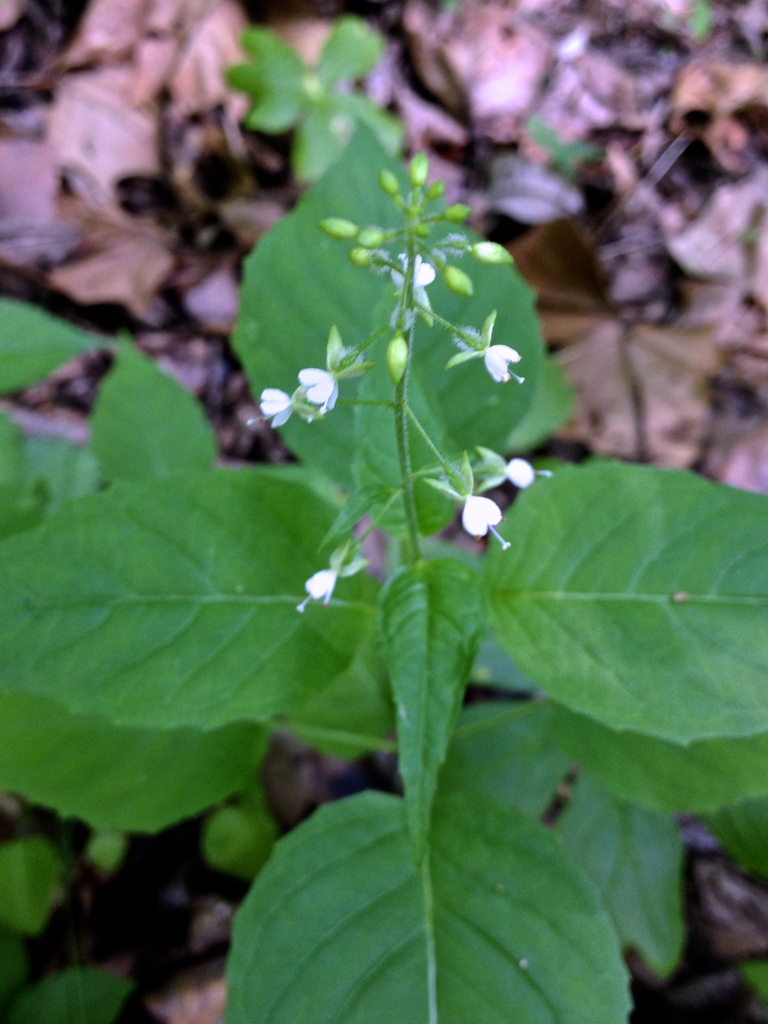
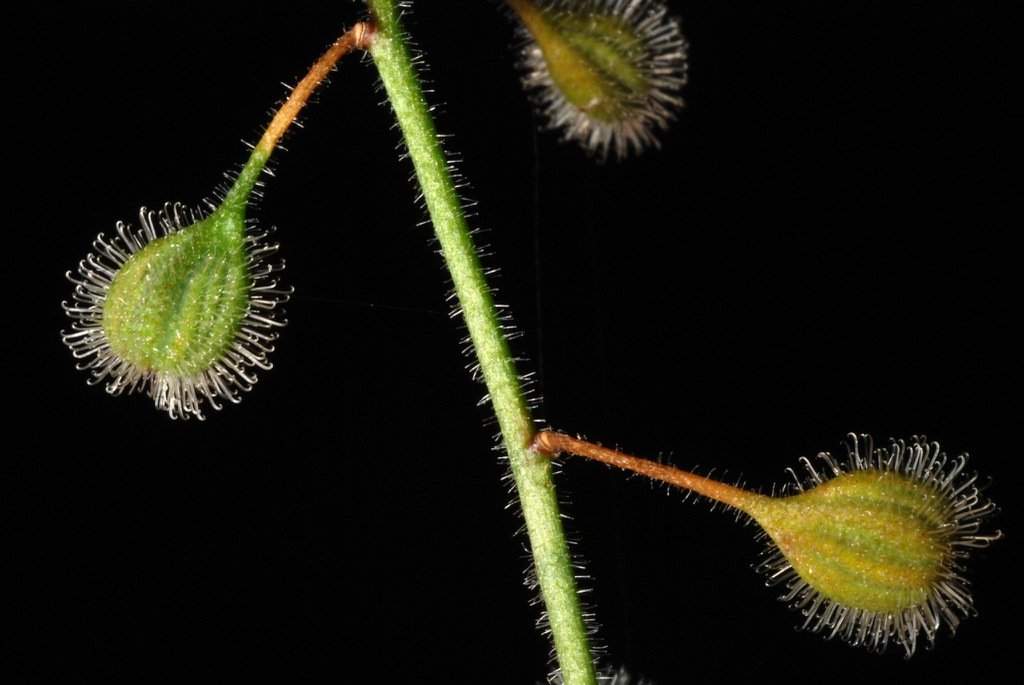
Broadleaf enchanter's nightshade is a native herbaceous perennial wildflower in the evening primrose family (Onagraceae), native of European Russia to North Central Japan, Central and Southeastern Canada, and North Central to Southeastern United States. It is found in moist, shaded woods or thickets, forming small colonies. It grows 1 to 2 feet tall and has a green, unbranched main stem. The delicate flowers appear on a terminal raceme and are sparsely scattered, with white to pinkish blooms that are 2-petaled and deeply notched. Its leaves are medium to deep green, oval to oblong, with toothed margins. Its fruits appear soon after flowering and present as a bristly or bur-like capsule that easily attaches to animals and to our clothing. The genus name Circaea is derived from Greek mythology and refers to the Greek goddess and enchantress, Circe, known for her knowledge of herbs. The specific epithet, canadensis, means "of Canada."
Prefers dappled sunlight or medium shade and grows in rich, moist, to medium-dry, organically rich to loamy soils. It spreads by short rhizomes and seeds. Deer like to browse this plant, and the nectar and pollen attract carpenter bees. The fruit capsule easily attaches to wildlife such as animal fur or to birds' feathers, dispersing the seeds.
In North Carolina, this wildflower is common in the mountain region and in the northern portions of the Piedmont and Central Coastal Plain. The small white flowers bloom from June through August, and the fruits appear from July to September.
This native wildflower can be used in a woodland setting, naturalized area, or shade garden. Reportedly, this plant is becoming popular with native plant enthusiasts.
Insects, Diseases, and Other Plant Problems: Caterpillars, beetles, and sawflies chew on the foliage. Deer will sometimes browse the leaves. This plant can easily spread and may need to be controlled.
- See this plant in the following landscape :
- Cultivars / Varieties:
-
- Circaea canadensis subsp. canadensis
native of South Central & SE Canada to North Central to Eastern United States - Circaea canadensis subsp. quadrisulcata
native to European Russia & North and North Central Japan
- Circaea canadensis subsp. canadensis
- Circaea canadensis subsp. canadensis, Circaea canadensis subsp. quadrisulcata
- Tags:



- Cultivars / Varieties:
-
- Circaea canadensis subsp. canadensis
native of South Central & SE Canada to North Central to Eastern United States - Circaea canadensis subsp. quadrisulcata
native to European Russia & North and North Central Japan
- Circaea canadensis subsp. canadensis
- Circaea canadensis subsp. canadensis, Circaea canadensis subsp. quadrisulcata
- Tags:
-
-
Attributes:
- Genus:
- Circaea
- Species:
- canadensis
- Family:
- Onagraceae
- Uses (Ethnobotany):
- It has been used to treat wounds.
- Life Cycle:
- Perennial
- Recommended Propagation Strategy:
- Division
- Seed
- Country Or Region Of Origin:
- European Russia to Japan, parts of Canada, & parts of the US
- Distribution:
- Native: European Russia to North & North Central Japan, South Central & Southeast Canada, North Central & Eastern United States--AL, AR, CT, DE, DC, GA, IL, IN, IA, KS, KY, LA, ME, MD, MA, MI, MN, MS, MO, NE, NH, NJ, NY, NC, ND, OH, OK, PA, RI, SC, SD, TN, VT, VA, WV, WI, and WY; Central European Russia, China North-Cenral, East European Russia, Inner Mongolia, Japan, Kazakhstan, Korea, Manchuria, Manitoba, New Brunswick, North Caucasus, Nova Scotia, Prince Edward Island, Quebec, and Siberia.
- Wildlife Value:
- Browsed by deer. The pollen and nectar attract bees.
-
-
Whole Plant Traits:
- Plant Type:
- Herbaceous Perennial
- Habit/Form:
- Clumping
- Erect
- Growth Rate:
- Medium
- Maintenance:
- Low
- Texture:
- Fine
-
-
Cultural Conditions:
- Light:
- Dappled Sunlight (Shade through upper canopy all day)
- Partial Shade (Direct sunlight only part of the day, 2-6 hours)
- Soil Texture:
- High Organic Matter
- Loam (Silt)
- Soil Drainage:
- Good Drainage
- Moist
- NC Region:
- Coastal
- Mountains
- Piedmont
- USDA Plant Hardiness Zone:
- 5a, 5b, 6a, 6b, 7a, 7b, 8a, 8b, 9a, 9b
-
-
Fruit:
- Fruit Color:
- Green
- Display/Harvest Time:
- Summer
- Fruit Type:
- Capsule
- Fruit Length:
- < 1 inch
- Fruit Width:
- < 1 inch
- Fruit Description:
- The fruit is a green, oval, 2-chambered seed capsule, grooved, ridged, covered with hooked or bristly hairs that can attach themselves to animal fur or clothing for dispersal. The capsule measures less than 0.25 inches long. There is one tear-drop-shaped seed in each chamber of the seed capsule. Fruits are present from July through September.
-
-
Flowers:
- Flower Color:
- Pink
- White
- Flower Inflorescence:
- Raceme
- Flower Bloom Time:
- Summer
- Flower Shape:
- Cup
- Flower Petals:
- 2-3 rays/petals
- Flower Size:
- < 1 inch
- Flower Description:
- Tiny white to pinkish, 2-petaled flowers appear at the top of the stem in a loose, 6-inch-long raceme from June through August. The blooms are sparse but spaced evenly on slender pedicels. Each bloom measures 1/8 to 1/4 inch across. The two petals are notched halfway into 2 lobes, with 2 green, oval-shaped sepals, two white stamens, and one pistil. The hairy, two-celled ovary sits below the flower.
-
-
Leaves:
- Leaf Color:
- Green
- Leaf Type:
- Simple
- Leaf Arrangement:
- Opposite
- Leaf Shape:
- Oblong
- Ovate
- Leaf Margin:
- Dentate
- Hairs Present:
- Yes
- Leaf Length:
- 3-6 inches
- Leaf Width:
- 1-3 inches
- Leaf Description:
- The green leaves are oblong to egg-shaped, 2 to 6 inches long and up to 3 inches wide, with a pointed tip, toothed margins, and a rounded base on a long stalk. The upper surface is smooth and medium to dark green, while the lower surface is paler and softer with fine whitish hair. The teeth have a tiny whitish tip. The leaves tend to be smaller toward the upper stem. The petioles are medium green and up to 1.5 inches long.
-
-
Stem:
- Stem Color:
- Green
- Stem Is Aromatic:
- No
- Stem Form:
- Straight
- Stem Surface:
- Smooth (glabrous)
- Stem Description:
- The single, green stems have scattered white stems, but as the plant ages, it becomes smooth,
-
-
Landscape:
- Landscape Location:
- Naturalized Area
- Woodland
- Landscape Theme:
- Shade Garden
- Attracts:
- Bees
- Pollinators
- Small Mammals
- Songbirds