


Oclemena acuminata
Common Name(s):
Previously known as:
- Aster acuminatus
- Aster acuminatus var. magdalenensis
- Phonetic Spelling
- ock-la-MEH-nah ah-kew-min-NAH-ta
- Description
-
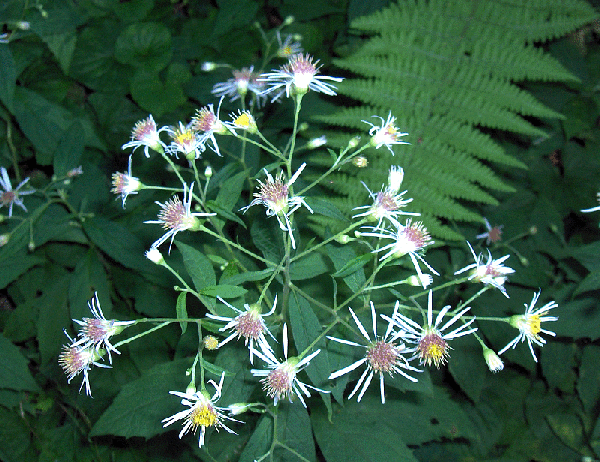
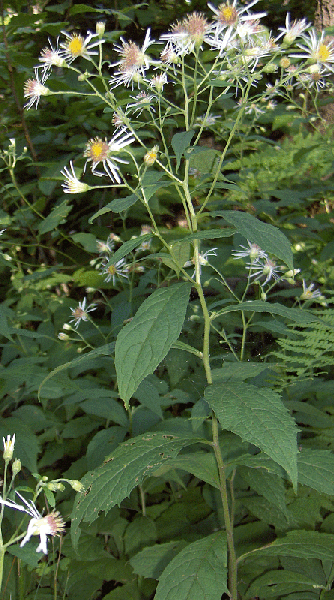
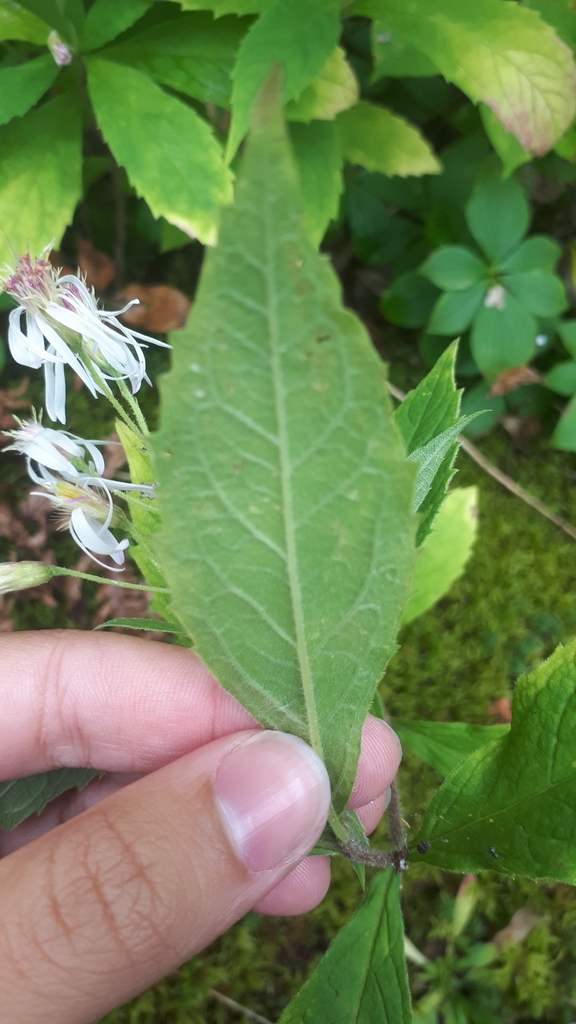
Whorled wood aster is a rhizomatous native wildflower found in the mountains of North Carolina, from eastern Canada to the eastern United States, and as far south as Georgia, in wooded forests or woodland edges. This wildflower belongs to the daisy family (Asteraceae). It spreads by underground runners, forming colonies, and grows 1 to 2 feet tall and equally as wide. The upright stems have a somewhat zigzag pattern, and the leaves are clustered in whorls along the stem. The lance-shaped leaves, with toothed margins and a long, pointed, thin tip, appear larger on the upper stem than the lower stem. The flowers have white petal rays and a yellow or red center, blooming from July to mid-October. The specific epithet acuminata means "tapered, pointed, or sharp." This likely refers to the leaf's pointed tips
The whorled wood aster prefers partial to full shade and cool to humid forests in moist, well-drained acidic soils. It supports pollinators and other wildlife. Propagation methods include division and seeds.
Use in woodland gardens, shade gardens, or naturalized settings to add late summer and fall color.
Insects, Diseases, and Other Plant Problems: Monitor for spider mites, lace bugs, leaf minters, leaf hoppers, and thrips. May be susceptible to powdery mildew or root rot.
- See this plant in the following landscape :
- Cultivars / Varieties:
-
- Tags:


- Cultivars / Varieties:
-
- Tags:
-
-
Attributes:
- Genus:
- Oclemena
- Species:
- acuminata
- Family:
- Asteraceae
- Life Cycle:
- Perennial
- Recommended Propagation Strategy:
- Division
- Seed
- Country Or Region Of Origin:
- Eastern Canada to the Eastern United States
- Distribution:
- Native: Canada--New Brunswick, Newfoundland, Nova Scotia, Ontario, Prince Edward Island, and Quebec; United States--Connecticut, Georgia, Kentucky, Maine, Maryland, Massachusetts, New Hampshire, New Jersey, New York, North Carolina, Ohio, Pennsylvania, Rhode Island, Tennessee, Vermont, Virginia, and West Virginia. Introduced: Switzerland
- Wildlife Value:
- Bees and butterflies will visit the flowers for nectar, and ruffled grouse will eat the seeds. Eastern chipmunks and white-footed mice will browse the foliage. Used by the Pearly Crescent caterpillars as a larval host plant.
- Play Value:
- Attractive Flowers
- Attracts Pollinators
- Colorful
- Wildlife Food Source
- Wildlife Larval Host
- Dimensions:
- Height: 1 ft. 0 in. - 2 ft. 0 in.
- Width: 1 ft. 0 in. - 2 ft. 0 in.
-
-
Whole Plant Traits:
- Plant Type:
- Herbaceous Perennial
- Native Plant
- Wildflower
- Habit/Form:
- Erect
- Growth Rate:
- Medium
- Maintenance:
- Low
- Texture:
- Medium
-
-
Cultural Conditions:
- Light:
- Deep shade (Less than 2 hours to no direct sunlight)
- Full sun (6 or more hours of direct sunlight a day)
- Partial Shade (Direct sunlight only part of the day, 2-6 hours)
- Soil Texture:
- Loam (Silt)
- Soil pH:
- Acid (<6.0)
- Soil Drainage:
- Good Drainage
- Moist
- Available Space To Plant:
- 12 inches-3 feet
- NC Region:
- Mountains
- USDA Plant Hardiness Zone:
- 4a, 4b, 5a, 5b, 6a, 6b, 7a, 7b
-
-
Fruit:
- Fruit Color:
- Cream/Tan
- Fruit Type:
- Achene
- Fruit Length:
- < 1 inch
- Fruit Width:
- < 1 inch
- Fruit Description:
- The fruit is a cypsela, but is often called an achene. It is tan, spindle-shaped, smooth, gland-dotted, with 3 to 5 ribs. It also has whitish bristled pappi.
-
-
Flowers:
- Flower Color:
- Gold/Yellow
- Pink
- Red/Burgundy
- White
- Flower Inflorescence:
- Corymb
- Flower Value To Gardener:
- Long Bloom Season
- Showy
- Flower Bloom Time:
- Fall
- Summer
- Flower Shape:
- Radial
- Flower Petals:
- 7 - 20 petals/rays
- Flower Size:
- 1-3 inches
- Flower Description:
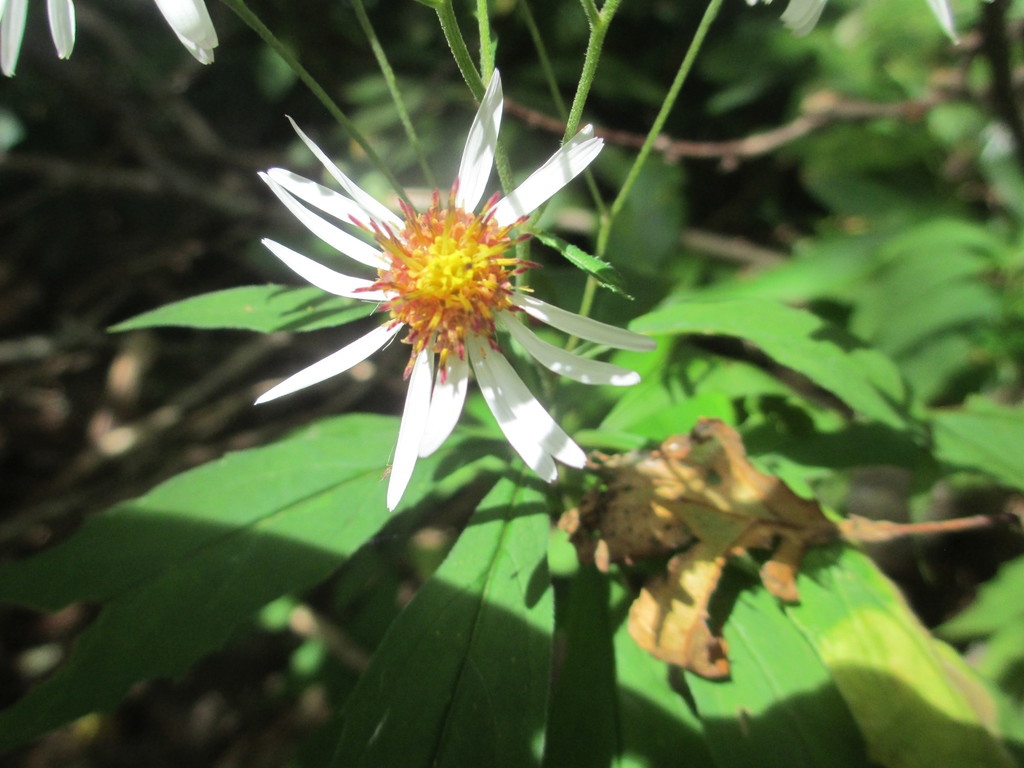
- The composite flowers measure 1 to 1.5 inches in diameter. Each bloom has 10 to 17 white, or sometimes pinkish, petal rays surrounding a center yellow or red disc. It has straw colored bracts that are sharply pointed and layered. Blooms July through October.
-
-
Leaves:
- Leaf Color:
- Green
- Leaf Type:
- Simple
- Leaf Arrangement:
- Alternate
- Whorled
- Leaf Shape:
- Elliptical
- Lanceolate
- Leaf Margin:
- Serrate
- Hairs Present:
- Yes
- Leaf Length:
- 1-3 inches
- Leaf Width:
- < 1 inch
- Leaf Description:
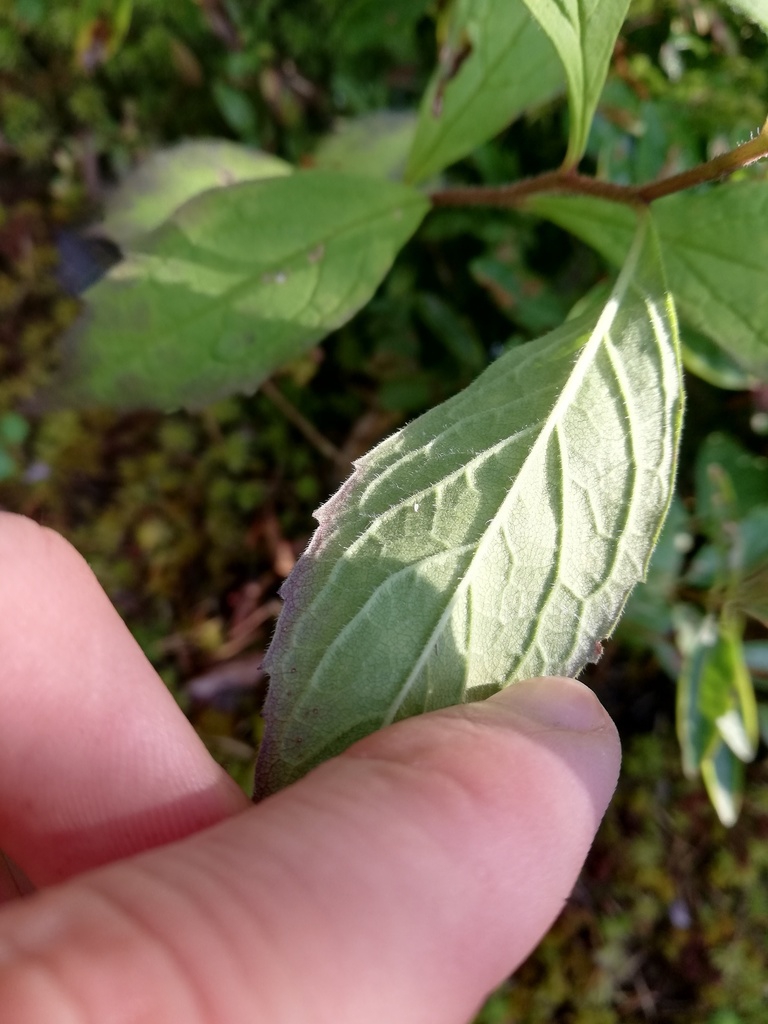
- This plant usually has 10 to 20 leaves below the flower cluster. The leaves are simple, coarsely toothed, alternately spiraled up the stem, and appear whorled and crowded near the top. They are lance-shaped or elliptic, with acuminate tips, and one main vein running from the base to the tip. Undersides are sticky. They are 2.5 inches long and 0.75 inches wide. They are hairy and sessile.
-
-
Stem:
- Stem Color:
- Green
- Stem Is Aromatic:
- No
- Stem Cross Section:
- Round
- Stem Form:
- Zig Zags
- Stem Surface:
- Hairy (pubescent)
- Stem Description:
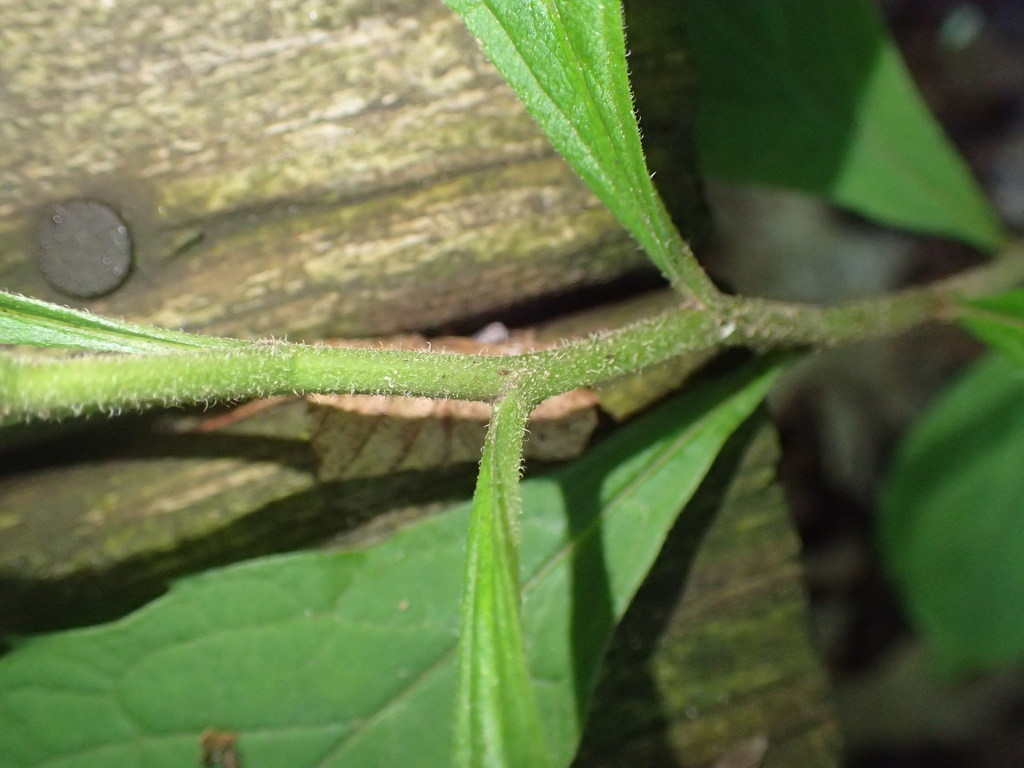
- The stems are green, erect, and have a somewhat zigzag pattern. They are circular and slightly hairy.
-
-
Landscape:
- Landscape Location:
- Slope/Bank
- Woodland
- Landscape Theme:
- Butterfly Garden
- Native Garden
- Shade Garden
- Attracts:
- Bees
- Butterflies
- Small Mammals
- Resistance To Challenges:
- Humidity