



Melampodium leucanthum
Common Name(s):
- Phonetic Spelling
- mel-am-POH-dee-um lew-KAN-thum
- Description
-
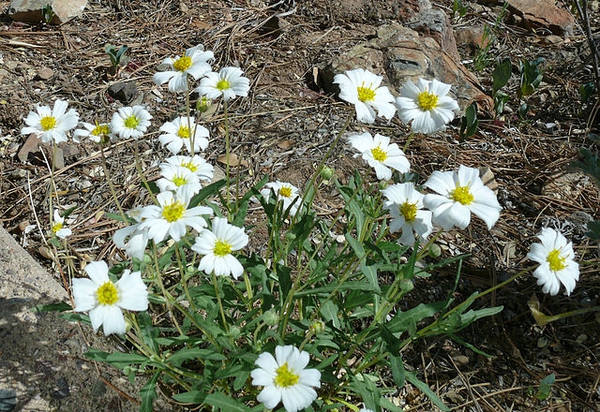
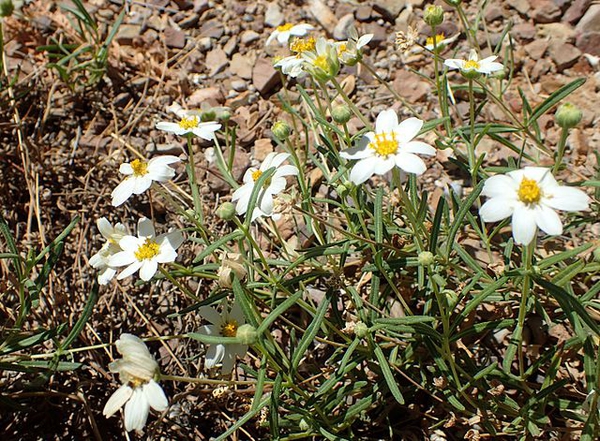
Blackfoot Daisy is a low, bushy, rounded and erect, long-blooming perennial wildflower in the daisy family. It is a sturdy, mounding plant that will flourish in rock gardens and grow up to 12 inches tall and twice as wide. It has narrow, grayish-green leaves and blooms in the summer with uniform white flowers that last until frost.
This plant requires full sun and needs to be planted deep in soil. It is heat and drought tolerant, and tolerant of nutritionally poor soils. It is a low water use plant. Good drainage is essential. You can cut the plant back to half its size in late winter to keep it compact. You can also increase flower production with rich soil and abundant water, but this will likely shorten the lifespan of the plant. This plant has a taproot and, thus, is not subject to propagation by division.
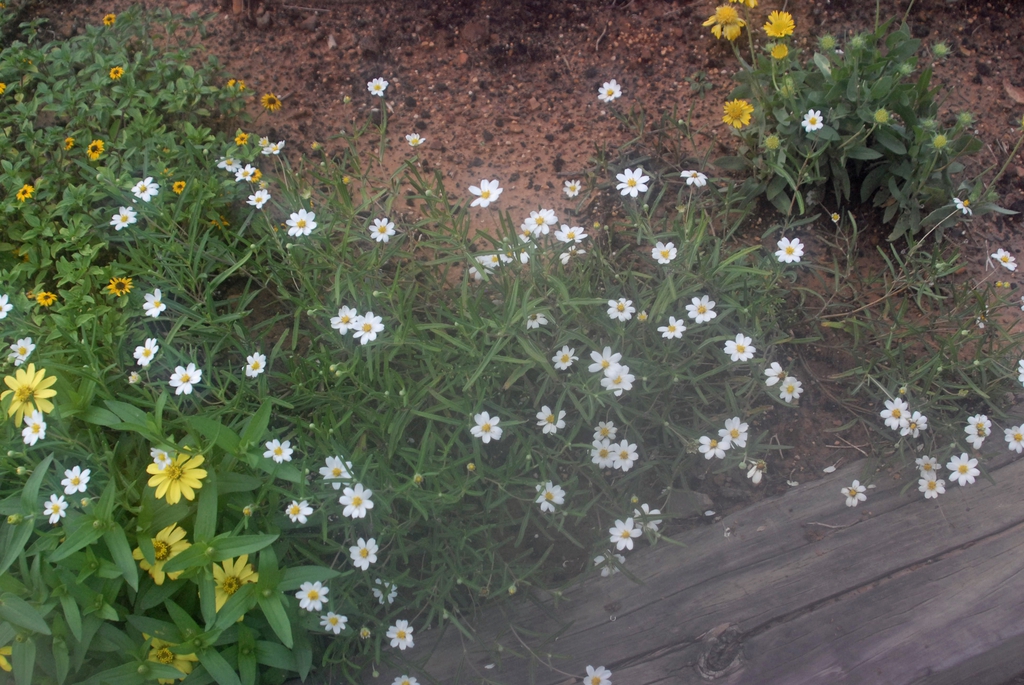
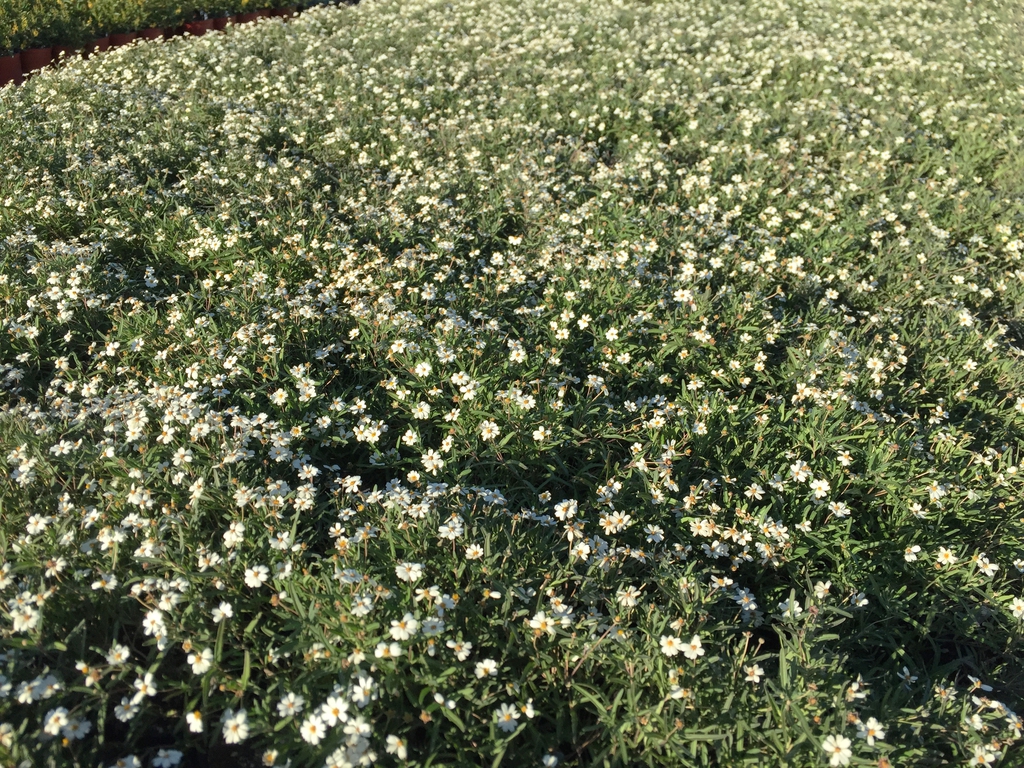
Along with rock gardens, this plant can also be utilized in mass planting, borders, or in the middle of flower beds. It does not require deadheading to continue producing flowers, but deadheading will tend to limit self-seeding. Note that birds are also attracted to the seeds.
At first glance, Blackfoot Daisy appears to be the twin of White Zinnia (Zinnia acerosa), but flower heads of the latter species have 4 to 7 broad white rays and a narrow base of several overlapping scales.
Quick ID Hints:
- Erect herb with white flowers in heads
- Heads with single row ray flowers
- Peduncle with 2 rows of erect white hairs
Diseases, Insect Pests, and Other Plant Problems:
No known diseases or insect pests. It is susceptible to powdery mildew in hot, humid environments.
- See this plant in the following landscape :
- Cultivars / Varieties:
-
- Tags:


- Cultivars / Varieties:
-
- Tags:
-
-
Attributes:
- Genus:
- Melampodium
- Species:
- leucanthum
- Family:
- Asteraceae
- Life Cycle:
- Perennial
- Recommended Propagation Strategy:
- Seed
- Country Or Region Of Origin:
- North American Sonoran desert
- Distribution:
- Prairie, Plains, Meadows, Pastures, Savannas, Dry calcalreous substrates across the western and south western parts of North America.
- Wildlife Value:
- Birds love the seeds
- Dimensions:
- Height: 0 ft. 6 in. - 1 ft. 0 in.
- Width: 1 ft. 0 in. - 2 ft. 0 in.
-
-
Whole Plant Traits:
- Plant Type:
- Herbaceous Perennial
- Wildflower
- Habit/Form:
- Clumping
- Erect
- Rounded
- Growth Rate:
- Medium
- Maintenance:
- Low
-
-
Cultural Conditions:
- Light:
- Full sun (6 or more hours of direct sunlight a day)
- Soil Texture:
- Sand
- Shallow Rocky
- Soil pH:
- Alkaline (>8.0)
- Soil Drainage:
- Good Drainage
- Moist
- Available Space To Plant:
- 12 inches-3 feet
- NC Region:
- Coastal
- Mountains
- Piedmont
- USDA Plant Hardiness Zone:
- 4a, 4b, 5a, 5b, 6a, 6b, 7a, 7b, 8a, 8b, 9a, 9b, 10a, 10b, 11a, 11b
-
-
Flowers:
- Flower Color:
- White
- Flower Inflorescence:
- Head
- Flower Value To Gardener:
- Fragrant
- Long Bloom Season
- Flower Bloom Time:
- Fall
- Spring
- Summer
- Flower Shape:
- Radial
- Flower Petals:
- 7 - 20 petals/rays
- Flower Size:
- 1-3 inches
- Flower Description:
- Daisy like flowers with 8 to 13 white rays surrounding a small yellow disc. Ray flowers are in a single series. Inflorescence is a head on terminal, elongated peduncles, 1-1 and 1/2" in diameter. There are few involucral bracts, they are 4-6 in a single series, and are broad and obtuse. Peduncle has 2 rows of erect, whitish hairs.
-
-
Leaves:
- Leaf Color:
- Green
- Leaf Type:
- Simple
- Leaf Arrangement:
- Opposite
- Leaf Shape:
- Linear
- Oblong
- Leaf Margin:
- Entire
- Lobed
- Hairs Present:
- Yes
- Leaf Length:
- 1-3 inches
- Leaf Description:
- Leaves are linear-oblong, entire to pinnately lobed, have rough hairs, and are 1-2" long.
-
-
Stem:
- Stem Is Aromatic:
- No
-
-
Landscape:
- Landscape Location:
- Container
- Naturalized Area
- Slope/Bank
- Landscape Theme:
- Drought Tolerant Garden
- Pollinator Garden
- Rock Garden
- Design Feature:
- Border
- Mass Planting
- Specimen
- Attracts:
- Butterflies
- Pollinators
- Songbirds
- Resistance To Challenges:
- Deer
- Drought
- Heat
- Poor Soil



