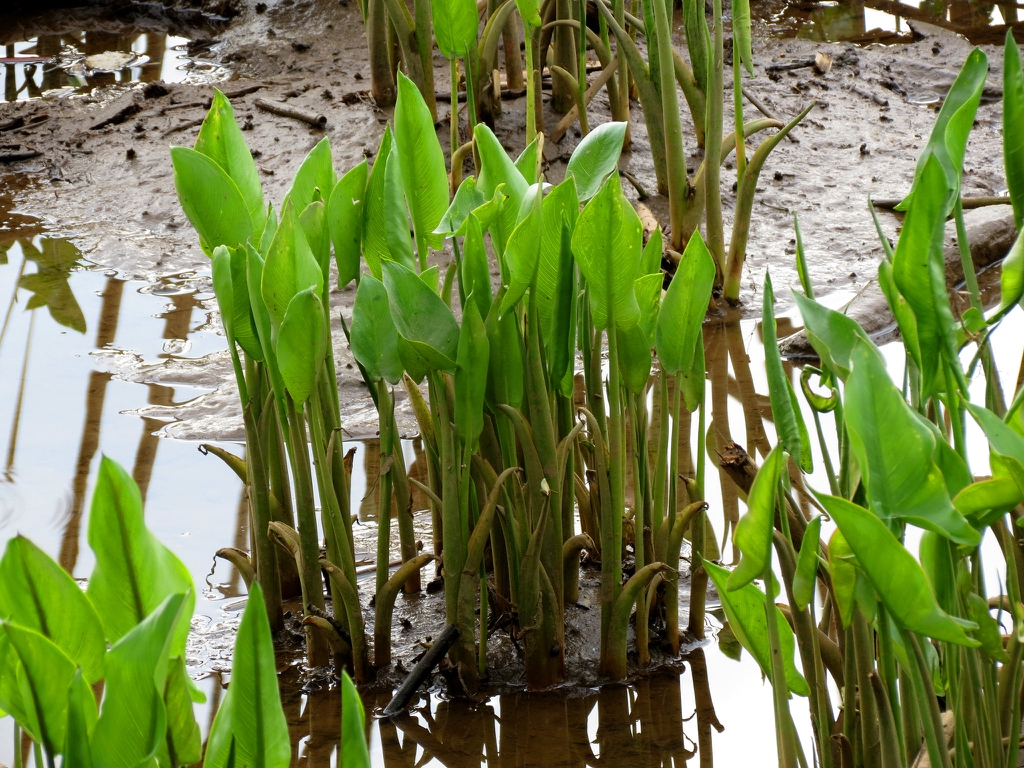
Green Arrow-arum Peltandra virginica
Other Common Name(s):
- Phonetic Spelling
- pelt-AN-dra vir-JIN-ih-kuh
- This plant has medium severity poison characteristics.
- See below
- Description
-
Green Arrow-arum is a flowering, herbaceous perennial, aquatic plant in the arum family native to Canada and eastern and central North America. It is commonly found in freshwater bogs, ponds and marshy areas. The large leaves are variable in shape and size, but they are often generally arrowhead-shaped. They grow from a large submerged rhizome and are tolerant of low oxygen water conditions. The greenish-white or yellow flowers appear in spring in a spadix, hidden behind a 8 inch light green spathe. The plant is deciduous in the northern range and evergreen in the far south. The genus name comes from the Greek words for a shield and man (andros). The species name means of Virginia.
Green Arrow-arum requires wet, acidic, consistently boggy, soils (muck containing organic matter, sand, or peat) in fresh water up to 6 inches deep. The acidic soil should have a mean pH of 4.8 (range 4.0 to 6.0). It does best sited in full sun to part shade, but will tolerates full shade.You can grow it in shallow ponds with earth at the bottom or in large containers or tubs.
If conditions are favorable, Green Arrow-arum can form dense colonies of expanding clumps over time. However, it does not colonize aggressively.
Clemson University Home and Garden Information Center has a factsheet on "Shorescaping Freshwater Shorelines" including information on planting Green Arrow-arum.
Diseases, Insect Pests, and Other Plant Problems:
No known diseases or insect pests.
- See this plant in the following landscape :
- Cultivars / Varieties:
-
- Tags:
- Cultivars / Varieties:
-
- Tags:
-
-
Attributes:
- Genus:
- Peltandra
- Species:
- virginica
- Family:
- Araceae
- Life Cycle:
- Perennial
- Recommended Propagation Strategy:
- Division
- Root Cutting
- Seed
- Country Or Region Of Origin:
- Eastern Canada, Eastern and Central United States
- Distribution:
- Maine to Minnesota south to Florida and Texas, Cuba, California and Oregon.
- Wildlife Value:
- Green Arrow-arum fruit is a preferred food of wood ducks, muskrats and rails.
- Edibility:
- Plant is toxic, but cooking eliminates the toxic element.
- Dimensions:
- Height: 1 ft. 6 in. - 3 ft. 0 in.
- Width: 1 ft. 6 in. - 2 ft. 0 in.
-
-
Whole Plant Traits:
- Plant Type:
- Herbaceous Perennial
- Native Plant
- Water Plant
- Wildflower
- Habit/Form:
- Clumping
- Creeping
- Dense
- Spreading
- Maintenance:
- Medium
-
-
Cultural Conditions:
- Light:
- Deep shade (Less than 2 hours to no direct sunlight)
- Full sun (6 or more hours of direct sunlight a day)
- Partial Shade (Direct sunlight only part of the day, 2-6 hours)
- Soil Texture:
- High Organic Matter
- Loam (Silt)
- Sand
- Soil pH:
- Acid (<6.0)
- Soil Drainage:
- Frequent Standing Water
- Moist
- Occasionally Wet
- NC Region:
- Coastal
- Mountains
- Piedmont
- USDA Plant Hardiness Zone:
- 5a, 5b, 6a, 6b, 7a, 7b, 8a, 8b, 9a, 9b
-
-
Fruit:
- Fruit Color:
- Brown/Copper
- Green
- Display/Harvest Time:
- Summer
- Fruit Type:
- Berry
- Fruit Description:
- Soft green to brown oval cluster of berries with a few seeds. Displays from June to July. As the berries mature, the peduncle bends downward, inserting the berries into the water where they are distributed.
-
-
Flowers:
- Flower Color:
- Gold/Yellow
- White
- Flower Inflorescence:
- Spadix
- Flower Value To Gardener:
- Showy
- Flower Bloom Time:
- Spring
- Summer
- Flower Shape:
- Dome
- Flower Description:
- The flower varies from whitish to greenish to yellow. The plant has both male and female flowers. The tiny flowers are arranged along a cylindrical spadix that is surrounded by a narrow, 3 to 6 inch spathe. Each spadix (male flowers on top, sterile flowers in middle and female flowers at bottom) is enveloped by a pointed, leaf-like, light green 8 inch spathe. Blooms from April to June.
-
-
Leaves:
- Leaf Color:
- Green
- Purple/Lavender
- Leaf Type:
- Simple
- Leaf Arrangement:
- Alternate
- Leaf Margin:
- Entire
- Hairs Present:
- No
- Leaf Length:
- > 6 inches
- Leaf Width:
- > 6 inches
- Leaf Description:
- The leaves are quite variable in shape and size, but they are often generally arrowhead-shaped. The parallel to spreading leaves are 8 to 24 inches long and 4 to 10 inches across.
-
-
Stem:
- Stem Color:
- Green
- Purple/Lavender
- Stem Is Aromatic:
- No
- Stem Description:
- Tall, 24 inch, green to purple stems rise from thick roots. Stems support clumps of arrowhead shaped, glossy, green leaves. The stems are green to green-purple to purple.
-
-
Landscape:
- Landscape Location:
- Naturalized Area
- Pond
- Landscape Theme:
- Native Garden
- Rain Garden
- Water Garden
- Attracts:
- Songbirds
-
-
Poisonous to Humans:
- Poison Severity:
- Medium
- Poison Symptoms:
- The plant is toxic if consumed affecting the mouth and digestive tract. However, the toxic element, calcium oxylate, is eliminated by thoroughly cooking or drying the plant.
- Poison Toxic Principle:
- Calcium oxylate
- Causes Contact Dermatitis:
- No
- Poison Part:
- Flowers
- Leaves
- Stems