


Odontostephana carolinensis
Common Name(s):
Previously known as:
- Gonolobus carolinensis
- Matelea carolinensis
- Vincetoxicum carolinense
- Vincetoxicum hirsutum
- Phonetic Spelling
- oh-DON-toh-STEF-uh-nuh kair-oh-lin-EN-sis
- Description
-
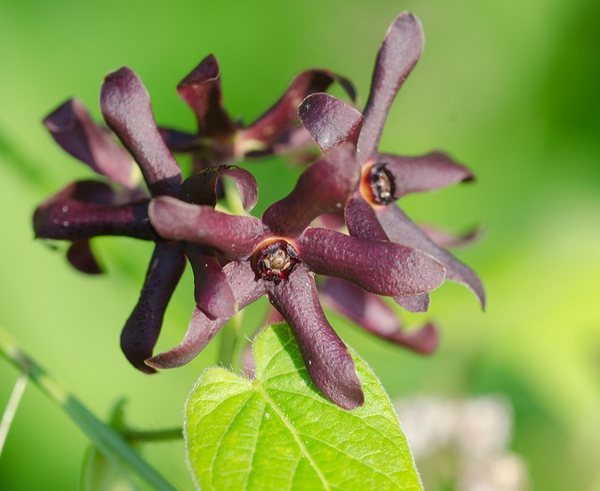
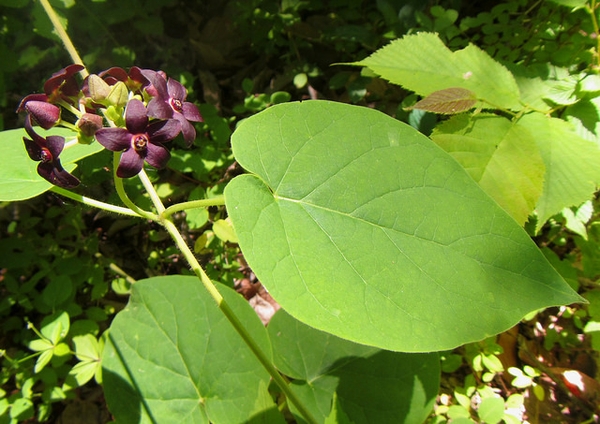
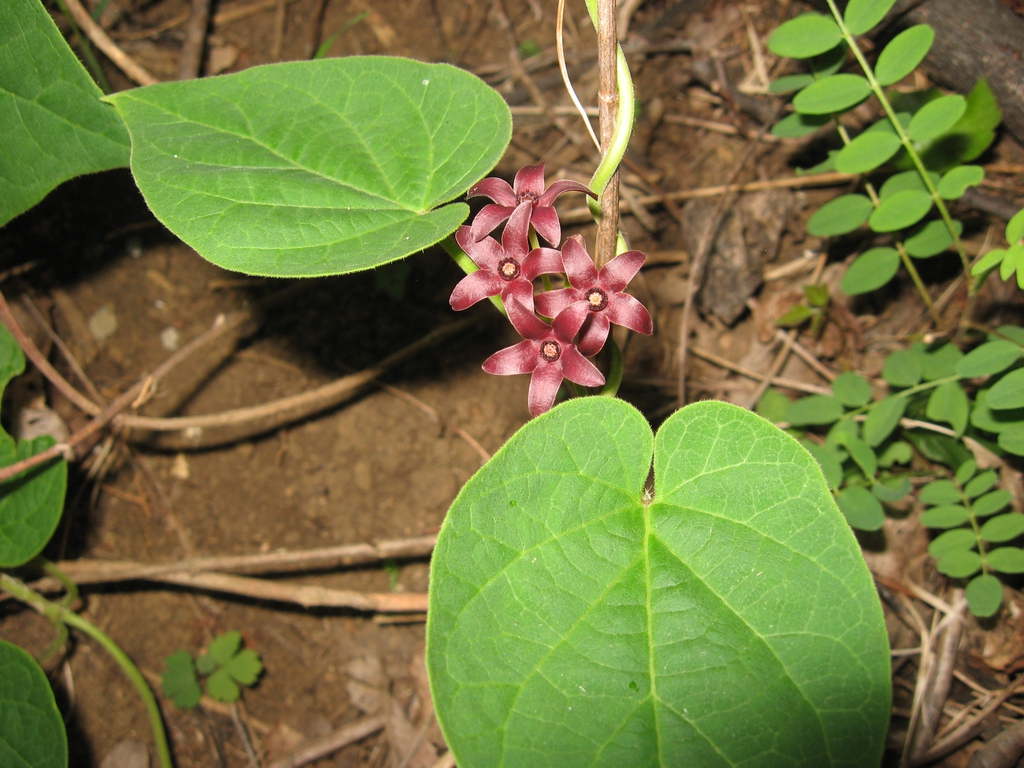
Carolina spinypod is a flowering herbaceous perennial vine native to the southeastern United States. It is typically found in sandy, loamy soils along streams, hardwood forests, riparian forests, old fields, and rocky outcrops. This species is somewhat variable, with blooms in some areas of the Southeast having small coronas, while others tend to have large flowers. The vine grows 6 to 12 feet tall and 3 to 6 feet wide; its stems are twining and hairy, and the leaves are heart-shaped. Flowers appear from April to August and are 5- petaled, star-shaped, brownish-purple to maroon, with recurved petals and a central corona. This perennial vine is in the dogbane family (Apocynaceae). The genus name Odontostephana is Greek in origin and derived from odon, meaning tooth, and stephana, meaning crown or garland. This refers to the flower corona or "toothed crown." The specific epithet carolinensis is Latin, meaning "of or from the Carolinas."
Prefers partial shade or dappled sunlight and moist to dry, well-drained, nutrient-rich soils with an acidic to neutral pH. It is hardy in zones 6 through 8. It is drought-tolerant once established. Provide a trellis or support for this twining vine.
In North Carolina, the Carolina spinypod, or maroon Carolina milkvine, is more common in the Piedmont region, and rare in the Coastal Plain and Mountains.
Consider the Carolina spinypod for a native garden or woodland setting.
Insects, Diseases, and Other Plant Problems: No serious insect pests or diseases.
- See this plant in the following landscape :
- Cultivars / Varieties:
-
- Tags:


- Cultivars / Varieties:
-
- Tags:
-
-
Attributes:
- Genus:
- Odontostephana
- Species:
- carolinensis
- Family:
- Apocynaceae
- Life Cycle:
- Perennial
- Recommended Propagation Strategy:
- Seed
- Country Or Region Of Origin:
- Southeastern United States
- Distribution:
- Native: Alabama, Delaware, District of Columbia, Georgia, Kentucky, Louisiana, Maryland, Mississippi, North Carolina, South Carolina, Tennessee, and Virginia.
- Wildlife Value:
- The flowers attract pollinating insects.
- Climbing Method:
- Twining
- Dimensions:
- Height: 6 ft. 0 in. - 12 ft. 0 in.
- Width: 3 ft. 0 in. - 6 ft. 0 in.
-
-
Whole Plant Traits:
- Plant Type:
- Native Plant
- Vine
- Wildflower
- Woody Plant Leaf Characteristics:
- Deciduous
- Habit/Form:
- Climbing
- Maintenance:
- Low
- Texture:
- Medium
-
-
Cultural Conditions:
- Light:
- Dappled Sunlight (Shade through upper canopy all day)
- Partial Shade (Direct sunlight only part of the day, 2-6 hours)
- Soil Texture:
- High Organic Matter
- Loam (Silt)
- Soil pH:
- Acid (<6.0)
- Neutral (6.0-8.0)
- Soil Drainage:
- Good Drainage
- Moist
- Occasionally Dry
- Available Space To Plant:
- 6-feet-12 feet
- NC Region:
- Coastal
- Piedmont
- USDA Plant Hardiness Zone:
- 6a, 6b, 7a, 7b, 8a, 8b
-
-
Fruit:
- Fruit Type:
- Follicle
- Fruit Description:
- The fruit is an oval- to lance-shaped, spiny follicle. The follicle measures 3 to 5 inches long and 0.5 to 1 inch wide. The seeds are brown, ovate, measuring 0.25 to 0.5 inches long. Fruits ripen from June to November.
-
-
Flowers:
- Flower Color:
- Brown/Copper
- Purple/Lavender
- Red/Burgundy
- Flower Inflorescence:
- Cyme
- Flower Bloom Time:
- Spring
- Summer
- Flower Shape:
- Cup
- Star
- Flower Petals:
- 4-5 petals/rays
- Flower Size:
- 3-6 inches
- Flower Description:
- The flowers are star-shaped, brownish-purple to maroon, measure 0.75 inches wide, and have 5 spreading to recurved petals and a central cup-like corona. Each petal is elliptical to oblong, with rounded tips. The flowers appear in clusters of 5 to 10 blooms. Blooms are present from April to August.
-
-
Leaves:
- Woody Plant Leaf Characteristics:
- Deciduous
- Leaf Color:
- Green
- Leaf Type:
- Simple
- Leaf Arrangement:
- Opposite
- Leaf Shape:
- Cordate
- Leaf Margin:
- Entire
- Hairs Present:
- Yes
- Leaf Length:
- 3-6 inches
- Leaf Description:
- The leaves are heart-shaped, with basal lobes that may overlap. They are arranged oppositely, with minute hairs, petiolate, and measure 2 to 4 inches long.
-
-
Stem:
- Stem Is Aromatic:
- No
- Stem Surface:
- Hairy (pubescent)
- Stem Description:
- The stems are slender, twining, climbing, hairy, and produce a milky sap when broken.
-
-
Landscape:
- Landscape Location:
- Riparian
- Slope/Bank
- Vertical Spaces
- Woodland
- Landscape Theme:
- Native Garden
- Attracts:
- Butterflies
- Pollinators
- Resistance To Challenges:
- Drought