


Malus toringo
Common Name(s):
Previously known as:
- Malus sargentii
- Malus sieboldii
- Phonetic Spelling
- MAY-lus tor-ING-oh
- Description
-
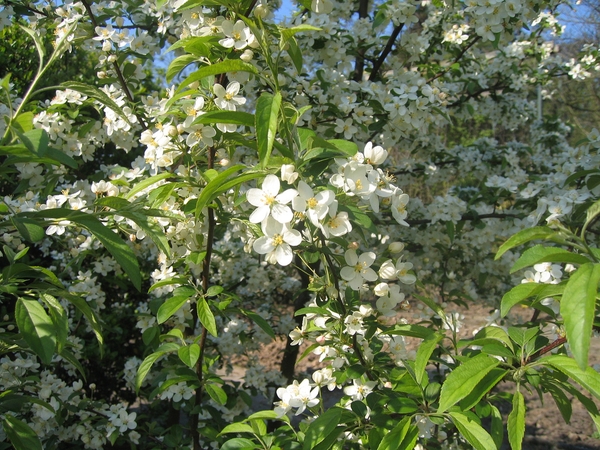
Sargent Crabapple is a flowering, deciduous shrub or small tree, native to Asia, with dense branching, a weeping habit, and a moderate growth rate. It tends to have a greater spread than height, 15 feet wide and 9 feet high at maturity. In spring, it produces pale pink buds and fragrant white flowers that are edible in small quantities. The fruit is edible, but not usually used in cooking. They do attract birds, however. The genus name comes from the Latin for apple. The species name honors Charles Sargent, the first director of Harvard University's Arnold Arboretum.
Sargent Crabapple does best in full sun, moist, well-drained soil. It tolerates most soil types including acidic loams and clay. The tree has some tolerance for drought once it is established and can be pruned in late winter. Avoid spring pruning, which can produce cuts that encourage firebright bacterium.
Sargent Crabapple works well as a hedge and is highly resistant to scab. However, this tree is frequently damaged by deer.
M. toringo is the older name for this plant and the one typically used, however, it can also be found under the name M. sieboldii.
Diseases, Insect Pests, and Other Plant Problems:
Sargent Crabapple is generally disease free. However, it can be susceptible to apple scab, leaf spot and fire blight, tent caterpillars, aphids, Japanese beetles, borers, spider mites and scale.
- See this plant in the following landscape :
- Mountain Ridgetop Garden - East Lawn and Lower Drive Border
- Cultivars / Varieties:
-
- Tags:

- Cultivars / Varieties:
-
- Tags:
-
-
Attributes:
- Genus:
- Malus
- Species:
- toringo
- Family:
- Rosaceae
- Life Cycle:
- Woody
- Country Or Region Of Origin:
- China, Japan, and Korea
- Distribution:
- Introduced into parts of eastern Canada and northeastern United States, Germany, Britain, and the Baltic States.
- Wildlife Value:
- Food source for birds, small mammals, and deer.
- Play Value:
- Wildlife Food Source
- Particularly Resistant To (Insects/Diseases/Other Problems):
- Highly resistant to scab
- Edibility:
- Flowers are edible in small quantities but contain the precursors to cyanide.
- Dimensions:
- Height: 6 ft. 0 in. - 8 ft. 0 in.
- Width: 9 ft. 0 in. - 15 ft. 0 in.
-
-
Whole Plant Traits:
- Plant Type:
- Edible
- Tree
- Woody Plant Leaf Characteristics:
- Deciduous
- Habit/Form:
- Dense
- Horizontal
- Mounding
- Spreading
- Weeping
- Growth Rate:
- Medium
- Maintenance:
- Low
- Texture:
- Medium
- Appendage:
- Thorns
-
-
Cultural Conditions:
- Light:
- Full sun (6 or more hours of direct sunlight a day)
- Soil Texture:
- Clay
- Loam (Silt)
- Shallow Rocky
- Soil Drainage:
- Good Drainage
- Available Space To Plant:
- 12-24 feet
- USDA Plant Hardiness Zone:
- 4a, 4b, 5a, 5b, 6a, 6b, 7a, 7b, 8a, 8b
-
-
Fruit:
- Fruit Color:
- Gold/Yellow
- Red/Burgundy
- Fruit Value To Gardener:
- Edible
- Showy
- Display/Harvest Time:
- Fall
- Fruit Type:
- Pome
- Fruit Length:
- < 1 inch
- Fruit Width:
- < 1 inch
- Fruit Description:
- This plant has 1/2 inch, yellow to red fruit. The small, red crabapples mature in the fall. The fruits are sweet-flavored like rose hips, long-lasting and attractive to birds.
-
-
Flowers:
- Flower Color:
- Pink
- White
- Flower Value To Gardener:
- Fragrant
- Good Cut
- Showy
- Flower Bloom Time:
- Spring
- Flower Size:
- < 1 inch
- Flower Description:
- This plant has pink buds that open to a profuse spring bloom of fragrant, 1 inch, white flowers. Blooms often occurs only in alternate years.
-
-
Leaves:
- Woody Plant Leaf Characteristics:
- Deciduous
- Leaf Color:
- Green
- Leaf Value To Gardener:
- Showy
- Leaf Type:
- Simple
- Leaf Arrangement:
- Alternate
- Leaf Shape:
- Ovate
- Leaf Margin:
- Lobed
- Hairs Present:
- Yes
- Leaf Description:
- Dark green leaves turn yellow in autumn. The yellow fall color contrasts well with the red fruit.
-
-
Stem:
- Stem Color:
- Purple/Lavender
- Stem Is Aromatic:
- No
- Stem Surface:
- Hairy (pubescent)
- Stem Description:
- Branches are spreading, purple, finely hairy at first.
-
-
Landscape:
- Landscape Location:
- Lawn
- Small Space
- Landscape Theme:
- Edible Garden
- Design Feature:
- Barrier
- Flowering Tree
- Hedge
- Attracts:
- Butterflies
- Hummingbirds
- Songbirds
- Resistance To Challenges:
- Poor Soil