


Magnolia 'Freeman'
Common Name(s):
- Phonetic Spelling
- mag-NO-lee-ah
- Description
-
Magnolia 'Freeman' is a cultivar selected from the hybrid offspring of Magnolia virginiana (sweetbay magnolia) and Magnolia grandiflora (southern magnolia). It is a member of the magnolia family (Magnoliaceae). Oliver Freeman was a botanist and supervised the construction of the newly established U.S. National Arboretum in the 1930's. He is best known for his work with crossing native tree species. The so-called Freeman hybrids were derived from crosses that he had made in 1930 and 1931. In 1962, Magnolia 'Freeman' was released as a cultivar by the U.S. National Arboretum.
It is a broadleaf evergreen tree with large, fragrant white flowers, a pleasant sweetbay fragrance, rather sweet and lemony. It has large blooms in the spring and may have repeat flowering in the summer. This specimen resembles Magnolia grandiflora, but has slightly narrower leaves and fewer fine fuzzy hairs. Magnolia 'Freeman' grows tall, up to 60 to 80 feet, but takes years to reach that height. Initially, the tree's habit is columnar, but it grows quite wide from 30 to 50 feet at full maturity. The tree provides cover for birds and other wildlife.
Prefers full sun to partial shade, especially in the afternoon, and moist, well-drained, organically rich, slightly acidic soil. This hybrid is hardy in zones 6b through 9.
It is unclear if this hybrid is still available commercially.
Insects, Diseases, and Other Plant Problems: Monitor for scale, tulip poplar weevil, and magnolia borer. May be susceptible to canker, blight, scabs, black mildew, and leaf spot.
- See this plant in the following landscape :
- Cultivars / Varieties:
-
- Tags:


- Cultivars / Varieties:
-
- Tags:
-
-
Attributes:
- Genus:
- Magnolia
- Family:
- Magnoliaceae
- Life Cycle:
- Woody
- Wildlife Value:
- Cover and habitat for birds and other wildlife.
- Play Value:
- Attractive Flowers
- Shade
- Wildlife Cover/Habitat
- Dimensions:
- Height: 60 ft. 0 in. - 80 ft. 0 in.
- Width: 30 ft. 0 in. - 50 ft. 0 in.
-
-
Whole Plant Traits:
- Plant Type:
- Tree
- Woody Plant Leaf Characteristics:
- Broadleaf Evergreen
- Habit/Form:
- Columnar
- Growth Rate:
- Medium
- Maintenance:
- Low
- Texture:
- Medium
-
-
Cultural Conditions:
- Light:
- Full sun (6 or more hours of direct sunlight a day)
- Partial Shade (Direct sunlight only part of the day, 2-6 hours)
- Soil Texture:
- Loam (Silt)
- Sand
- Soil pH:
- Acid (<6.0)
- Neutral (6.0-8.0)
- Soil Drainage:
- Good Drainage
- Moist
- Available Space To Plant:
- more than 60 feet
- NC Region:
- Coastal
- Mountains
- Piedmont
- USDA Plant Hardiness Zone:
- 6a, 6b, 7a, 7b, 8a, 8b, 9a, 9b
-
-
Flowers:
- Flower Color:
- White
- Flower Inflorescence:
- Solitary
- Flower Value To Gardener:
- Fragrant
- Showy
- Flower Bloom Time:
- Spring
- Summer
- Flower Shape:
- Cup
- Flower Petals:
- Tepals
- Flower Size:
- 3-6 inches
- Flower Description:
- Large, showy, white, fragrant flowers during the spring and summer.
-
-
Leaves:
- Woody Plant Leaf Characteristics:
- Broadleaf Evergreen
- Leaf Color:
- Green
- Leaf Feel:
- Glossy
- Leathery
- Leaf Value To Gardener:
- Showy
- Leaf Type:
- Simple
- Leaf Arrangement:
- Alternate
- Leaf Shape:
- Elliptical
- Ovate
- Leaf Margin:
- Entire
- Hairs Present:
- Yes
- Leaf Length:
- 3-6 inches
- Leaf Width:
- 1-3 inches
- Leaf Description:
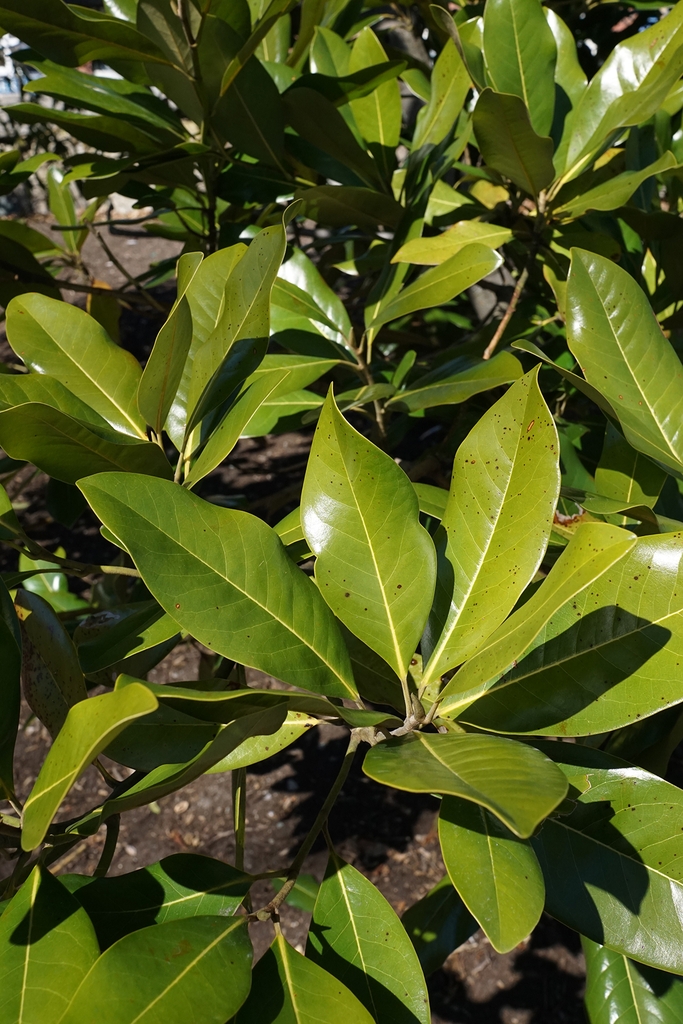
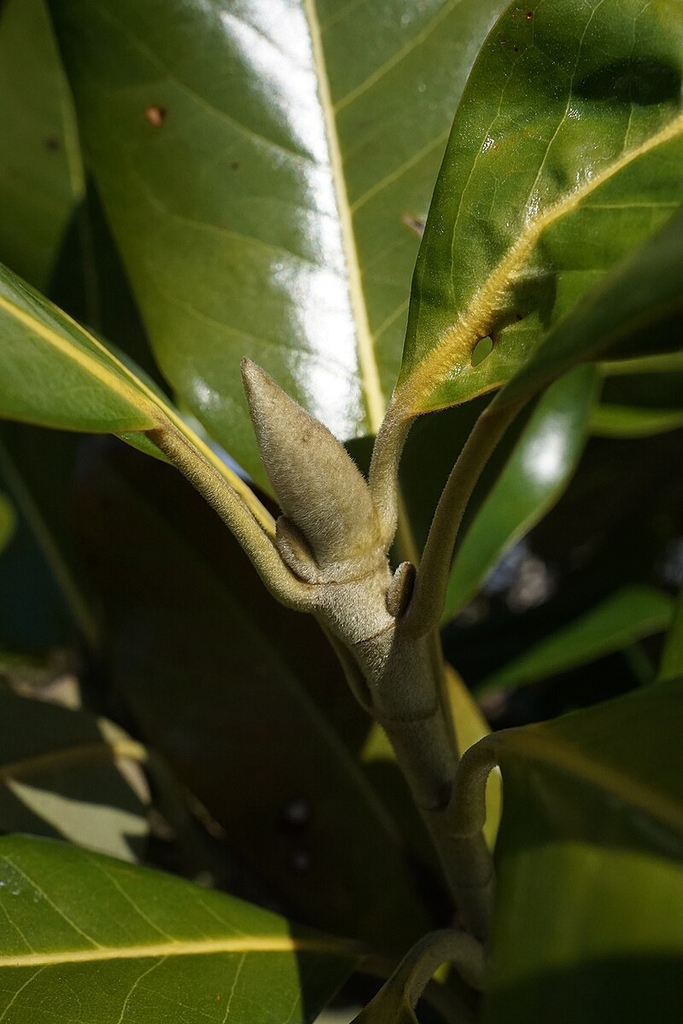
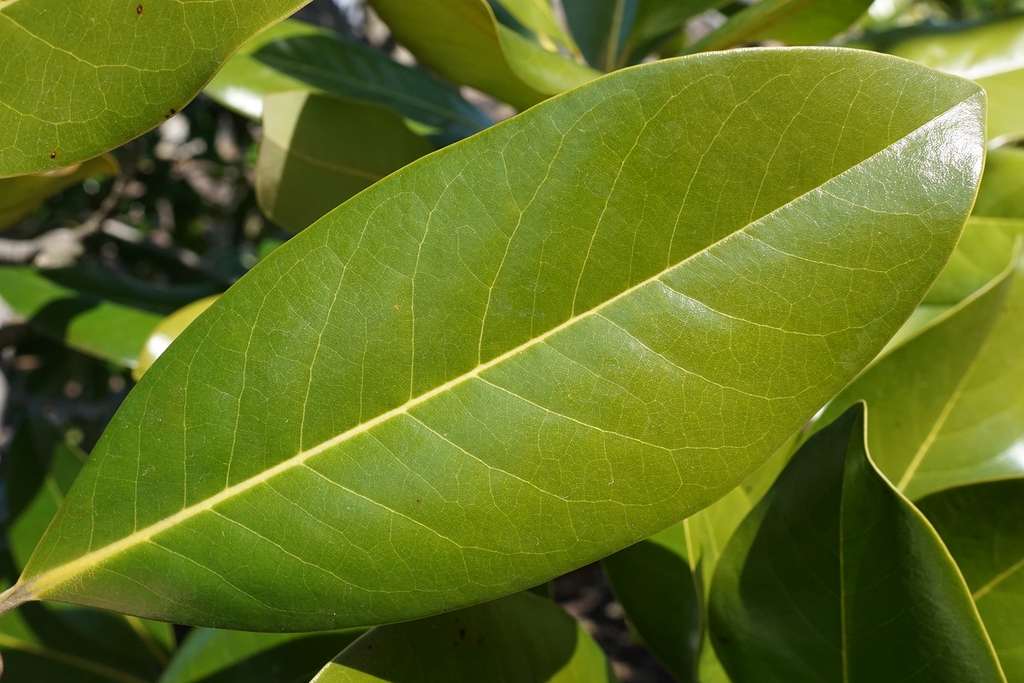
- The leaves are medium to dark green, simple, leathery, and glossy. Its leaves are elliptical to ovate, but narrower and have fewer fine hairs than those of its parent, Magnolia grandiflora. The undersides appear dull, paler, brownish-green.
-
-
Bark:
- Bark Color:
- Light Brown
- Light Gray
- Surface/Attachment:
- Smooth
- Bark Description:
- The bark is grayish-brown and smooth.
-
-
Stem:
- Stem Is Aromatic:
- No
-
-
Landscape:
- Landscape Location:
- Lawn
- Slope/Bank
- Landscape Theme:
- Shade Garden
- Winter Garden
- Design Feature:
- Flowering Tree
- Attracts:
- Songbirds