



Lagerstroemia 'Sioux'
Common Name(s):
- Phonetic Spelling
- la-ger-STROH-mee-ah
- Description
-
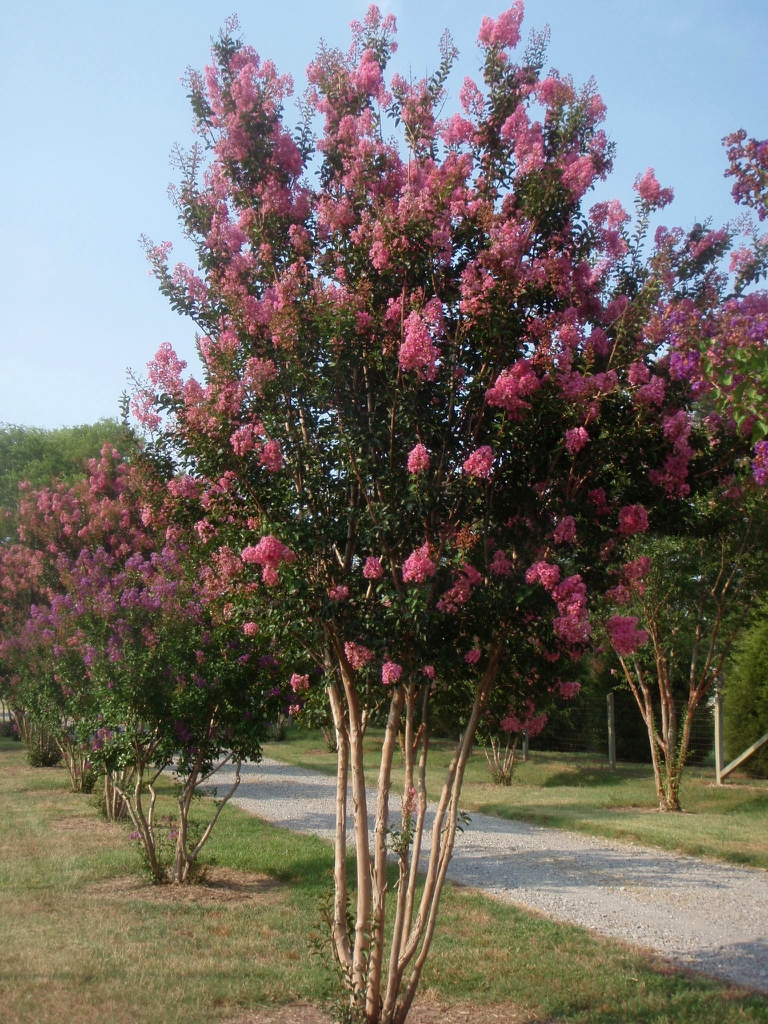
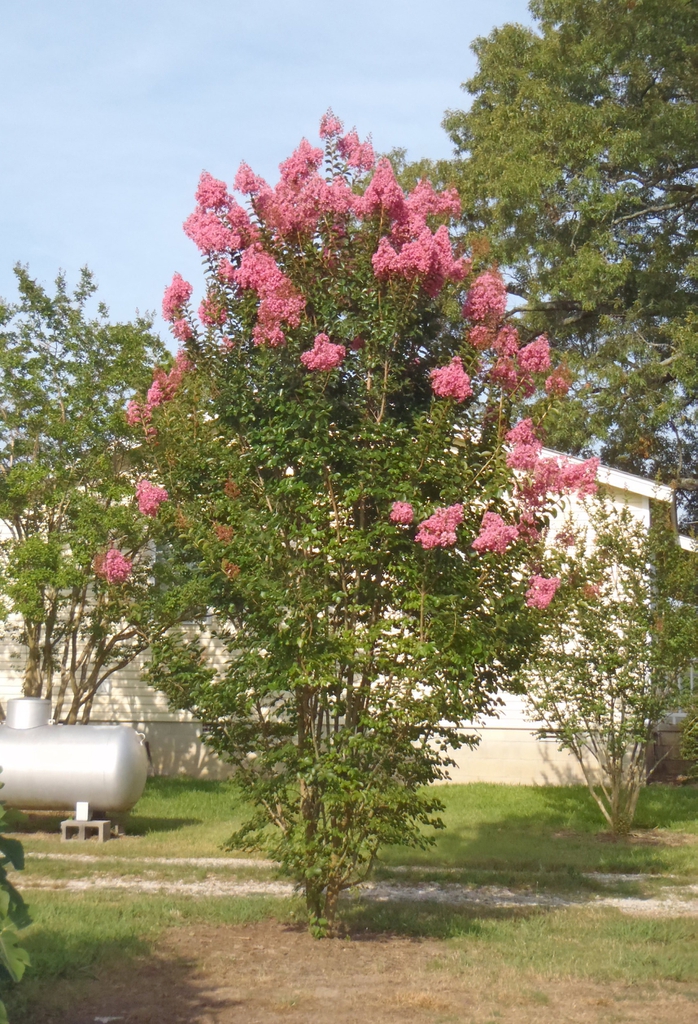
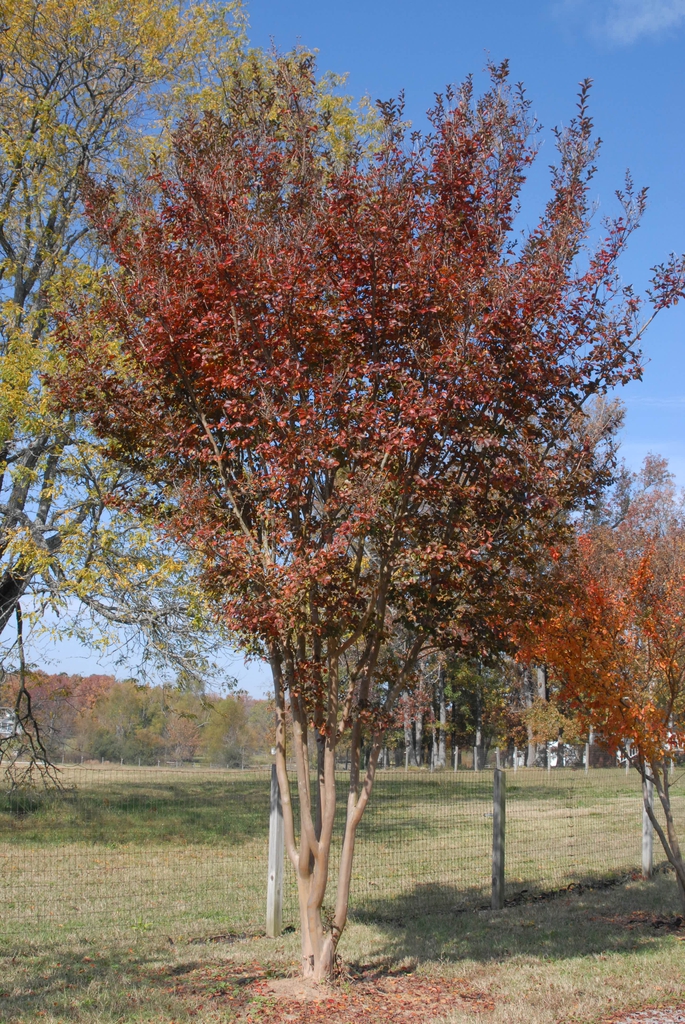
Sioux crape myrtle is an upright, narrow, multistemmed flowering deciduous large shrub or small tree cultivar that is a cross between (L. indica 'Tiny Fire' x L. subcostata var. fauriei) x (L. indica 'Pink Lace' x L. subcostata var. fauriei). In 1974, it was hybridized and then introduced in 1987 by the U.S. National Arboretum in Washington, D.C., for its mildew resistance. This cultivar was named for a Native American Tribe, and it is a member of the loosestrife family (Lythraceae). This plant grows 15-20 feet tall and 10-15 feet wide, with an erect, narrow, multi-stemmed habit. Large panicles of dark pink, crinkled florets bloom from late July to mid-September. Its leaves are dark green, elliptical to obovate, with entire margins, and they become light maroon to red in the fall. The tree bark is light medium grayish-brown and exfoliates as the tree ages.
Prefers full sun and moist, well-drained, acidic loamy to clay soils. It is winter hardy in zones 7-9. A layer of organic mulch will help keep the plant retaining moisture. Pruning should be completed in winter or early spring, as this plant blooms on new wood.
Dr. Donald Egolf began to research crape myrtles at the U.S. National Arboretum in 1959. He sought to improve the plant's disease resistance, hardiness, flower colors, and growth habits. It is a Gold Medal award-winning hybrid cultivar.
Consider the mildew-resistant, low-maintenance cultivar 'Sioux' as a specimen, border planting, or informal hedge. Its vibrant summer floral color, interesting exfoliating bark, and fall leaf color will add interest to your home landscape.
Insects, Diseases, and Other Plant Problems: Aphids and scales are potential insects. It may be susceptible to leaf spots and powdery mildew. In hardiness zones 5 to 6, the tree or shrub is susceptible to winter injury, especially any top growth. Be aware that the flowers can stain walkways and your car surface. Avoid planting near a walkway or driveway.
The Clemson Cooperative Extension Home & Garden Information Center has a factsheet on common crape myrtle pests and diseases.
- See this plant in the following landscape :
- Cultivars / Varieties:
-
- Tags:


- Cultivars / Varieties:
-
- Tags:
-
-
Attributes:
- Genus:
- Lagerstroemia
- Family:
- Lythraceae
- Life Cycle:
- Woody
- Fire Risk Rating:
- low flammability
- Wildlife Value:
- Produces a small amount of nectar that attracts bees.
- Play Value:
- Attractive Flowers
- Attracts Pollinators
- Colorful
- Easy to Grow
- Dimensions:
- Height: 15 ft. 0 in. - 20 ft. 0 in.
- Width: 10 ft. 0 in. - 15 ft. 0 in.
-
-
Whole Plant Traits:
- Plant Type:
- Shrub
- Tree
- Woody Plant Leaf Characteristics:
- Deciduous
- Habit/Form:
- Erect
- Multi-stemmed
- Oval
- Growth Rate:
- Medium
- Texture:
- Medium
-
-
Cultural Conditions:
- Light:
- Full sun (6 or more hours of direct sunlight a day)
- Soil Texture:
- Clay
- Loam (Silt)
- Sand
- Soil pH:
- Acid (<6.0)
- Soil Drainage:
- Good Drainage
- Moist
- Available Space To Plant:
- 3 feet-6 feet
- NC Region:
- Coastal
- Mountains
- Piedmont
- USDA Plant Hardiness Zone:
- 7a, 7b, 8a, 8b, 9a, 9b
-
-
Fruit:
- Fruit Color:
- Brown/Copper
- Display/Harvest Time:
- Fall
- Fruit Type:
- Capsule
- Fruit Length:
- < 1 inch
- Fruit Width:
- < 1 inch
- Fruit Description:
- The fruit is a round, dry, hard, oval, brown capsule, measuring 0.5 to 1 inch long.
-
-
Flowers:
- Flower Color:
- Pink
- Flower Inflorescence:
- Panicle
- Flower Value To Gardener:
- Long Bloom Season
- Showy
- Flower Bloom Time:
- Summer
- Flower Size:
- 1-3 inches
- Flower Description:
- The 70 to 150 dark pink, crinkled florets, each measuring 1.25 inches in diameter, are arranged in branched panicles. The panicles measure 7 to 9 inches long. Blooms appear from late July to mid-September.
-
-
Leaves:
- Woody Plant Leaf Characteristics:
- Deciduous
- Leaf Color:
- Green
- Leaf Feel:
- Glossy
- Leaf Value To Gardener:
- Showy
- Deciduous Leaf Fall Color:
- Red/Burgundy
- Leaf Type:
- Simple
- Leaf Arrangement:
- Alternate
- Leaf Shape:
- Elliptical
- Obovate
- Leaf Margin:
- Entire
- Hairs Present:
- No
- Leaf Length:
- 1-3 inches
- Leaf Width:
- 1-3 inches
- Leaf Description:
- The young leaves are glossy and bronze. They become dark green, elliptic to obovate, with entire margins. The leaves measure 1.5 to 2.25 inches long and 0.75 to 1.5 inches wide. Their fall color is light maroon to bright red.
-
-
Bark:
- Bark Color:
- Light Gray
- Surface/Attachment:
- Peeling
- Smooth
- Bark Description:
- As the tree matures, the bark becomes grayish-brown, mottled, and exfoliates. This reveals an inner bark color of light medium grayish-brown to grayish-orange.
-
-
Stem:
- Stem Color:
- Red/Burgundy
- Stem Is Aromatic:
- No
- Stem Surface:
- Smooth (glabrous)
- Stem Description:
- The young stems are smooth, thin, and reddish.
-
-
Landscape:
- Landscape Location:
- Lawn
- Design Feature:
- Border
- Hedge
- Small Tree
- Specimen
- Attracts:
- Bees
- Resistance To Challenges:
- Drought


