



Dollarweed Hydrocotyle umbellata
Other Common Name(s):
Previously known as:
- Hydrocotyle polystachya
- Hydrocotyle umbellulata
- Phonetic Spelling
- hi-droh-KOT-ol um-bell-AY-tuh
- Description
-
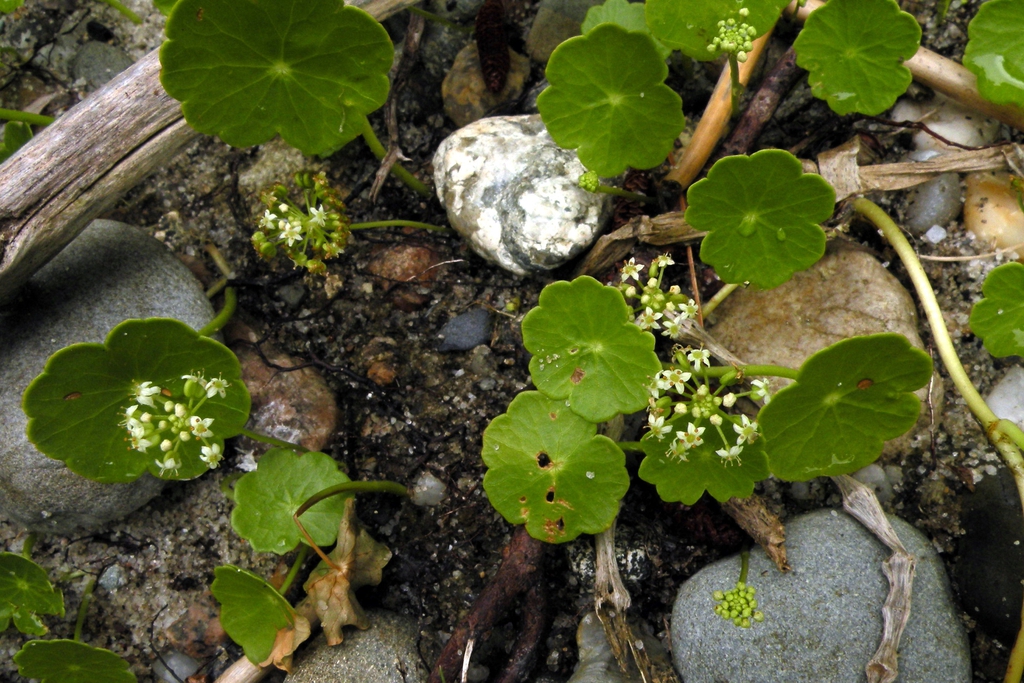
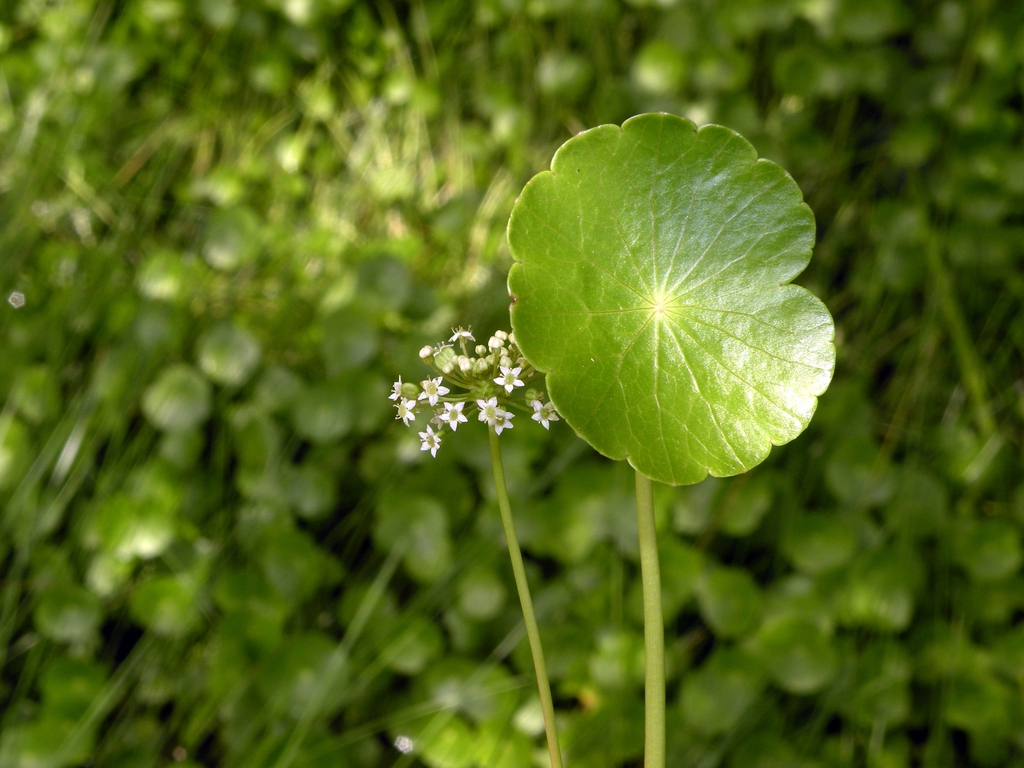
Dollarweed is a native, rhizomatous, low-growing, floating or creeping, semi-aquatic, herbaceous perennial weed, measuring 3 to 10 inches tall and spreading 3 to 20 feet wide. It is native to portions of North America, Central America, and South America and is found in moist, open areas, along roadside ditches, and in swamps. In North Carolina, dollarweed is found in the Piedmont and Coastal Plains. It is typically used as a groundcover, growing on poorly drained land or in water. It has a prostrate, spreading habit, and forms dense mats. Blooms appear from late spring to fall, bearing small white 5-petaled flowers arranged in umbels. Its attractive, shiny, smooth, round green leaves are the size of silver dollars, with crenate and lobed margins. The petiole attaches at the center of the leaf, making it appear umbrella-like. It spreads by long, creeping roots, and its seeds are eaten by waterfowl. Dollarweed is a member of the ivy family (Araliaceae). The genus name Hydrocotyle is derived from two Greek words: hydros, meaning water, and kotyle, meaning a small cup. This refers to the cup-like appearance of the leaves in some of its species. The specific epithet, umbellata, is Latin, meaning bearing umbels or umbrella-shaped. This may refer to the umbrella-like appearance of its leaves as well as the flowers' inflorescence.
Prefers full sun to partial shade and poorly drained to wet soils with a slightly acidic pH. It is winter hardy in zones 4 through 10. Due to its aggressive habit, it is a high-maintenance plant. This plant does provide food for waterfowl and fish, serves as a habitat for small fish and frogs, and hosts many insects. May be propagated by division or seeds.
Consider for use in a bog or water garden for its lush green foliage, but beware of its rapid growth.
Diseases, Insects, and Other Plant Problems: No significant insect or disease problems. Considered a noxious weed or invasive in some areas. Dollarweed's formation of dense mats in ponds can alter oxygen levels, and the plant also competes with other vegetation. Natural control methods are not effective. It can easily re-establish from seeds or roots when physical management is used.
- See this plant in the following landscape :
- Cultivars / Varieties:
-
- Tags:


- Cultivars / Varieties:
-
- Tags:
-
-
Attributes:
- Genus:
- Hydrocotyle
- Species:
- umbellata
- Family:
- Araliaceae
- Uses (Ethnobotany):
- Used in folk medicine for treatment of inflammatory disorders.
- Life Cycle:
- Perennial
- Recommended Propagation Strategy:
- Division
- Seed
- Country Or Region Of Origin:
- Portions of North America, Central America, and South America
- Distribution:
- Native: United States--AL, AR, CA, CT, DE, FL, GA, IL, IN, LA, MD, MA, MI, MN, MS, NJ, NY, NC, OH, OK, OR, PA, RI, SC, TN, TX, and VA; Bahamas, Belize, Bolivia, Chile, Colombia, Costa Rica, Cuba, Dominican Republic, Ecuador, El Salvador, French Guiana, Galapagos, Guatemala, Guyana, Haiti, Hondruas, Jamaica, Leeeward Islands, Mexico, Nova Scotia, Panama, Paraguay, Peru, Puerto Rico, Suriname, Trinidad-Tobago, and Windward Island. Introduced: Central American Pacific Islands, Myanmar, North New Zealand, and Thailand.
- Wildlife Value:
- Seeds eaten by waterfowl. Submerged plants provide habitat for micro and macro invertebrates.
- Play Value:
- Wildlife Cover/Habitat
- Wildlife Food Source
- Edibility:
- Leaves cause nausea. Keep away from children.
- Dimensions:
- Height: 0 ft. 3 in. - 0 ft. 10 in.
- Width: 3 ft. 0 in. - 20 ft. 0 in.
-
-
Whole Plant Traits:
- Plant Type:
- Ground Cover
- Herbaceous Perennial
- Native Plant
- Weed
- Woody Plant Leaf Characteristics:
- Deciduous
- Habit/Form:
- Creeping
- Dense
- Horizontal
- Prostrate
- Spreading
- Growth Rate:
- Rapid
- Maintenance:
- High
- Texture:
- Medium
-
-
Cultural Conditions:
- Light:
- Full sun (6 or more hours of direct sunlight a day)
- Partial Shade (Direct sunlight only part of the day, 2-6 hours)
- Soil Texture:
- Clay
- Loam (Silt)
- Sand
- Soil pH:
- Acid (<6.0)
- Neutral (6.0-8.0)
- Soil Drainage:
- Moist
- Occasional Flooding
- Occasionally Wet
- Available Space To Plant:
- 6-feet-12 feet
- 12-24 feet
- NC Region:
- Coastal
- Piedmont
- USDA Plant Hardiness Zone:
- 4a, 4b, 5a, 5b, 6a, 6b, 7a, 7b, 8a, 8b, 9a, 9b, 10a, 10b
-
-
Fruit:
- Fruit Color:
- Brown/Copper
- Green
- Display/Harvest Time:
- Summer
- Fruit Type:
- Schizocarp
- Fruit Length:
- < 1 inch
- Fruit Width:
- < 1 inch
- Fruit Description:
- The fruit is a round, flat, capsule-shaped schizocarp, measuring 1 to 3 mm in diameter.
-
-
Flowers:
- Flower Color:
- White
- Flower Inflorescence:
- Umbel
- Flower Value To Gardener:
- Long Bloom Season
- Flower Bloom Time:
- Fall
- Spring
- Summer
- Flower Shape:
- Star
- Flower Petals:
- 4-5 petals/rays
- Flower Size:
- < 1 inch
- Flower Description:
- The flowers are star-shaped, small, and white. They are arranged in a simple umbel or clusters of 5 to 10 tiny blooms. Each bloom measures less than 0.25 inch in diameter. It has 5 white petals, 5 stamens, a central greenish ovary, and 2 green styles. Blooming occurs from April to October.
-
-
Leaves:
- Woody Plant Leaf Characteristics:
- Deciduous
- Leaf Color:
- Green
- Leaf Feel:
- Glossy
- Leathery
- Leaf Value To Gardener:
- Showy
- Leaf Type:
- Simple
- Leaf Arrangement:
- Alternate
- Leaf Shape:
- Orbicular
- Peltate
- Reniform
- Leaf Margin:
- Crenate
- Hairs Present:
- No
- Leaf Length:
- 1-3 inches
- Leaf Width:
- 1-3 inches
- Leaf Description:
- The leaves are shiny, smooth, dark green, simple, alternate, orbicular to reniform, measuring 0.5 to 2.5 inches wide with crenately lobed margins. The petiole is attached in the center of the leaf (umbrella-like) instead of at the leaf margins. The petiole measures 5 to 10 inches long.
-
-
Stem:
- Stem Color:
- Green
- Stem Is Aromatic:
- No
- Stem Cross Section:
- Round
- Stem Form:
- Straight
- Stem Surface:
- Smooth (glabrous)
- Stem Description:
- The stems are green, fleshy, branching, smooth, and creeping.
-
-
Landscape:
- Landscape Location:
- Coastal
- Container
- Pond
- Landscape Theme:
- Native Garden
- Water Garden
- Attracts:
- Bees
- Frogs
- Resistance To Challenges:
- Foot Traffic
- Humidity
- Wet Soil
- Problems:
- Weedy

