


Galactia regularis
Common Name(s):
Previously known as:
- Dolichos regularis
- Galactia angustifolia var. retusa
- Phonetic Spelling
- ga-LAK-tee-uh reg-yoo-lair-us
- Description
-
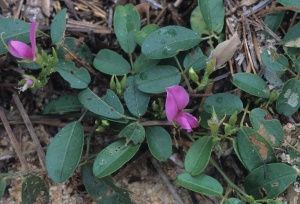
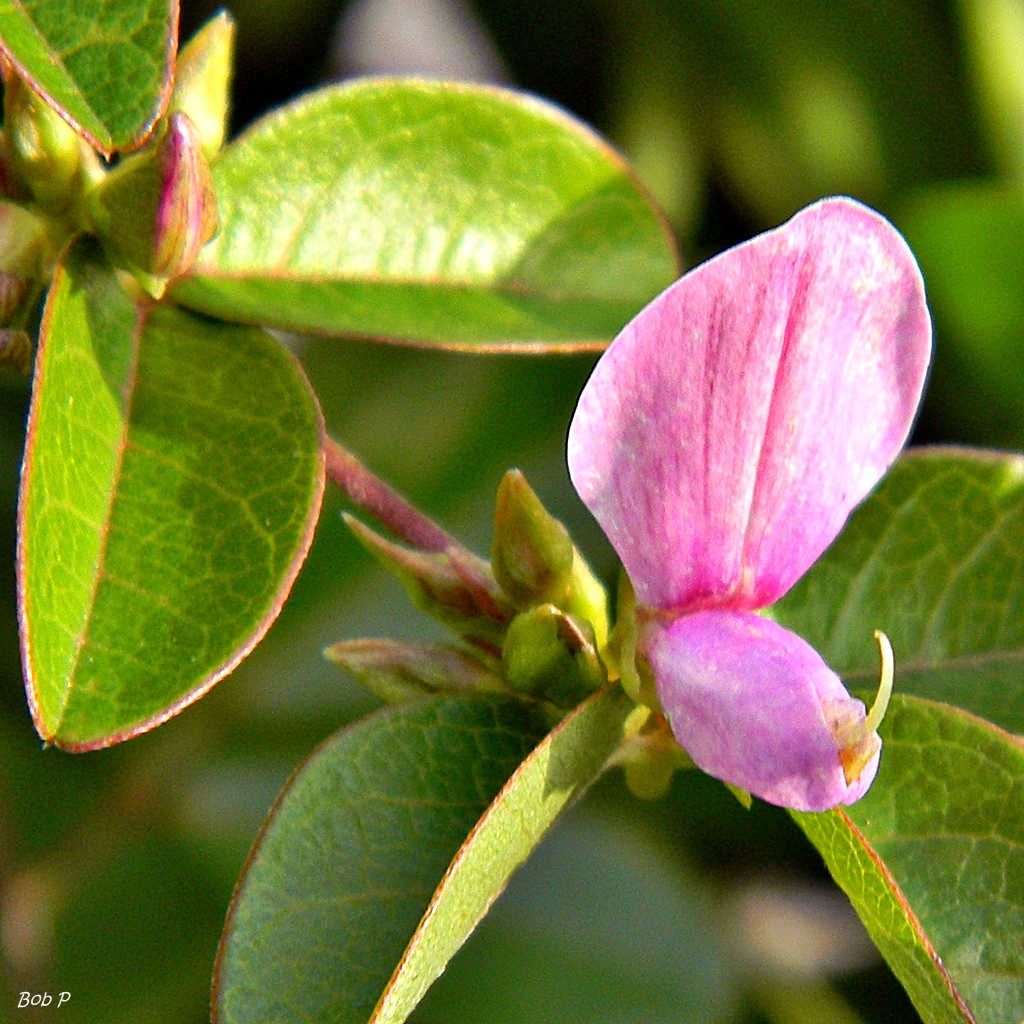
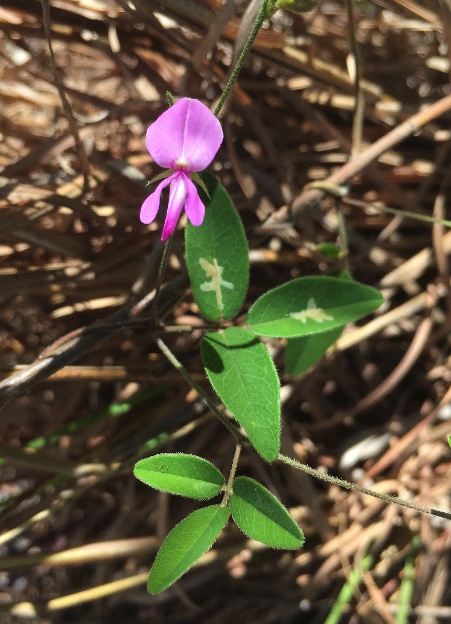
Eastern milkpea is a native wildflower and herbaceous perennial vine found in the central and eastern United States and Cuba. Its native habitat includes dry pine or oak forests and woodlands. The plant has delicate, weakly erect or trailing, twining, hairy stems and palmately compound leaves having three elliptical leaflets. The vine gently twines around other vegetation or trails along the ground and can grow 3 to 4 feet long. The small, pea-shaped flowers appear in sets of 1 to 10 blooms per stalk and may be pink or white. Blooms occur from July through September, and the legume fruits appear from August to October. It is a member of the bean family (Fabaceae).
Prefers full sun and sandy, well-drained, nutrient-poor soils with a slightly acidic to neutral pH. It is drought-tolerant and moderately salt-tolerant. It also easily resprouts after forest fires.
Bees and other pollinators are attracted to the eastern milkpea, and it is the larval host plant for the Long-tailed Skipper and Gray Hairstreak Butterfly. Cattle and quail enjoy eating the foliage.
In North Carolina, this wildflower is commonly found in the Central Piedmont, most of the Coastal Plain, and the southern mountains. Consider using it as an ornamental and pollinator plant for a butterfly garden, native garden, or woodland setting.
Insects, Diseases, and Other Plant Problems: No significant insect or disease problems, but may be visited by aphids and caterpillars. Monitor for leaf spots, powdery mildew, and root rot.
- See this plant in the following landscape :
- Cultivars / Varieties:
-
- Tags:


- Cultivars / Varieties:
-
- Tags:
-
-
Attributes:
- Genus:
- Galactia
- Species:
- regularis
- Family:
- Fabaceae
- Life Cycle:
- Perennial
- Recommended Propagation Strategy:
- Seed
- Country Or Region Of Origin:
- Central and Eastern United States and Cuba
- Distribution:
- Native: Cuba and the United States--Alabama, Arkansas, Delaware, Florida, Georgia, Illinois, Kansas, Kentucky, Louisiana, Maryland, Mississippi, Missouri, New Jersey, New York, North Carolina, Oklahoma, Pennsylvania, South Carolina, Texas, and Virginia
- Wildlife Value:
- The flowers attract common little leaf-cutter bees, golden sweat bees, and white-footed leaf-cutter bees. Quail enjoy eating the plants. Larval host plant for the Long-tailed Skipper, Gray Hairstreak, and Zarucco Duskywing Butterflies.
- Play Value:
- Attractive Flowers
- Colorful
- Wildlife Food Source
- Wildlife Larval Host
- Climbing Method:
- Twining
- Edibility:
- Not edible for human consumption.
-
-
Whole Plant Traits:
- Plant Type:
- Ground Cover
- Herbaceous Perennial
- Native Plant
- Wildflower
- Habit/Form:
- Climbing
- Erect
- Prostrate
- Growth Rate:
- Medium
- Maintenance:
- Low
- Texture:
- Medium
-
-
Cultural Conditions:
- Light:
- Full sun (6 or more hours of direct sunlight a day)
- Partial Shade (Direct sunlight only part of the day, 2-6 hours)
- Soil Texture:
- Loam (Silt)
- Sand
- Shallow Rocky
- Soil pH:
- Acid (<6.0)
- Neutral (6.0-8.0)
- Soil Drainage:
- Good Drainage
- Moist
- Occasionally Dry
- Available Space To Plant:
- Less than 12 inches
- NC Region:
- Coastal
- Mountains
- Piedmont
- USDA Plant Hardiness Zone:
- 7a, 7b, 8a, 8b, 9a, 9b
-
-
Fruit:
- Fruit Color:
- Cream/Tan
- Green
- Display/Harvest Time:
- Fall
- Summer
- Fruit Type:
- Legume
- Fruit Length:
- 1-3 inches
- Fruit Width:
- < 1 inch
- Fruit Description:
- The fruit is a slender, hairy, oblong pod, tapered at the tip. The legume is flat, measuring 1 to 2 inches long and is only 0.25 inches wide. They are initially green, become tan when mature, papery, and have sparse hairs. Three to eight tiny, yellowish or dark brown seeds are dispersed as the pod dehisces. Fruits appear from August to October.
-
-
Flowers:
- Flower Color:
- Pink
- White
- Flower Inflorescence:
- Raceme
- Flower Bloom Time:
- Summer
- Flower Shape:
- Bell
- Lipped
- Flower Size:
- < 1 inch
- Flower Description:
- The flowers appear at the leaf axils and are arranged on a short raceme of 1 to 10 blooms, sometimes paired. Each bloom measures about 0.5 inches long and is 5-lobed with fusion of the two upper lobes, and narrowly bell-shaped and hairy. Its color ranges from dark pink, pink or white. Blooms from July through September.
-
-
Leaves:
- Leaf Color:
- Green
- Leaf Feel:
- Velvety
- Leaf Type:
- Compound (Pinnately , Bipinnately, Palmately)
- Leaf Arrangement:
- Alternate
- Leaf Shape:
- Elliptical
- Oblong
- Ovate
- Leaf Margin:
- Entire
- Hairs Present:
- Yes
- Leaf Length:
- 3-6 inches
- Leaf Width:
- 1-3 inches
- Leaf Description:
- The dark green, velvety leaves are alternate and palmately compound with three leaflets (trifolate). Each leaflet measures 0.75 to 1.5 inches long and 0.25 to 1 inch wide, and is elliptic to oblong or oblong-ovate. They are rounded at the base of the leaflet, and are rounded at the tip, or may be slightly notched. The margins are entire. The upper surface is hairy to smooth, and the underside has moderate to dense fine hairs and is a paler green. The texture may be smooth or hairy. The petiole measures 0.25 to 0.75 inches long.
-
-
Stem:
- Stem Color:
- Brown/Copper
- Green
- Stem Is Aromatic:
- No
- Stem Surface:
- Hairy (pubescent)
- Stem Description:
- The hairy stems are mostly trailing, prostrate, or weakly climbing.
-
-
Landscape:
- Landscape Location:
- Coastal
- Naturalized Area
- Woodland
- Landscape Theme:
- Cottage Garden
- Native Garden
- Pollinator Garden
- Attracts:
- Bees
- Butterflies
- Resistance To Challenges:
- Drought
- Poor Soil