



Baboon Flower Freesia
Other Common Name(s):
Other plants called Baboon Flower:
Previously known as:
- Anomatheca
- Nymanina
- Phonetic Spelling
- FREE-see-ah
- Description
-
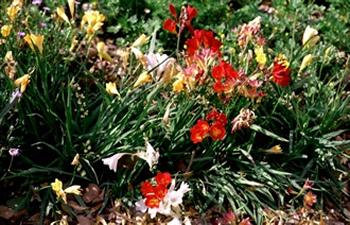
Freesia is a genus of fragrant, herbaceous perennials that are grown from conical-shaped corms. There are 16 accepted species, but hybrids are the most common forms. The plant has an erect, leafless, wiry stem, growing 1 to 2 feet tall, with narrow, sword-like leaves. The 5 to 10 funnel-shaped flowers are borne on a one-sided raceme at the top of the stem. Depending on the species or cultivar, the flower color varies from blue, lavender, orange, pink, purple, red, and white, and bicolored. The genus is a member of the iris family (Iridaceae) and is native to Kenya and as far south as South Africa. Freesias were first introduced in Europe in the 19th century. The genus name, Freesia, honors Dr. Friedrich Heinrich Theodor Freese, a German physician and botanist.
Freesias prefer full sun to partial shade, and cool daytime and nighttime temperatures. Daytime temperatures of 60 to 70 degrees Fahrenheit, and nighttime temperatures between 40 and 55 degrees Fahrenheit are best. They also prefer mild, frost-free climates and are hardy in zones 9 to 10. A moist, well-drained, organic-rich soil with a neutral pH is recommended. If the corms are planted in succession, you will enjoy a longer flowering season. Young plants should be fertilized every 2 weeks with a liquid fertilizer after they are about 6 inches tall. For overwintering, the corms need to be lifted from the soil and stored to protect them from cold temperatures. They may be replanted each spring from the harvested corms, or fresh bulbs may be purchased each year. Freesias are best propagated by division. They may also be propagated from seeds; however, it will take 1 to 2 years before the flowers appear.
Freesias may also be planted in containers. These plants have a long tap root and will need a deep pot. Plant 6 to 8 corms, about 1 inch below the soil surface with the pointed end upwards and 1 to 2 inches apart, in an organic-rich potting mix with coarse sand or crushed rocks to provide good drainage. Due to the hot, humid summers in North Carolina, freesias are best grown as houseplants or in a greenhouse since they require cool nights for peak flowering. Plant them during the late summer for winter blooming. Locate them in a well-ventilated area with morning sun and afternoon shade.
Freesia blooms make a good cut flower and are a favorite of florists, often used in wedding bouquets. The most popular cultivars originate from the species Freesia refracta and Freesia leichilinii, which are from South Africa.
Diseases, Insect Pests, and Other Plant Problems: Susceptible to aphids, thrips, slugs, and snails. Diseases such as bacterial leaf spot, iris leaf spot, fusarium wilt, root rot, viruses, and blights can occur. Avoid overwatering, as it can cause the corms to rot.
- See this plant in the following landscape :
- Cultivars / Varieties:
-
- 'Belleville'
trumpet-shaped double blooms of pure white with creamy yellow throat, favorite for bouquets - Freesia corymbosa
flowers may be shades of yellow, rose, or deep pink, and the base of the tube bright yellow or orange - Freesia laxa
from Kenya, star-shaped flowers, salmon pink to rosy-red - Freesia leichtlinii subsp. alba
white or cream blooms with yellow markings; flushed with purple. - Freesia marginata
low-growing, prostrate, white flowers, flushed with purple on the opposite side, base yellow orange, violet scented - Freesia refracta
pale greenish-yellow or white flowers, flushed with purple at the base and opposite side - Freesia viridis
green flowers, flushed with brown or maroon - 'Golden Passion'
up to 10 yellow flowers per stem - 'Oberon'
bicolor flowers, golden yellow center, and orange to reddish- orange on the outer side - 'Red Lion'
funnel-shaped, deep red flowers - 'Red River'
bicolored, funnel-shaped, bright red with yellow throat - 'Royal Blue'
lavender flowers with white centers and purple veins - 'White River'
pure white funnel-shaped flowers, strong fragrance
- 'Belleville'
- 'Belleville', Freesia corymbosa, Freesia laxa, Freesia leichtlinii subsp. alba, Freesia marginata, Freesia refracta, Freesia viridis, 'Golden Passion', 'Oberon', 'Red Lion', 'Red River', 'Royal Blue', 'White River'
- Tags:

- Cultivars / Varieties:
-
- 'Belleville'
trumpet-shaped double blooms of pure white with creamy yellow throat, favorite for bouquets - Freesia corymbosa
flowers may be shades of yellow, rose, or deep pink, and the base of the tube bright yellow or orange - Freesia laxa
from Kenya, star-shaped flowers, salmon pink to rosy-red - Freesia leichtlinii subsp. alba
white or cream blooms with yellow markings; flushed with purple. - Freesia marginata
low-growing, prostrate, white flowers, flushed with purple on the opposite side, base yellow orange, violet scented - Freesia refracta
pale greenish-yellow or white flowers, flushed with purple at the base and opposite side - Freesia viridis
green flowers, flushed with brown or maroon - 'Golden Passion'
up to 10 yellow flowers per stem - 'Oberon'
bicolor flowers, golden yellow center, and orange to reddish- orange on the outer side - 'Red Lion'
funnel-shaped, deep red flowers - 'Red River'
bicolored, funnel-shaped, bright red with yellow throat - 'Royal Blue'
lavender flowers with white centers and purple veins - 'White River'
pure white funnel-shaped flowers, strong fragrance
- 'Belleville'
- 'Belleville', Freesia corymbosa, Freesia laxa, Freesia leichtlinii subsp. alba, Freesia marginata, Freesia refracta, Freesia viridis, 'Golden Passion', 'Oberon', 'Red Lion', 'Red River', 'Royal Blue', 'White River'
- Tags:
-
-
Attributes:
- Genus:
- Freesia
- Family:
- Iridaceae
- Uses (Ethnobotany):
- Often used for scent in hand creams, shampoo and candles.
- Life Cycle:
- Bulb
- Perennial
- Recommended Propagation Strategy:
- Division
- Seed
- Country Or Region Of Origin:
- Kenya to South Africa
- Distribution:
- Native: Cape Provinces, DR Congo, Eswatini, Free State, Kenya, KwaZulu-Natal, Malawi, Mozambique, Namibia, Northern Provinces, Rwanda, Tanzania, Uganda, Zambia, and Zimbabwe. Introduced: Argentina Northeast, Baleares, Bermuda, Canary Islands, Corsica, East Aegean Islands, France, Greece, Italy, Japan, Kriti, Madeira, Mauritius, New South Wales, Norfolk Island, Portugal, Réunion, Sardinia, Sicily, Spain, St.Helena, Tunisia, Turkey, and the United States--CA and FL.
- Wildlife Value:
- Attracts bees and butterflies.
- Play Value:
- Attractive Flowers
- Colorful
- Fragrance
- Bulb Storage:
- Store corms in a dry location at 77 to 86 degrees F (25 to 30 degrees C).
- Dimensions:
- Height: 1 ft. 0 in. - 2 ft. 0 in.
- Width: 0 ft. 6 in. - 1 ft. 0 in.
-
-
Whole Plant Traits:
- Plant Type:
- Annual
- Bulb
- Herbaceous Perennial
- Houseplant
- Habit/Form:
- Ascending
- Clumping
- Multi-stemmed
- Growth Rate:
- Medium
- Maintenance:
- Medium
-
-
Cultural Conditions:
- Light:
- Full sun (6 or more hours of direct sunlight a day)
- Partial Shade (Direct sunlight only part of the day, 2-6 hours)
- Soil Texture:
- High Organic Matter
- Soil pH:
- Neutral (6.0-8.0)
- Soil Drainage:
- Good Drainage
- Moist
- Available Space To Plant:
- Less than 12 inches
- USDA Plant Hardiness Zone:
- 9a, 9b, 10a, 10b
-
-
Flowers:
- Flower Color:
- Blue
- Gold/Yellow
- Orange
- Pink
- Purple/Lavender
- Red/Burgundy
- White
- Flower Inflorescence:
- Raceme
- Flower Value To Gardener:
- Fragrant
- Good Cut
- Showy
- Flower Bloom Time:
- Summer
- Flower Shape:
- Funnel
- Trumpet
- Flower Petals:
- Tepals
- Flower Size:
- 1-3 inches
- Flower Description:
- Both single and double-flowering cultivars exist. Sweetly fragrant, funnel-shaped flowers (5 to 10 per stem) that bloom in one-sided racemes. Each bloom measures 1 to 2 inches long.
-
-
Leaves:
- Leaf Color:
- Green
- Leaf Shape:
- Lanceolate
- Hairs Present:
- No
- Leaf Length:
- > 6 inches
- Leaf Description:
- Narrow, sword-shaped leaves appear in an iris-like fan. The leaves measure 4 to 12 inches long
-
-
Stem:
- Stem Color:
- Green
- Stem Is Aromatic:
- No
- Stem Description:
- Flowers appear atop of the leafless, sometimes branching, arching, wiry, 1 to 2 feet long stems.
-
-
Landscape:
- Landscape Location:
- Container
- Houseplants
- Landscape Theme:
- Cutting Garden
- Design Feature:
- Specimen
- Attracts:
- Bees
- Butterflies

