


Eleutherococcus henryi
Common Name(s):
Previously known as:
- Acanthopanax henryi
- Phonetic Spelling
- el-ew-ther-oh-KOK-us HEN-ree-eye
- Description
-
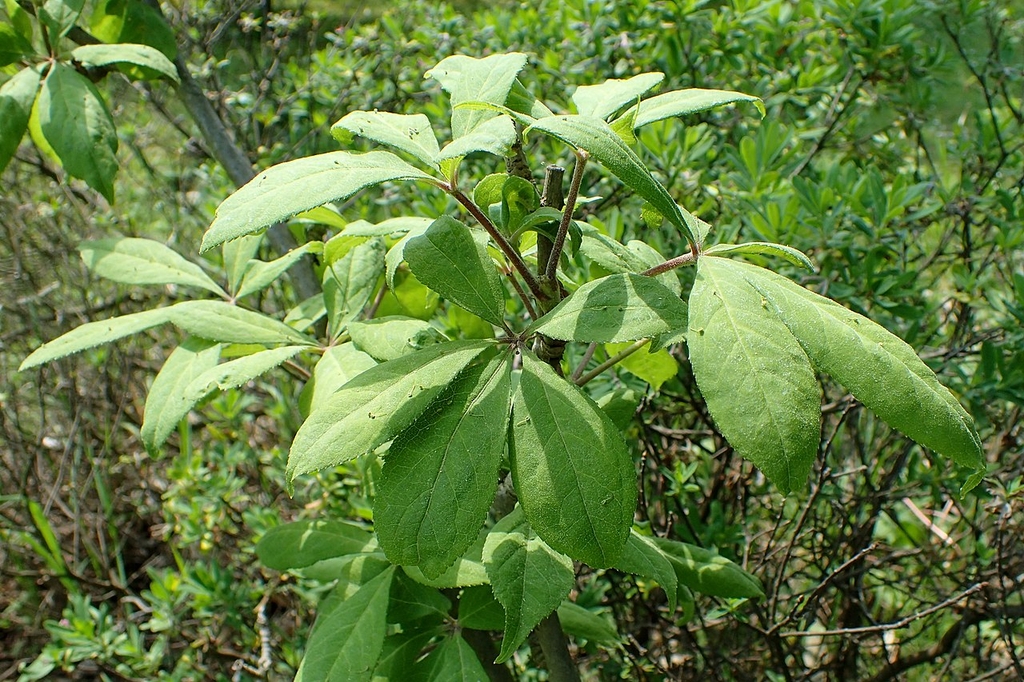
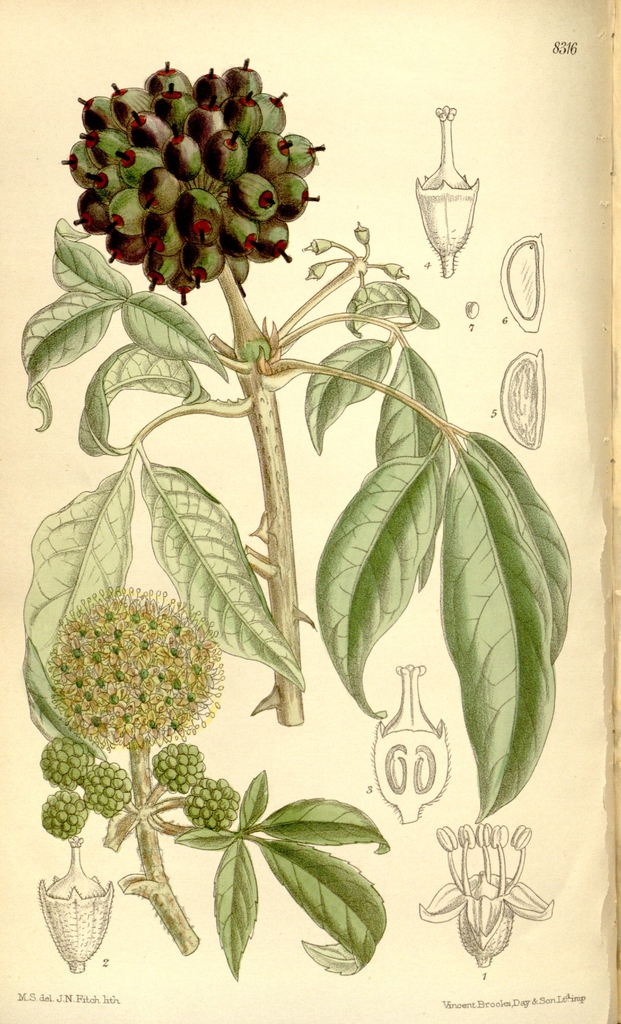
Henry-aralia is an upright, arching, ornamental, deciduous shrub native to China in the ginseng family (Araliaceae) that is found along forest edges, roadsides, or mountain slopes in its native habitat. It can grow up to 12 feet tall with stout stems and down-curved spines. The leaves are green, rough, coarse, and palmately compound with 5 leaflets. From July to September, tiny white flowers appear, arranged as terminal umbels. They are followed by round black berries that are persistent on the shrub. The genus name Eleutherococcus is derived from two Greek words: eleutheros, meaning free, and kokkos, meaning seed. This refers to the seed arrangement inside its fruit. The specific epithet, henryi, is in honor of Augustine Henry, a physician, botanist, and plant collector from Ireland.
Prefers full sun to partial shade and is adaptable to various soils as long as they are moist and well-drained. Once established, it is drought-tolerant and pollution-tolerant. This shrub is slow-growing, dioecious (male and female plants), and produces suckers. Pruning is recommended annually, while rejuvenation pruning is recommended every 4 to 5 years.
Henry-arlia is suitable as a border hedge or woodland site. This shrub and its seeds are rare and can be difficult to find.
Insects, Diseases, and Other Plant Problems: No significant insect pests or diseases.
- See this plant in the following landscape :
- Cultivars / Varieties:
-
- Eleuthercoccus henryi var. henryi
variety native to Central and South China - Eleutherococcus henryi var. faberi
variety native to South Anhui, South Shaanxi, and Northwest Zhejiang, China - 'Nana'
dwarf, grows up to 4 feet tall and wide, dense habit, cold resistant, white flowers, and black berries
- Eleuthercoccus henryi var. henryi
- Eleuthercoccus henryi var. henryi, Eleutherococcus henryi var. faberi, 'Nana'
- Tags:


- Cultivars / Varieties:
-
- Eleuthercoccus henryi var. henryi
variety native to Central and South China - Eleutherococcus henryi var. faberi
variety native to South Anhui, South Shaanxi, and Northwest Zhejiang, China - 'Nana'
dwarf, grows up to 4 feet tall and wide, dense habit, cold resistant, white flowers, and black berries
- Eleuthercoccus henryi var. henryi
- Eleuthercoccus henryi var. henryi, Eleutherococcus henryi var. faberi, 'Nana'
- Tags:
-
-
Attributes:
- Genus:
- Eleutherococcus
- Species:
- henryi
- Family:
- Araliaceae
- Uses (Ethnobotany):
- Its roots are used in Chinese medicine as a muscle relaxant, to improve blood circulation, and joint health, to treat arthritis, and rheumatism, and liver disease.
- Life Cycle:
- Woody
- Recommended Propagation Strategy:
- Seed
- Country Or Region Of Origin:
- Central and Southern China
- Distribution:
- Native: China North-Central, China South-Central, and China Southwest
- Wildlife Value:
- Birds enjoy eating the berries, and small mammals browse the leaves and stems.
- Play Value:
- Easy to Grow
- Wildlife Food Source
- Particularly Resistant To (Insects/Diseases/Other Problems):
- air pollution and poor soil
- Dimensions:
- Height: 10 ft. 0 in. - 12 ft. 0 in.
- Width: 10 ft. 0 in. - 12 ft. 0 in.
-
-
Whole Plant Traits:
- Plant Type:
- Shrub
- Woody Plant Leaf Characteristics:
- Deciduous
- Habit/Form:
- Arching
- Erect
- Spreading
- Growth Rate:
- Slow
- Maintenance:
- Low
- Texture:
- Coarse
- Appendage:
- Spines
-
-
Cultural Conditions:
- Light:
- Full sun (6 or more hours of direct sunlight a day)
- Partial Shade (Direct sunlight only part of the day, 2-6 hours)
- Soil Texture:
- Clay
- Loam (Silt)
- Soil pH:
- Acid (<6.0)
- Alkaline (>8.0)
- Neutral (6.0-8.0)
- Soil Drainage:
- Good Drainage
- Moist
- Occasionally Dry
- Available Space To Plant:
- 12-24 feet
- NC Region:
- Coastal
- Mountains
- Piedmont
- USDA Plant Hardiness Zone:
- 5a, 5b, 6a, 6b, 7a, 7b, 8a, 8b
-
-
Fruit:
- Fruit Color:
- Black
- Fruit Value To Gardener:
- Long-lasting
- Showy
- Display/Harvest Time:
- Fall
- Fruit Type:
- Berry
- Fruit Length:
- < 1 inch
- Fruit Width:
- < 1 inch
- Fruit Description:
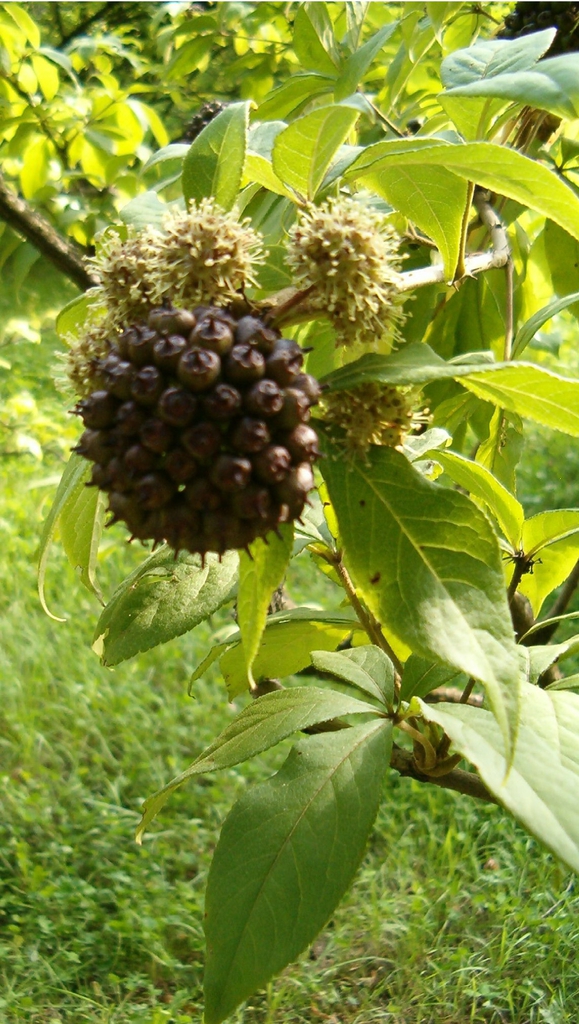
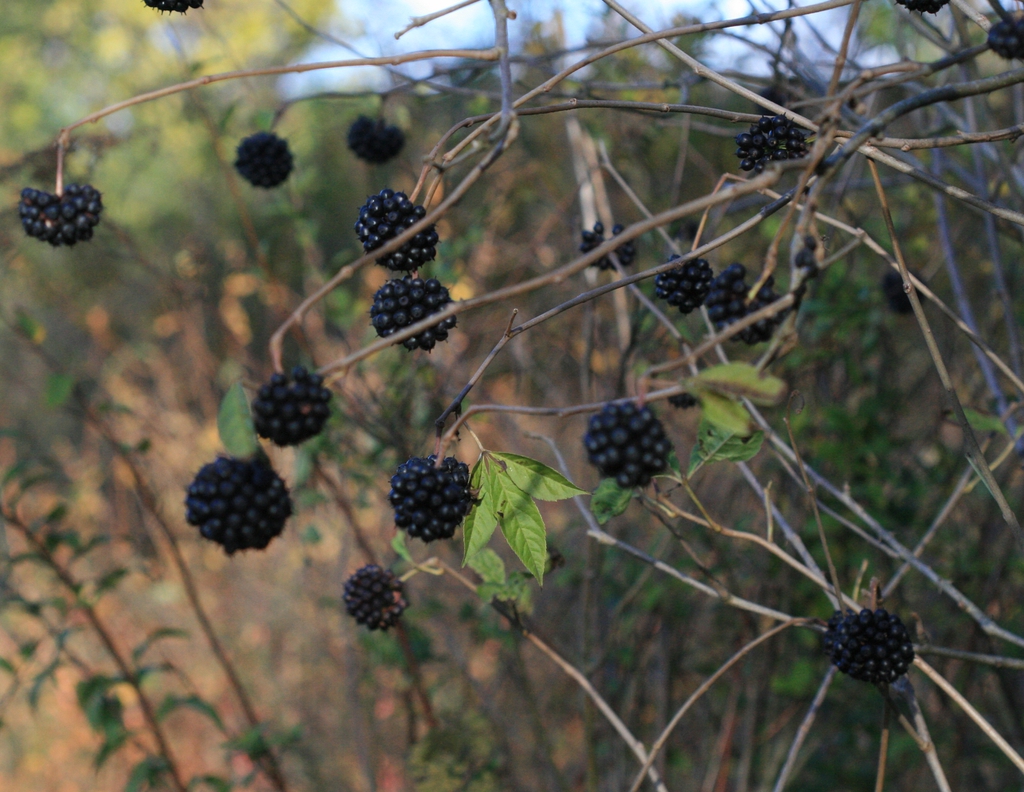
- The fruit is a round, black berry when ripe, measuring 3/8 inch long. They are presented densely clustered as a rounded umbel, measuring 2 inches wide. Each berry contains 2 small, flat seeds. They ripen from September to October, and may persist long afterwards.
-
-
Flowers:
- Flower Color:
- White
- Flower Inflorescence:
- Umbel
- Flower Bloom Time:
- Fall
- Summer
- Flower Size:
- < 1 inch
- Flower Description:
- Individual flowers are tiny and white, with 5 petals, 5 stamens, 5 ovaries, and 1 style. They are presented on a slightly hairy stalk in a spherical umbel inflorescence that measures 0.5 to 1 inches in diameter. Blooms from July to September.
-
-
Leaves:
- Woody Plant Leaf Characteristics:
- Deciduous
- Leaf Color:
- Green
- Leaf Feel:
- Rough
- Leaf Type:
- Compound (Pinnately , Bipinnately, Palmately)
- Leaf Shape:
- Elliptical
- Leaf Margin:
- Serrate
- Hairs Present:
- Yes
- Leaf Length:
- 3-6 inches
- Leaf Width:
- 1-3 inches
- Leaf Description:
- The leaves are palmately compound with 5 leaflets. Each leaflet is elliptical or obovate with an acute apex and a wedge-shaped base. They measure 3 to 4.75 inches long and 1 to 2 inches wide. The upper surface is rough and dark green, and the lower surface is grayish-green with leaf veins covered with soft, short hairs. The leaf margins are serrate. The leaf petiole measures 1.5 to 2.75 inches long, and the leaflet petioles are small or may be apetiolate.
-
-
Stem:
- Stem Color:
- Brown/Copper
- Stem Is Aromatic:
- No
- Stem Surface:
- Hairy (pubescent)
- Stem Description:
- The branches are pale brown with small bristles and spines. The spines are stout, straight or slightly down-turned, measuring 1/6 inch long.
-
-
Landscape:
- Landscape Location:
- Woodland
- Design Feature:
- Border
- Hedge
- Specimen
- Attracts:
- Small Mammals
- Songbirds
- Resistance To Challenges:
- Drought
- Pollution
- Poor Soil