


Spoonleaf Sundew Drosera intermedia
Other Common Name(s):
Previously known as:
- Drosera americana
- Drosera intermedia f. corymbosa
- Rorella intermedia
- Phonetic Spelling
- DROSS-er-uh in-ter-MEE-dee-uh
- Description
-
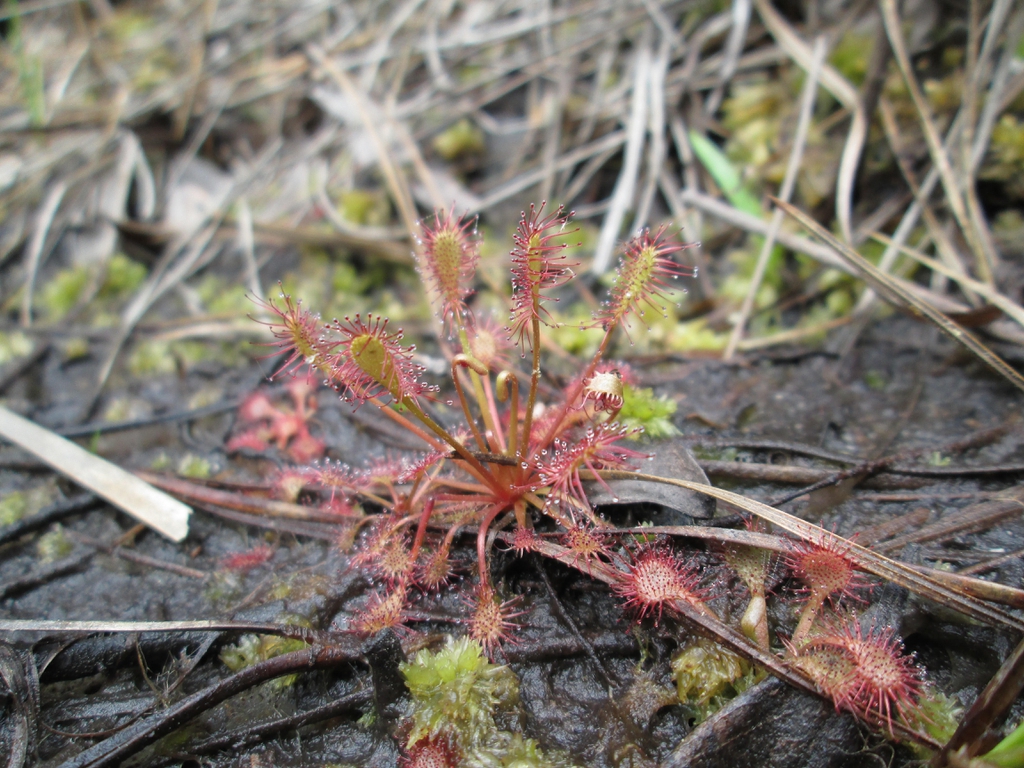
Spoonleaf sundew is a native carnivorous plant in the sundew family (Droseraceae). This species grows in bogs and wet areas throughout Europe, eastern North America, and parts of eastern South America. In the southern Coastal Plain of North Carolina, it may be found in protected natural areas, and is uncommon in the northern Coastal Plain and Piedmont regions. The species epithet, intermedia, is Latin for “intermediate,” but the reference is obscure.
The spoonleaf sundew is hardy and easy to grow, but even in optimum conditions, it is short-lived. It thrives in full sun but will tolerate partial shade. Like all carnivorous plants, it grows best in a nutrient-free medium that is kept moist with distilled water or rainwater. Do not fertilize the plant; it will get all the nutrients it needs from the insects it traps.
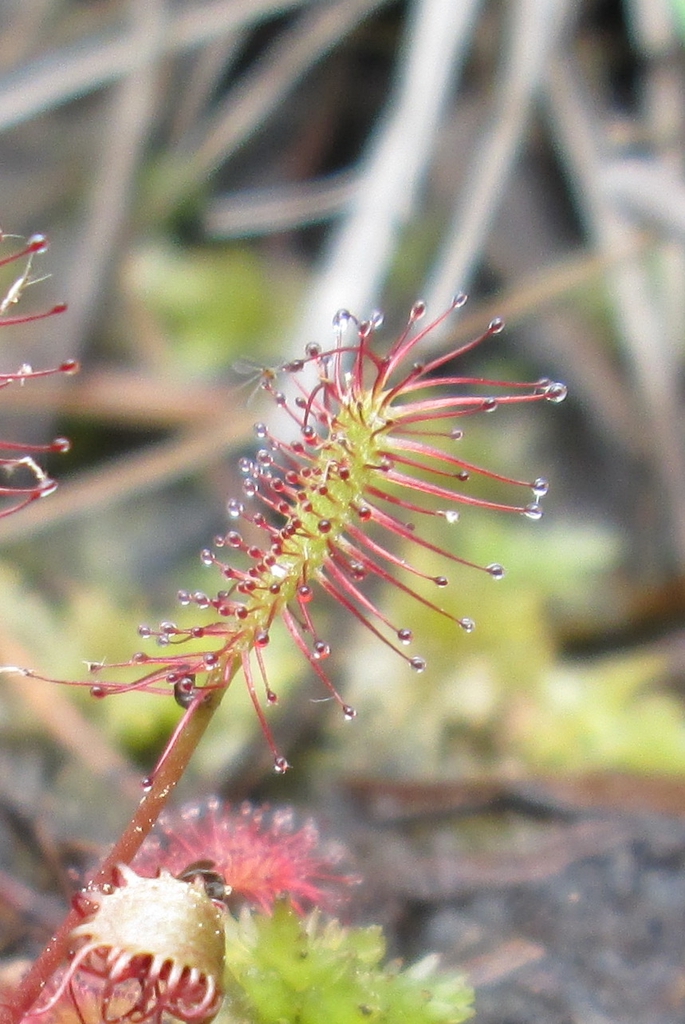
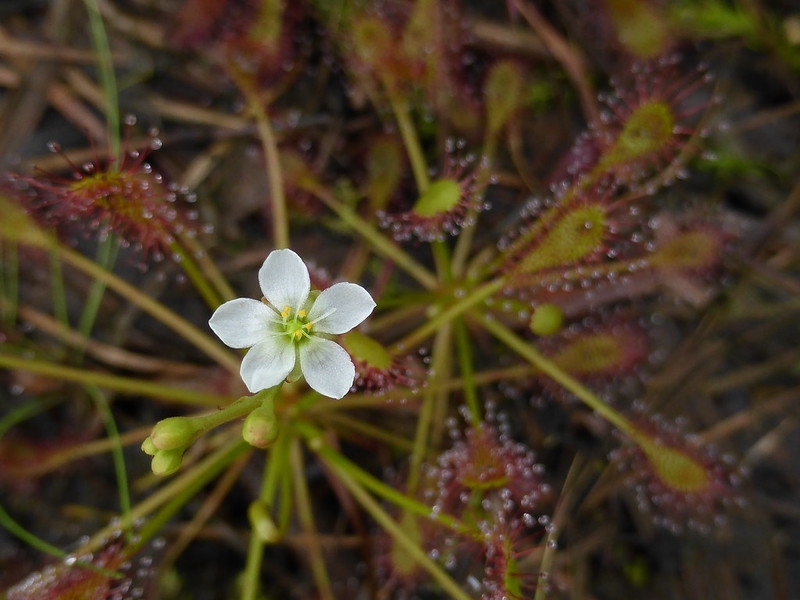
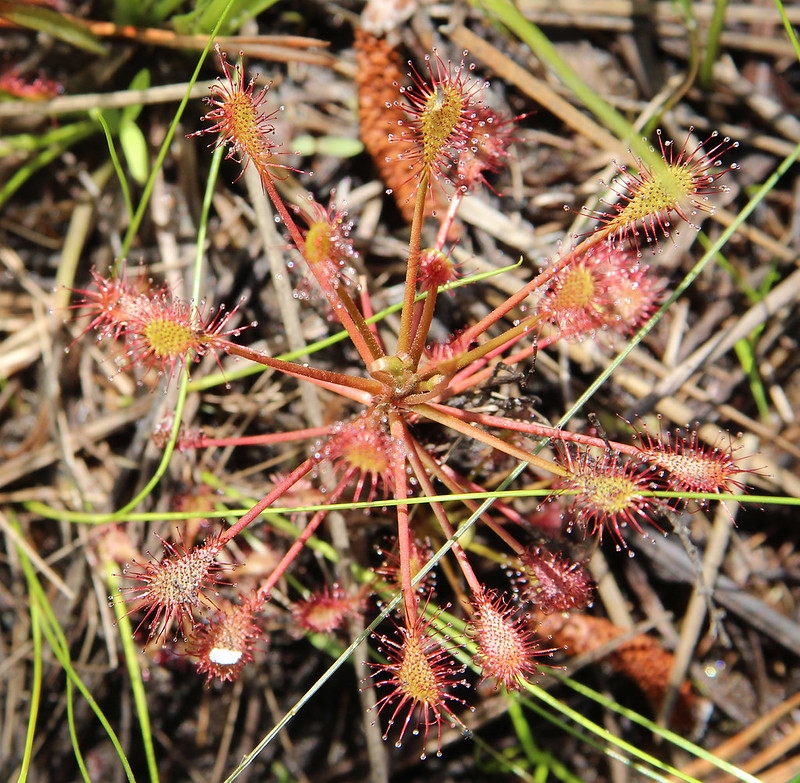
This species usually grows as a rosette, but vigorous plants will produce a short, elongate, leafy stem. The leaves are small, bright green, paddle-shaped, with red sticky hairs on top to trap insects. During the summer, flowers appear in cymes of 3 to 8 blooms of pink to red or white. The thin bare flower stalk (scape) starts curled and unfurls to display the flowers. Its fruit is a dry, oval capsule that splits open when ripe, with reddish-brown seeds.
This sundew can be grown outside in bog gardens, troughs, or containers. Grow it in a native garden, rain garden, or children’s garden. This species can also be grown indoors. Place the plant in a small pot and set the pot in a tray of distilled or rainwater.
Insects, Diseases, and Other Plant Problems: No significant problems.
- See this plant in the following landscape :
- Cultivars / Varieties:
-
- Tags:


- Cultivars / Varieties:
-
- Tags:
-
-
Attributes:
- Genus:
- Drosera
- Species:
- intermedia
- Family:
- Droseraceae
- Life Cycle:
- Perennial
- Recommended Propagation Strategy:
- Division
- Leaf Cutting
- Root Cutting
- Seed
- Country Or Region Of Origin:
- Europe to Turkey, North America to Eastern Brazil
- Distribution:
- Native: United States--AL, AR, CT, DE, DC, FL, GA, IL, IN, KY, LA, ME, MD, MA, MI, MN, MS, MO, NH, NJ, NY, NC, OH, PA, RI, SC, TN, TX, VT, VA, WV, and WI; Austria, Baltic States, Belgium, Brazil, Central European Russia, Cuba, Czechoslovakia, Denmark, East European Russia, Finland, France, Germany, Great Britain, Ireland, Italy, Manitoba, New Brunswick, Newfoundland, North European Russia, Northwest European Russia, Norway, Nova Scotia, Ontario, Poland, Portugal, Prince Edward Island, Quebec, Romania, Spain, Suriname, Sweden, Switzerland, Transcaucasus, Trinidad-Tobago, Turkey, Ukraine, Venezuela. Introduced: Liberia. Extinct: Hungary
- Dimensions:
- Height: 0 ft. 1 in. - 0 ft. 3 in.
- Width: 0 ft. 1 in. - 0 ft. 3 in.
-
-
Whole Plant Traits:
- Plant Type:
- Carnivorous
- Herbaceous Perennial
- Native Plant
- Wildflower
- Habit/Form:
- Ascending
- Prostrate
- Growth Rate:
- Medium
-
-
Cultural Conditions:
- Light:
- Full sun (6 or more hours of direct sunlight a day)
- Partial Shade (Direct sunlight only part of the day, 2-6 hours)
- Soil Texture:
- High Organic Matter
- Sand
- Soil pH:
- Acid (<6.0)
- Soil Drainage:
- Frequent Standing Water
- Moist
- Occasional Flooding
- Occasionally Wet
- Available Space To Plant:
- Less than 12 inches
- NC Region:
- Coastal
- Mountains
- Piedmont
- USDA Plant Hardiness Zone:
- 4a, 4b, 5a, 5b, 6a, 6b, 7a, 7b, 8a, 8b, 9a, 9b
-
-
Fruit:
- Fruit Color:
- Brown/Copper
- Display/Harvest Time:
- Fall
- Summer
- Fruit Type:
- Capsule
- Fruit Length:
- < 1 inch
- Fruit Width:
- < 1 inch
- Fruit Description:
- Dry, oval capsule splits open when ripe, to reveal reddish-brown, bumpy seeds. The capsule is less than 1/8 inch long, and the seeds are tiny, up to 1mm long. Displays from August to October
-
-
Flowers:
- Flower Color:
- Pink
- Red/Burgundy
- White
- Flower Inflorescence:
- Raceme
- Flower Bloom Time:
- Summer
- Flower Shape:
- Star
- Flower Petals:
- 4-5 petals/rays
- Flower Size:
- < 1 inch
- Flower Description:
- Symmetrical blooms, pink to red or white, appear on a one-sided, scorpioid cyme of 3 to 8 flowers from July to September. The thin bare flower stalk (scape) starts curled and unfurls to display the flowers. The flowers have 5 petals, 5 yellow-tipped stamens, and a pistil with three styles.
-
-
Leaves:
- Leaf Color:
- Green
- Red/Burgundy
- Leaf Type:
- Simple
- Leaf Arrangement:
- Alternate
- Rosulate
- Leaf Shape:
- Oblong
- Obovate
- Ovate
- Spatulate
- Hairs Present:
- Yes
- Leaf Length:
- < 1 inch
- Leaf Width:
- < 1 inch
- Leaf Description:
- Simple, bright green, paddle-shaped leaves 1/8 to 3/16 of an inch wide by less than 1 inch long. Red sticky hairs on top trap insects. The undersides are smooth and green. At the base of the plant, the leaves are more congested, spreading out as they move up the stem.
-
-
Stem:
- Stem Is Aromatic:
- No
- Stem Description:
- The stems are 3/8 to 3 inches long. If the stems are very short, the leaves appear to be in a basal rosette. On longer stems, the leaves appear alternate. The flower stems are smooth, extend beyond the leaves, and appear to grow in an "L" configuration.
-
-
Landscape:
- Landscape Location:
- Pond
- Riparian
- Landscape Theme:
- Children's Garden
- Native Garden
- Water Garden
- Resistance To Challenges:
- Humidity
- Poor Soil
- Wet Soil