


Cryptomeria japonica 'Globosa Nana'
Common Name(s):
- Phonetic Spelling
- krip-toh-MER-ee-uh juh-PON-ih-kuh
- Description
-
Japanese cedar is a woody, needled evergreen tree in the Cupressaceae (cypress) family that is native to central and south Japan and China. Originally described and named in 1923, it was believed to have come through Europe from Japan. The genus name comes from the Greek krypto, meaning to hide, and meris, meaning a part in reference to the concealed position of the reproductive organs.
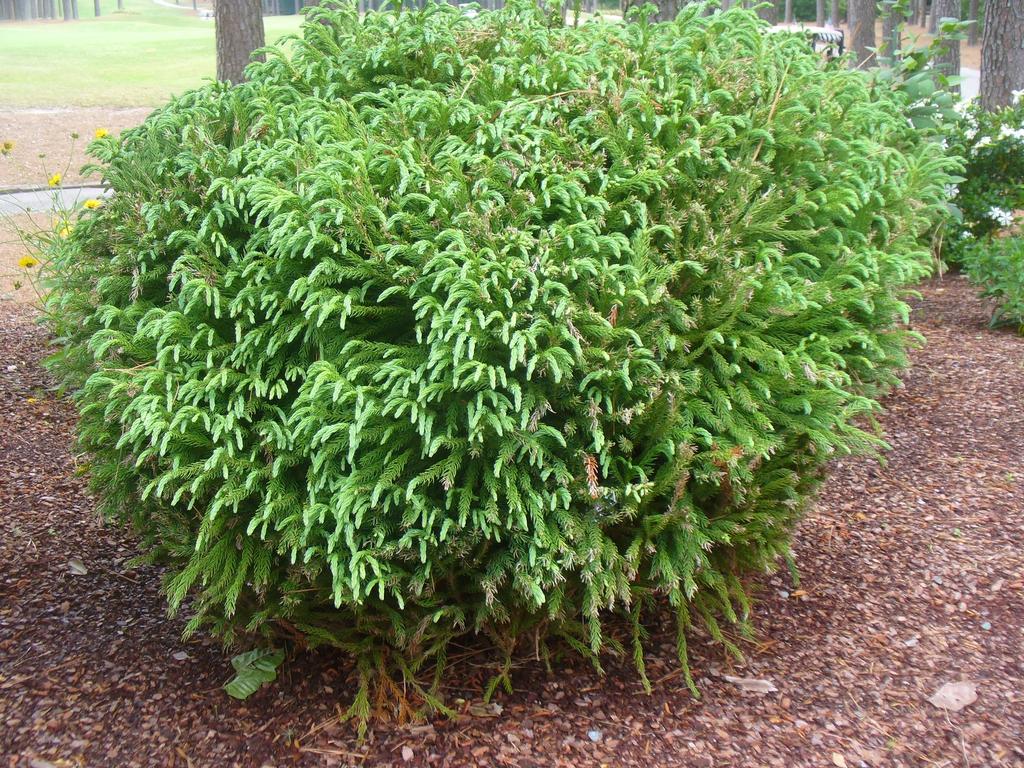
An extremely old cultivar, the dwarf dome form 'Globosa Nana' is grown for its attractive foliage. Its bluish-green, awl-shaped needles become rusty-red during the winter months, making this specimen a great addition to your winter garden.
This evergreen shrub performs best in full sun to partial shade with moist and well-drained soil. Its naturally rounded habit needs no maintenance to keep is attractive form.
Insects, Diseases, and Other Plant Problems: Insect and Disease resistant.
- Profile Video:
- See this plant in the following landscapes:
- Children's Secret Garden at Wilson Botanical Gardens Border Landscape Pinewild County Club, Moore County
- Cultivars / Varieties:
-
- Tags:


- Cultivars / Varieties:
-
- Tags:
-
-
Attributes:
- Genus:
- Cryptomeria
- Species:
- japonica
- Family:
- Cupressaceae
- Uses (Ethnobotany):
- Specimen
- Life Cycle:
- Woody
- Recommended Propagation Strategy:
- Stem Cutting
- Country Or Region Of Origin:
- Japan
- Play Value:
- Easy to Grow
- Dimensions:
- Height: 2 ft. 0 in. - 4 ft. 0 in.
- Width: 3 ft. 0 in. - 4 ft. 0 in.
-
-
Whole Plant Traits:
- Plant Type:
- Shrub
- Woody Plant Leaf Characteristics:
- Needled Evergreen
- Habit/Form:
- Dense
- Rounded
- Growth Rate:
- Slow
- Maintenance:
- Low
- Texture:
- Fine
-
-
Cultural Conditions:
- Light:
- Full sun (6 or more hours of direct sunlight a day)
- Partial Shade (Direct sunlight only part of the day, 2-6 hours)
- Soil Texture:
- Clay
- Loam (Silt)
- Sand
- Soil pH:
- Acid (<6.0)
- Alkaline (>8.0)
- Neutral (6.0-8.0)
- Soil Drainage:
- Good Drainage
- Moist
- Available Space To Plant:
- 3 feet-6 feet
- NC Region:
- Coastal
- Mountains
- Piedmont
- USDA Plant Hardiness Zone:
- 6a, 6b, 7a, 7b, 8a, 9a, 9b
-
-
Fruit:
- Fruit Color:
- Brown/Copper
- Fruit Length:
- < 1 inch
- Fruit Width:
- < 1 inch
- Fruit Description:
- Male (pollen) cones are in clusters near the apex of branches and are oblong and scaly. Female (seed) cones are round, brown, rosette looking on terminal branches singly or in groups.
-
-
Leaves:
- Woody Plant Leaf Characteristics:
- Needled Evergreen
- Leaf Color:
- Blue
- Green
- Red/Burgundy
- Leaf Feel:
- Soft
- Leaf Value To Gardener:
- Long-lasting
- Showy
- Deciduous Leaf Fall Color:
- Red/Burgundy
- Leaf Type:
- Needles
- Leaf Arrangement:
- Whorled
- Leaf Shape:
- Acicular
- Leaf Margin:
- Entire
- Hairs Present:
- No
- Leaf Length:
- < 1 inch
- Leaf Width:
- < 1 inch
- Leaf Description:
- Bluish-green needles becoming rusty-red during the winter months.
-
-
Bark:
- Bark Color:
- Dark Brown
- Red/Burgundy
- Surface/Attachment:
- Exfoliating
- Bark Description:
- Reddish-brown, showy exfoliating bark.
-
-
Stem:
- Stem Color:
- Brown/Copper
- Green
- Stem Is Aromatic:
- No
- Stem Buds:
- Smooth/Hairless
- Stem Description:
- Branches are whorled and horizontally spreading to slightly drooping. Branchlets are green the first year. Winter buds are small and non-scaly.
-
-
Landscape:
- Landscape Location:
- Container
- Lawn
- Patio
- Walkways
- Landscape Theme:
- Asian Garden
- Cottage Garden
- Drought Tolerant Garden
- Rock Garden
- Shade Garden
- Winter Garden
- Design Feature:
- Border
- Foundation Planting
- Mass Planting
- Small groups
- Specimen
- Resistance To Challenges:
- Deer
- Diseases
- Drought
- Dry Soil
- Heat
- Insect Pests
- Salt