


Malus halliana
Common Name(s):
Previously known as:
- Malus domestica var. halliana
- Pyrus halliana
- Phonetic Spelling
- MAY-lus hall-lee-AY-na
- Description
-
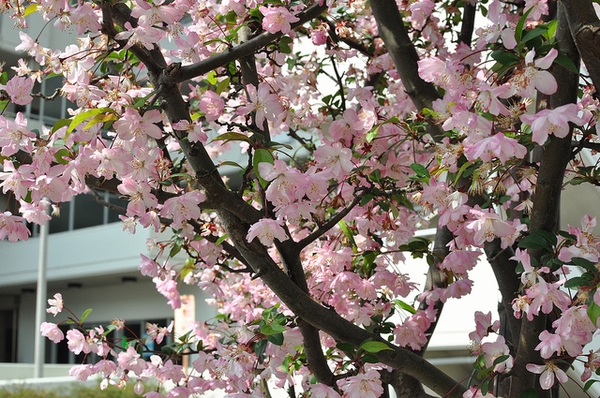
Hall crabapple is a small, deciduous, flowering tree native to Central and Southern China and Southwest Korea. It's typically found in thickets along streams or on slopes. The specific epithet halliana honors Dr. George Rogers Hall, an American physician who worked in Shanghai, China. This showy and fragrant flowering tree produces edible fruit. It is a member of the rose family (Rosaceae). The Hall crabapple grows 13 to 17 feet tall, 8 to 12 feet wide, with a spreading habit and gray or purplish-brown fissured bark. The dark green leaves are ovate to elliptical, and the flowers appear in corymbs of 4 to 6 shell-pink blossoms from March through May. The reddish-purple, edible, pome-like fruits ripen from September to October.
Prefers full sun and moist, well-drained soil. It is adaptable to a variety of soil types and pH levels. Hardy in zones 4 through 8. It requires very little maintenance, and it should be pruned only to improve air circulation or remove diseased or dead limbs. This tree has moderate disease resistance, but deer may damage the tree. As the tree ages, it may form colonies from seeds or root suckers.
Consider the Hall crabapple for its striking pink blossoms in spring as a small specimen tree in the landscape.
Insects, Diseases, and Other Plant Problems: Monitor for aphids, spider mites, and scale. Susceptible to cedar- apple rust, apple scab, powdery mildew, and fire blight.
Toxic to cats and dogs: The stems, leaves, and seeds contain cyanide and can cause difficulty breathing, dilated pupils, and shock.
- See this plant in the following landscape :
- Cultivars / Varieties:
-
- 'Parkmanii'
Vase-shaped, with semi-double shell-pink flowers, dark red fruits; low susceptibility to disease
- 'Parkmanii'
- 'Parkmanii'
- Tags:


- Cultivars / Varieties:
-
- 'Parkmanii'
Vase-shaped, with semi-double shell-pink flowers, dark red fruits; low susceptibility to disease
- 'Parkmanii'
- 'Parkmanii'
- Tags:
-
-
Attributes:
- Genus:
- Malus
- Species:
- halliana
- Family:
- Rosaceae
- Life Cycle:
- Woody
- Recommended Propagation Strategy:
- Grafting
- Stem Cutting
- Country Or Region Of Origin:
- Central and Southern China to Southwestern Korea
- Distribution:
- Native: China North-Central, China South-Central, China Southeast, and Korea; Introduced: Japan, United States--New Jersey and North Carolina
- Wildlife Value:
- Nectar attracts butterflies and bees. The fruits attract birds and small mammals.
- Play Value:
- Attractive Flowers
- Attracts Pollinators
- Fragrance
- Wildlife Cover/Habitat
- Wildlife Food Source
- Edibility:
- The fruits are edible, but the seeds contain cyanogenic glycosides.
- Dimensions:
- Height: 13 ft. 0 in. - 17 ft. 0 in.
- Width: 8 ft. 0 in. - 12 ft. 0 in.
-
-
Whole Plant Traits:
- Plant Type:
- Edible
- Tree
- Woody Plant Leaf Characteristics:
- Deciduous
- Habit/Form:
- Dense
- Erect
- Vase
- Growth Rate:
- Medium
- Maintenance:
- Medium
- Texture:
- Medium
-
-
Cultural Conditions:
- Light:
- Full sun (6 or more hours of direct sunlight a day)
- Soil Texture:
- Clay
- Loam (Silt)
- Sand
- Soil pH:
- Acid (<6.0)
- Neutral (6.0-8.0)
- Soil Drainage:
- Good Drainage
- Available Space To Plant:
- 12-24 feet
- NC Region:
- Coastal
- Mountains
- Piedmont
- USDA Plant Hardiness Zone:
- 4a, 4b, 5a, 5b, 6a, 6b, 7a, 7b, 8a, 8b
-
-
Fruit:
- Fruit Color:
- Purple/Lavender
- Fruit Value To Gardener:
- Edible
- Display/Harvest Time:
- Fall
- Fruit Type:
- Pome
- Fruit Length:
- < 1 inch
- Fruit Width:
- < 1 inch
- Fruit Description:
- The fruit is a dark red or purple, pear-shaped pome, measuring 0.25 to 0.3 inches in diameter. It ripens from September through October and can stay on the tree all winter if not harvested. The seeds are brown.
-
-
Flowers:
- Flower Color:
- Pink
- Flower Inflorescence:
- Corymb
- Flower Value To Gardener:
- Fragrant
- Flower Bloom Time:
- Spring
- Flower Petals:
- 4-5 petals/rays
- Flower Size:
- < 1 inch
- Flower Description:
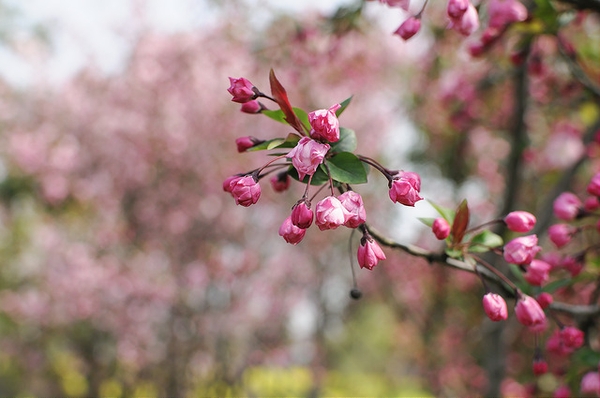
- The purplish-red buds open into double, shell-pink to rose colored flowers in a corymb of 4 to 6 blooms. Each bloom measures up to 1.25 inches in diameter. The petals are obovate. There are 20 to 25 stamens and 4 to 5 styles. Blooming occurs from March through May
-
-
Leaves:
- Woody Plant Leaf Characteristics:
- Deciduous
- Leaf Color:
- Green
- Leaf Feel:
- Leathery
- Deciduous Leaf Fall Color:
- Red/Burgundy
- Leaf Type:
- Simple
- Leaf Arrangement:
- Alternate
- Leaf Shape:
- Elliptical
- Ovate
- Leaf Margin:
- Serrate
- Hairs Present:
- No
- Leaf Length:
- 1-3 inches
- Leaf Width:
- 1-3 inches
- Leaf Description:
- The leaves are dark green, ovate to elliptical, with a cuneate base and acuminate apex, and serrulate margins. The leaf blade measures 1.5 to 3 inches long and 1 to 1.75 inches wide. The leaf surface is smooth, except it may be sparsely hairy along the midveins.
-
-
Bark:
- Bark Color:
- Light Gray
- Surface/Attachment:
- Fissured
- Bark Description:
- The bark is gray and becomes fissured with age.
-
-
Stem:
- Stem Color:
- Brown/Copper
- Green
- Purple/Lavender
- Stem Is Aromatic:
- No
- Stem Surface:
- Hairy (pubescent)
- Stem Description:
- Initially, the stems are green and hairy, then become dark purplish-brown and smooth. The buds are purplish-brown and ovoid.
-
-
Landscape:
- Landscape Location:
- Lawn
- Meadow
- Naturalized Area
- Landscape Theme:
- Butterfly Garden
- Edible Garden
- Pollinator Garden
- Design Feature:
- Flowering Tree
- Specimen
- Attracts:
- Bees
- Butterflies
- Hummingbirds
- Pollinators
- Small Mammals
- Problems:
- Problem for Cats
- Problem for Dogs