



Cherrystone Juniper Juniperus monosperma
Other Common Name(s):
- Phonetic Spelling
- jew-NIP-er-us mo-no-SPUR-mah
- Description
-
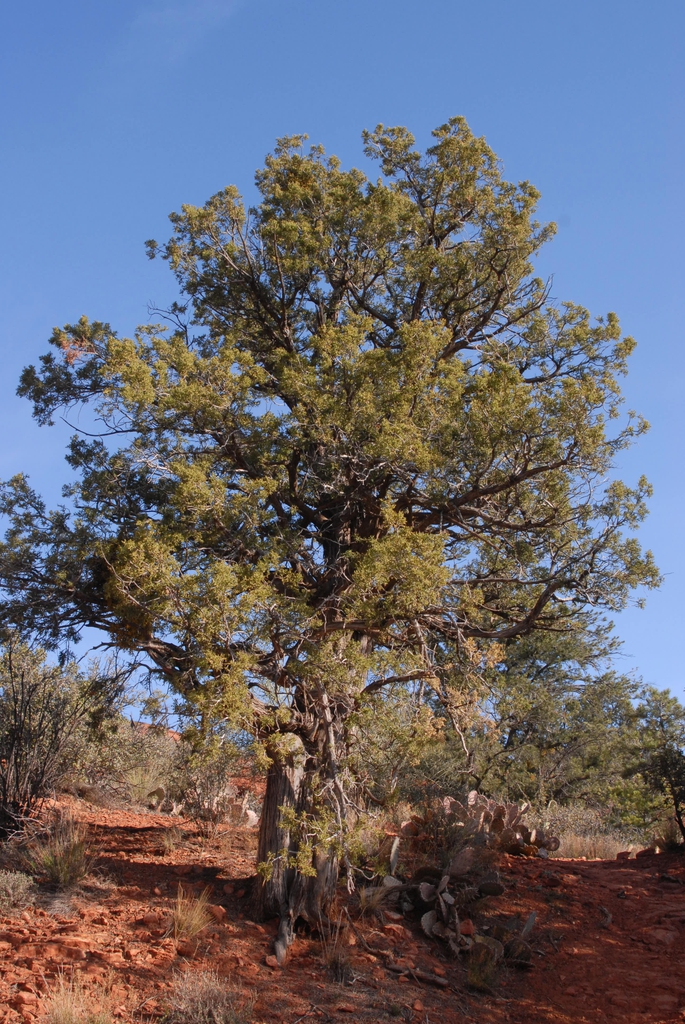
One-seed Juniper is a needled evergreen large shrub or tree native to the southwestern United States and Mexico where it is often found in dry, rocky, or sandy soils. It typically grows to 20 feet, but has been known to reach a height of 40 feet, although it may take more than 20 years to reach that height. The fragrant foliage is dark green, fine to the touch, and grows densely on the tree. Unlike most conifers, it does have orange flowers, but they are inconspicuous and, on female plants, quickly give way to blue-black fruits. The genus name identifies it as a juniper. The species name means single seed.
One-seed Juniper grows best in full sun and sandy, loamy, or clay soils that are well-drained. It will tolerate very alkaline soils, dry or moist soil, and drought. The fruit of the female plants has a thin flesh, matures in a single season, with one or occasionally two seeds. Hence the species name.
The plant is relatively fast-growing for a Juniper, and is long-lived in its native habitat, preferring dry areas with hot summers. It can have a gnarled, multi-trunked appearance with large branches rising from below ground level.
Use as a small tree in a drought-tolerant garden.
Diseases, Insect Pests, and Other Plant Problems: No significant problems. See the "Pests of Conifers" fact sheet to the left. Goats browse the foliage. The Clemson Cooperative Extension Home and Garden Information Center has a factsheet on common juniper diseases and insect pests.
- See this plant in the following landscape :
- Cultivars / Varieties:
-
- Tags:

- Cultivars / Varieties:
-
- Tags:
-
-
Attributes:
- Genus:
- Juniperus
- Species:
- monosperma
- Family:
- Cupressaceae
- Uses (Ethnobotany):
- This plant is useful for wood for fence posts and fuel. At one time, native Americans made mats and cloth from the fibrous bark.
- Life Cycle:
- Woody
- Recommended Propagation Strategy:
- Seed
- Country Or Region Of Origin:
- SW North America, along the Rockies from Wyoming to Mexico
- Wildlife Value:
- Fruit are consumed by birds and small mammals.
- Dimensions:
- Height: 6 ft. 0 in. - 20 ft. 0 in.
- Width: 6 ft. 0 in. - 20 ft. 0 in.
-
-
Whole Plant Traits:
- Plant Type:
- Shrub
- Tree
- Woody Plant Leaf Characteristics:
- Needled Evergreen
- Habit/Form:
- Dense
- Erect
- Multi-stemmed
- Growth Rate:
- Medium
- Maintenance:
- Low
- Texture:
- Fine
-
-
Cultural Conditions:
- Light:
- Full sun (6 or more hours of direct sunlight a day)
- Soil Texture:
- Clay
- Loam (Silt)
- Sand
- Shallow Rocky
- Soil pH:
- Alkaline (>8.0)
- Neutral (6.0-8.0)
- Soil Drainage:
- Good Drainage
- Moist
- Occasionally Dry
- NC Region:
- Coastal
- Mountains
- Piedmont
- USDA Plant Hardiness Zone:
- 4a, 4b, 5a, 5b, 6a, 6b, 7a, 7b, 8a, 8b
-
-
Fruit:
- Fruit Color:
- Black
- Blue
- Brown/Copper
- Display/Harvest Time:
- Summer
- Fruit Length:
- < 1 inch
- Fruit Width:
- < 1 inch
- Fruit Description:
- Female cones are 1/4 inch, bluish-black to copper-colored. Male cones usually occur on separate trees and have overlapping scales that are initially tightly closed, then spread apart to open and release pollen
-
-
Flowers:
- Flower Description:
- No flowers
-
-
Leaves:
- Woody Plant Leaf Characteristics:
- Needled Evergreen
- Leaf Color:
- Green
- Leaf Feel:
- Soft
- Leaf Value To Gardener:
- Fragrant
- Leaf Type:
- Needles
- Simple
- Leaf Arrangement:
- Opposite
- Hairs Present:
- No
- Leaf Length:
- < 1 inch
- Leaf Width:
- < 1 inch
- Leaf Description:
- Fragrant foliage is scale-like on mature twigs; needle-like on juvenile shoots and seedlings. Leaves are dense on the twig in opposite pairs, foliage is yellowish-green to gray-green.
-
-
Bark:
- Bark Color:
- Dark Gray
- Orange
- Surface/Attachment:
- Exfoliating
- Scaly
- Bark Description:
- Bark is thin, scaly and ashy. Gray-brown bark exfoliates in strips, exposing bright orange-brown bark beneath.
-
-
Stem:
- Stem Is Aromatic:
- No
- Stem Cross Section:
- Angular
- Stem Description:
- Stout, somewhat angular stems
-
-
Landscape:
- Landscape Theme:
- Drought Tolerant Garden
- Design Feature:
- Accent
- Small Tree
- Attracts:
- Small Mammals
- Songbirds
- Resistance To Challenges:
- Drought
- Dry Soil
