



Hydrocotyle americana
Common Name(s):
Previously known as:
- Hydrocotyle americana var. flexicaulis
- Hydrocotyle americana var. gracilis
- Hydrocotyle nitens
- Phonetic Spelling
- HY-droh-klees a-mer-ih-KAY-nah
- Description
-
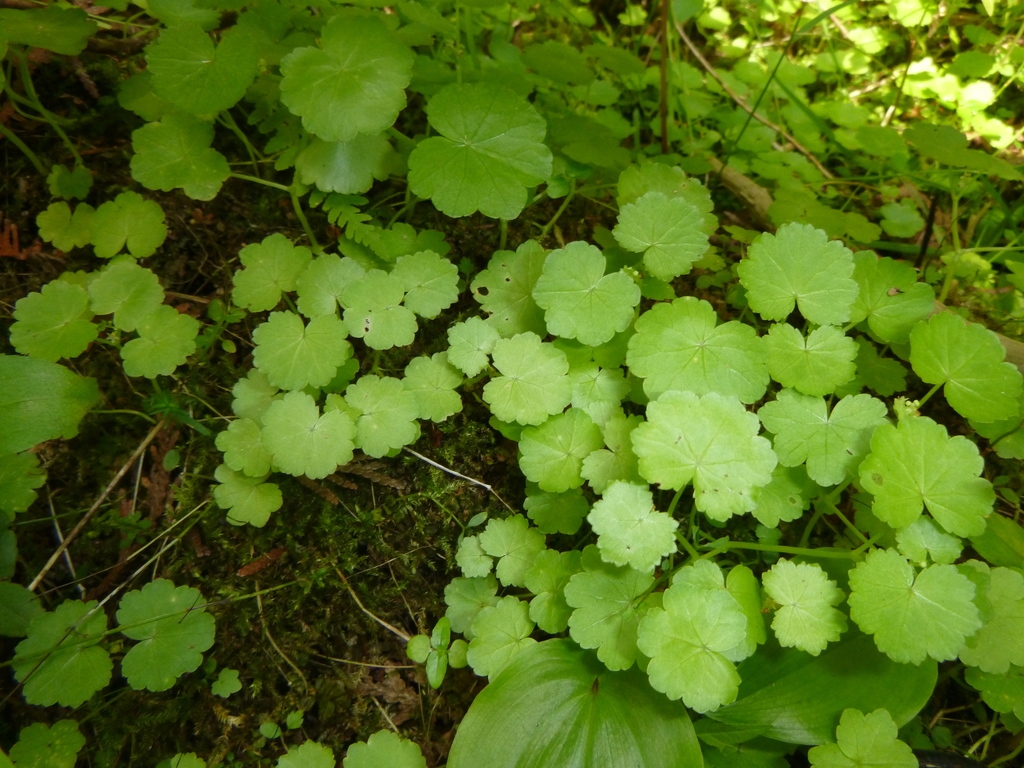
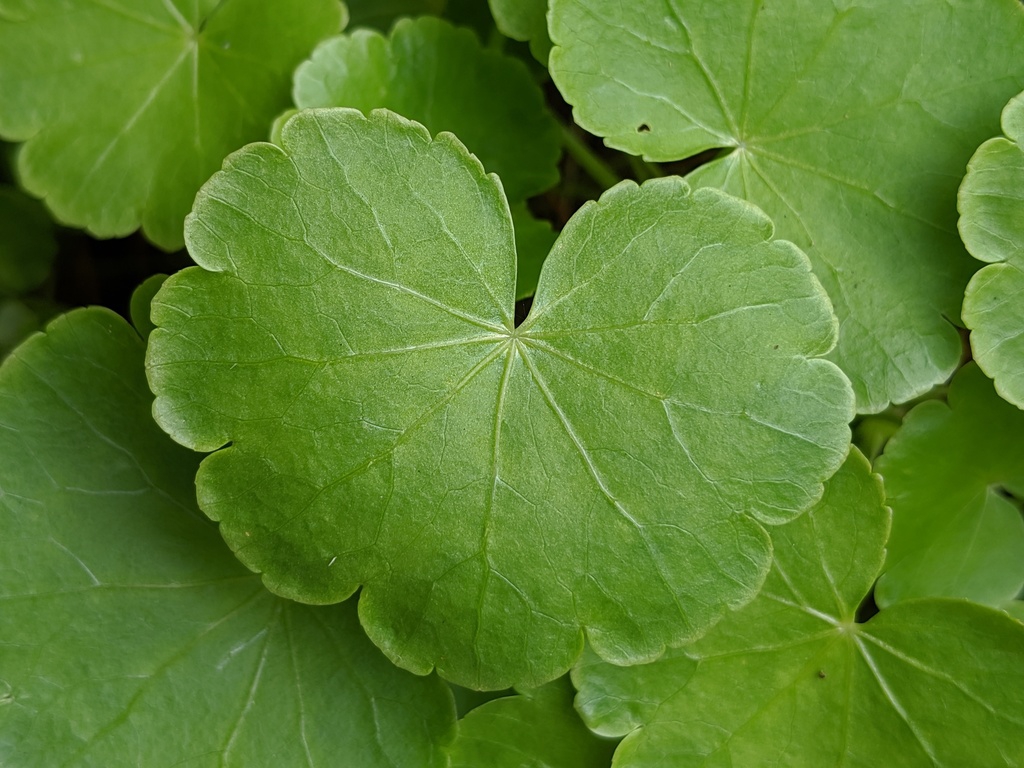
American water-pennywort is a small, creeping, herbaceous perennial, native marsh plant that typically grows in moist areas such as swamps, marshes, bogs, wet woods, and lake margins. It is found in Eastern Canada and the Eastern and North Central United States. In North Carolina, it is found in the western portion of the state in the Appalachian Mountains. This plant grows 2 to 10 inches tall and spreads by rhizomes and creeping stems that easily root, forming a dense mat. Its leaves are light green, nearly circular to kidney-shaped, and have slightly scalloped or lobed margins. The petiole is attached at the leaf margin, which is distinctly different from Hydrocotyle umbellata, commonly known as dollarweed. Clusters of tiny, greenish-white, 5-petaled, star-shaped flowers bloom from May to August. Water pennywort is a member of the ivy family (Araliaceae). The genus name Hydrocotyle is derived from two Greek words: hydros, meaning water, and kotyle, meaning a small cup. This refers to the cup-like appearance of the leaves in some of its species. The specific epithet, americana, means of the Americas. The common name pennywort refers to the leaves' rounded and coin-like shape.
Prefers bright but indirect light, high humidity, and organically rich, loamy, consistently moist or waterlogged soil with a slightly acidic to neutral pH. The plant does well along the margins of ponds or streams where it can root in shallow water. The roots should not be allowed to dry out completely. It is winter hardy in zones 3 to 7. The plant will die back in October to November at the first frost, but it will regenerate in the spring. Easily propagated by seeds, division, or stem cuttings.
This plant is currently globally secure; however, in the State of Minnesota, it is designated as a Species of Special Concern. The major threats to this native species are habitat loss and climate change.
American water-pennywort is an attractive, low-maintenance, and hardy specimen for a shady and consistently wet site such as in rain gardens, garden ponds, bogs, or stream banks.
Insects, Diseases, and Other Plant Problems: Monitor for aphids, spider mites, and snails. May be susceptible to leaf spots and root rot. Avoid clay soils that can become compacted and drain poorly. Leaf scorch can occur in full sun.
- See this plant in the following landscape :
- Cultivars / Varieties:
-
- Tags:


- Cultivars / Varieties:
-
- Tags:
-
-
Attributes:
- Genus:
- Hydrocotyle
- Species:
- americana
- Family:
- Araliaceae
- Life Cycle:
- Perennial
- Recommended Propagation Strategy:
- Division
- Seed
- Stem Cutting
- Country Or Region Of Origin:
- Eastern Canada to North Central & Eastern United States
- Distribution:
- Native: United States--AR, CT, DE, DC, IN, KY, ME, MD, MA, MI, MN, NH, NJ, NY, NC, OH, PA, RI, SC, TN, VT, VA, WV, and WI; Canada--New Brunswick, Newfoundland, Nova Scotia, Ontario, Prince Edward Island, and Quebec. Introduced: Eswatini, KwaZulu-Natal, Lesotho, New Zealand North, New Zealand South, and Northern Provinces.
-
-
Whole Plant Traits:
- Plant Type:
- Herbaceous Perennial
- Native Plant
- Water Plant
- Habit/Form:
- Creeping
- Maintenance:
- Low
- Texture:
- Medium
-
-
Cultural Conditions:
- Light:
- Dappled Sunlight (Shade through upper canopy all day)
- Deep shade (Less than 2 hours to no direct sunlight)
- Soil Texture:
- Loam (Silt)
- Soil pH:
- Acid (<6.0)
- Neutral (6.0-8.0)
- Soil Drainage:
- Frequent Standing Water
- Occasionally Wet
- NC Region:
- Mountains
- USDA Plant Hardiness Zone:
- 3a, 3b, 4a, 4b, 5a, 5b, 6a, 6b, 7a, 7b
-
-
Fruit:
- Fruit Color:
- Brown/Copper
- Green
- Fruit Type:
- Schizocarp
- Fruit Length:
- < 1 inch
- Fruit Width:
- < 1 inch
- Fruit Description:
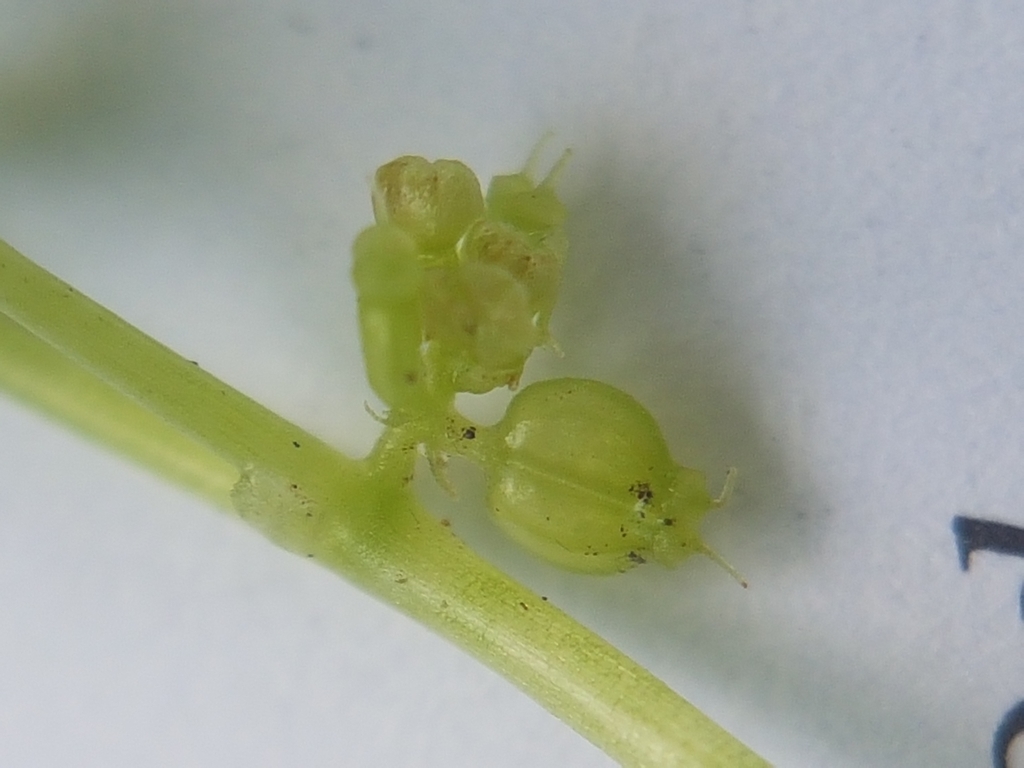
- The fruit is a tiny, dry, flat, rounded, and greenish-brown schizocarp. Each fruit contains two seeds. The fruit measures 1 to 2mm in length.
-
-
Flowers:
- Flower Color:
- Green
- White
- Flower Inflorescence:
- Insignificant
- Umbel
- Flower Bloom Time:
- Summer
- Flower Shape:
- Star
- Flower Petals:
- 4-5 petals/rays
- Flower Size:
- < 1 inch
- Flower Description:
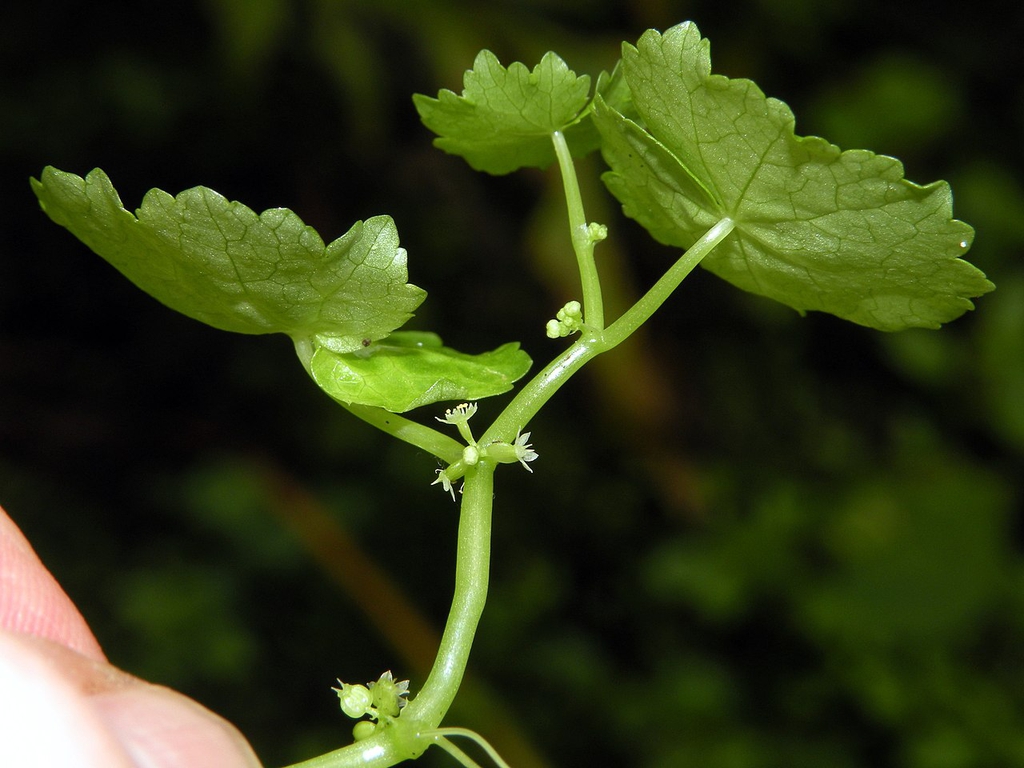
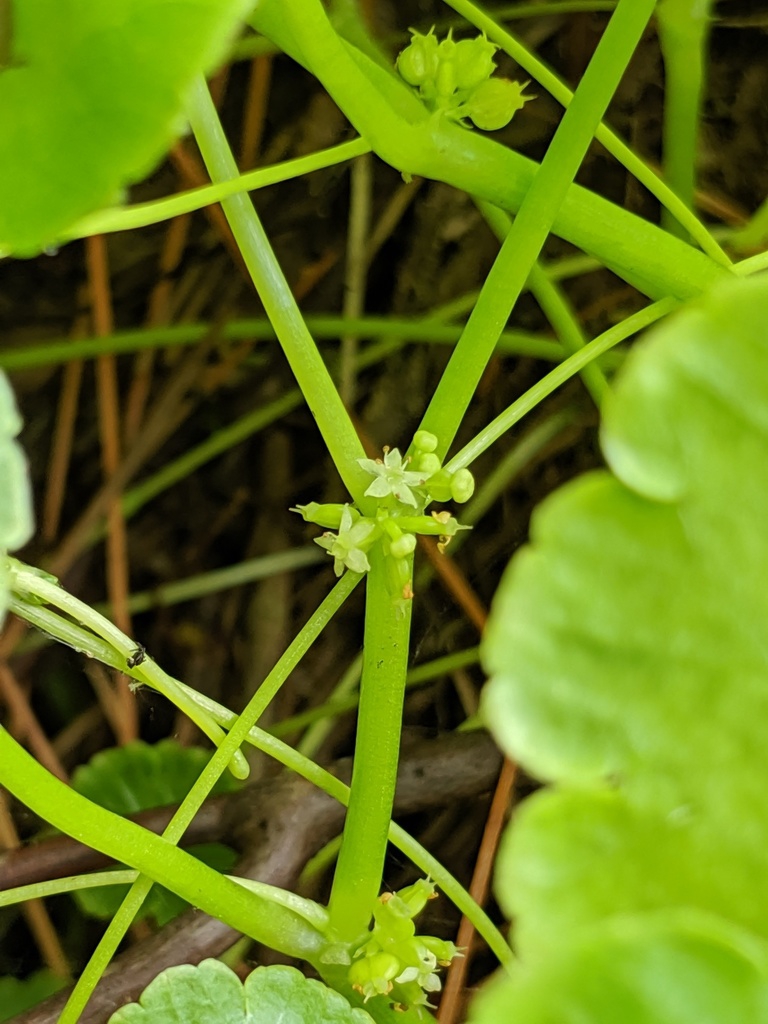
- The flowers are greenish to white, star-shaped, with 5 thin, delicate, tiny petals. Each flower measures up to 0.125 inches in diameter. They appear in clusters of up to 7 stalkless flowers and are borne on the leaf axils and form umbel-like clusters. Each bloom has 5 stamens. Blooming occurs from May to August.
-
-
Leaves:
- Leaf Color:
- Green
- Leaf Feel:
- Glossy
- Smooth
- Leaf Type:
- Simple
- Leaf Arrangement:
- Alternate
- Leaf Shape:
- Orbicular
- Leaf Margin:
- Crenate
- Lobed
- Undulate
- Hairs Present:
- No
- Leaf Length:
- 1-3 inches
- Leaf Width:
- 1-3 inches
- Leaf Description:
- The leaves grow at the base of the plant and are shiny, smooth, green, simple, alternate, round to kidney-shaped, measuring 0.25 to 2.25 inches wide. Each leaf has 6 to 10 shallow, rounded teeth and shallow lobes along the wavy margins. The petiole is up to 2 inches long, sparsely hairy, and is attached at the base of the leaf.
-
-
Stem:
- Stem Color:
- Green
- Stem Is Aromatic:
- No
- Stem Surface:
- Smooth (glabrous)
- Stem Description:
- The stems are green, smooth, slender, fragile, branched, weakly erect, and creep along the ground. The plant roots at the stem nodes and can produce small colonies. The stems turn upwards at the tips and trail at the base.
-
-
Landscape:
- Landscape Location:
- Pond
- Riparian
- Landscape Theme:
- Native Garden
- Rain Garden
- Water Garden
- Resistance To Challenges:
- Wet Soil

