



Gentiana acaulis
Common Name(s):
Previously known as:
- Ciminalis acaulis
- Gentianusa acaulis
- Phonetic Spelling
- jen-tee-AN-ah ay-KAW-lis
- Description
-
Gentian is an alpine, broadleaf evergreen perennial native to central and southern Europe, and is found in Alpine grasslands, rocky meadows, and subalpine forests at altitudes from 2,500 to 9,700 feet. They have been seen in the mountain ranges of the Alps, Pyrenees, and Carpathians. It is usually found in acidic soils, and sometimes found on chalky limestone or sandstone. It grows 3 to 6 inches tall and 3 to 9 inches wide with a dense, mat-forming habit. The glossy green leaves grow in basal rosettes. Its flowers are solitary, deep gentian blue with a green-spotted throat and form upward-facing trumpets, sitting atop the basal foliage. This plant is a member of the gentian family (Gentianaceae). The genus name, Gentiana, honors King Gentius of Illyria, who reigned from 180 to 163 BC and studied the medicinal uses of plants. The specific epithet acaulis means stemless.
Prefers full sun to partial shade, but requires afternoon shade to protect the plant from leaf bleaching. Thrives in moist, well-drained, gritty, slightly acidic soil and prefers cool summer climates. It is winter hardy in zones 3a to 7a. It would be intolerant of the hot, humid conditions of Eastern North Carolina. Best propagated by seeds or division.
Gentian is primarily an ornamental plant. Gardeners might enjoy this alpine native in a patio container, as a ground cover, in a rock garden, or in a cottage garden. The challenge will be to find a place where this plant would be happy, and that is similar to its native habitat.
Diseases, Pests, and Other Plant Problems: No serious insect pests or diseases. Monitor for slugs and snails. May be susceptible to root rot. The plant can not tolerate hot or humid conditions.
- See this plant in the following landscape :
- Cultivars / Varieties:
-
- 'Hohenstein'
up to 3 inches tall, blooms April to May, foliage is small and dense, and lighter blue flowers - 'Holzmann'
3 to 6 inches tall, leathery foliage, large, deep blue flowers - 'Undulatifolia'
up to 3 inches tall, leathery foliage, and velvet-blue flowers
- 'Hohenstein'
- 'Hohenstein', 'Holzmann', 'Undulatifolia'
- Tags:

- Cultivars / Varieties:
-
- 'Hohenstein'
up to 3 inches tall, blooms April to May, foliage is small and dense, and lighter blue flowers - 'Holzmann'
3 to 6 inches tall, leathery foliage, large, deep blue flowers - 'Undulatifolia'
up to 3 inches tall, leathery foliage, and velvet-blue flowers
- 'Hohenstein'
- 'Hohenstein', 'Holzmann', 'Undulatifolia'
- Tags:
-
-
Attributes:
- Genus:
- Gentiana
- Species:
- acaulis
- Family:
- Gentianaceae
- Uses (Ethnobotany):
- Gentian has been used to treat wounds, sore throats, arthritic inflammation, and jaundice.
- Life Cycle:
- Perennial
- Recommended Propagation Strategy:
- Division
- Seed
- Country Or Region Of Origin:
- Northeast Spain to the Alps, Central Italy to Carpathians
- Distribution:
- Native: Albania, Austria, Bulgaria, Czechoslovakia, France, Germany, Italy, the Northwest Balkan Peninsula, Romania, Spain, Switzerland, and Ukraine. Introduced: Great Britain
- Wildlife Value:
- Bees are reportedly attracted to the flower for nectar and pollination.
- Edibility:
- Gentian root has a long history of use as a herbal bitter in the treatment of digestive disorders and is an ingredient of many proprietary medicines. It contains some of the most bitter compounds known and is used as a scientific basis for measuring bitterness.
- Dimensions:
- Height: 0 ft. 3 in. - 0 ft. 6 in.
- Width: 0 ft. 3 in. - 0 ft. 9 in.
-
-
Whole Plant Traits:
- Plant Type:
- Herbaceous Perennial
- Woody Plant Leaf Characteristics:
- Broadleaf Evergreen
- Habit/Form:
- Clumping
- Growth Rate:
- Slow
- Maintenance:
- Medium
- Texture:
- Fine
-
-
Cultural Conditions:
- Light:
- Full sun (6 or more hours of direct sunlight a day)
- Partial Shade (Direct sunlight only part of the day, 2-6 hours)
- Soil Texture:
- Loam (Silt)
- Sand
- Soil pH:
- Acid (<6.0)
- Neutral (6.0-8.0)
- Soil Drainage:
- Good Drainage
- Moist
- Available Space To Plant:
- 12 inches-3 feet
- NC Region:
- Mountains
- USDA Plant Hardiness Zone:
- 3a, 3b, 4a, 4b, 5a, 5b, 6a, 6b, 7a
-
-
Fruit:
- Display/Harvest Time:
- Fall
- Fruit Type:
- Capsule
- Fruit Description:
- Ellipsoidal-shaped capsules form after the flower fades. They should be allowed to dry on the plant. Once dried, the capsules can be opened to collect the brown seeds. Seeds are best sown in the fall when fresh.
-
-
Flowers:
- Flower Color:
- Blue
- Flower Inflorescence:
- Solitary
- Flower Value To Gardener:
- Showy
- Flower Bloom Time:
- Spring
- Summer
- Flower Shape:
- Trumpet
- Flower Petals:
- 4-5 petals/rays
- Flower Size:
- 1-3 inches
- Flower Description:
- The flowers are stemless, sitting on leafy ground cover, and are trumpet-shaped and upward-facing. The blooms are solitary and are deep blue with green-spotted throats. It measures about 2.8 inches long and has 5 pointed petals. Each petal is about 0.4 inches long and is separated by small folds. Blooms from late spring to early summer.
-
-
Leaves:
- Woody Plant Leaf Characteristics:
- Broadleaf Evergreen
- Leaf Color:
- Green
- Leaf Feel:
- Glossy
- Smooth
- Leaf Value To Gardener:
- Long-lasting
- Showy
- Leaf Arrangement:
- Rosulate
- Leaf Shape:
- Elliptical
- Lanceolate
- Hairs Present:
- No
- Leaf Length:
- < 1 inch
- Leaf Width:
- < 1 inch
- Leaf Description:
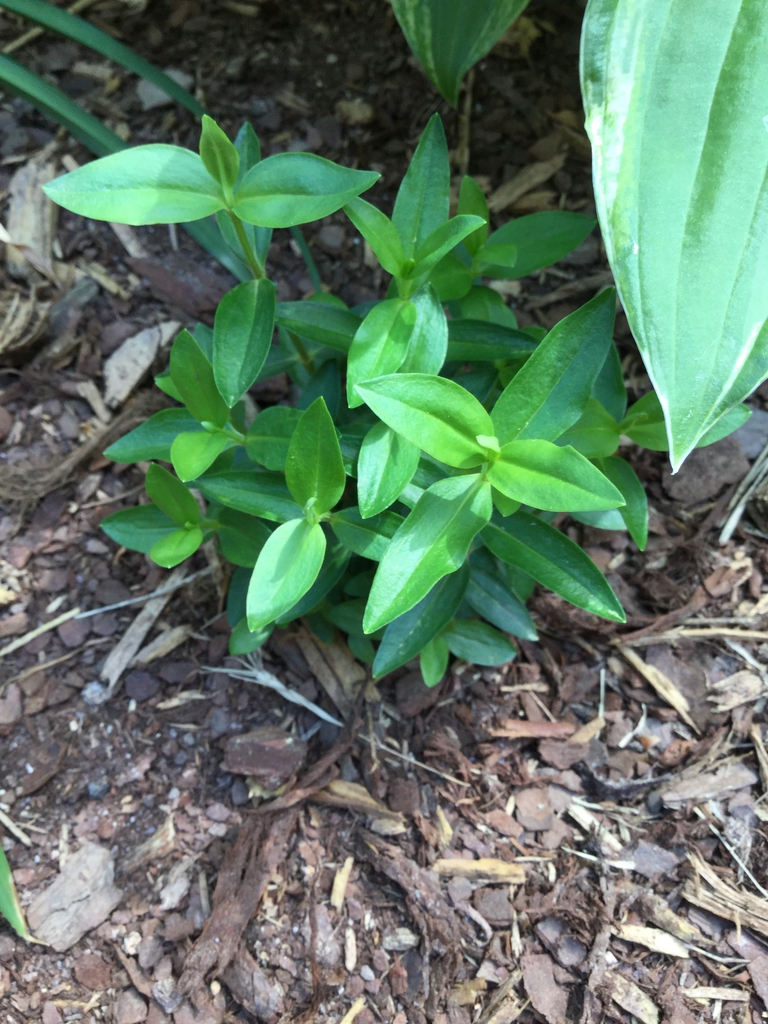
- The evergreen leaves measure up to 1 inch long and grow in rosettes that, once established, form a dense carpet-like appearance.
-
-
Stem:
- Stem Is Aromatic:
- No
- Stem Description:
- Plant is stemless.
-
-
Landscape:
- Landscape Location:
- Container
- Patio
- Landscape Theme:
- Cottage Garden
- Pollinator Garden
- Rock Garden
- Winter Garden
- Design Feature:
- Accent
- Border
- Specimen
- Attracts:
- Bees
- Pollinators
- Resistance To Challenges:
- Rabbits
